|
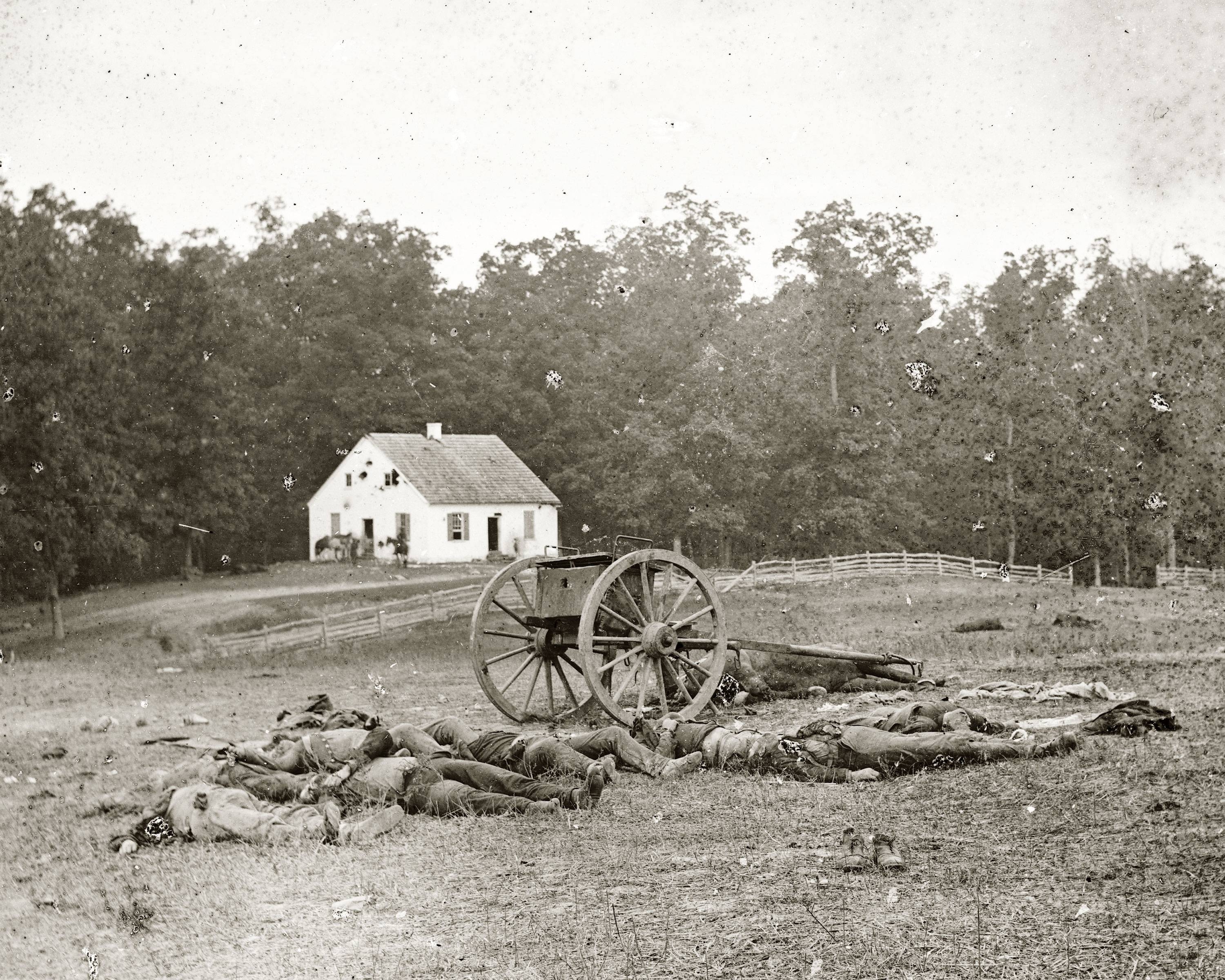
| Confederate Artillery near Dunker Church |
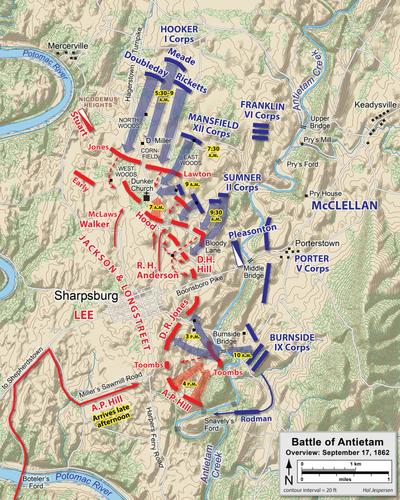
Dawn broke at 6:00 on the morning of September 17th 1862. The hollows of the fields around Antietam were filled with mist. The battle had begun hours before with Hooker's Corps moving toward Stonewall Jackson's position. To attack Jackson they would move through a forty acre field of corn that was owned by David Miller. It was bordered on three sides by woods, called West, North and East, while to the South lay Dunker Church. Jackson already knew of Hooker's position and plans. Hooker had advanced a skirmish line the day before, alerting the Confederates. The attack came as no surprise. Colonel Stephen D. Lee had four batteries of artillery posted on the plateau near Dunker Church, and more artillery was placed on the left. In the cornfield was posted the brigades of Jones and Lawton, with more brigades in reserve. Stuart's cavalry was on the left, guarding the flank. As soon as the day dawned an artillery duel began between the cannon on both sides. The fire was terrific from both sides. "Pray that you may never see another Sharpsburg.” Stephen Lee later told a subordinate, “Sharpsburg was artillery hell.”

On the Federal side although Mansfield's corps had not yet arrived, Hooker decided to go forward with his men anyway. He hoped to gain fame and renown for defeating Jackson without the help of Mansfield. Doubleday's division was on the right, Rickett's on the left and Meade's in the rear in reserve. They were heading for the Confederate artillery positioned at the Dunker Church. As they advanced forward they were struck with a crossfire from the Confederate artillery. Men began to fall, and soon after the start of the advance a Union Brigadier General was hit. The Federals soon saw Confederates ahead in the corn, their bayonets glistening in the air. Hooker brought up his artillery, opened fire on the Confederates, and ordered his infantry to charge. On the right of the turnpike the charge was spearheaded by the Iron Brigade, with their tall black hats and famous fighting powers. Under John Gibbon, a North Carolinian, they spearheaded the attack of Doubleday's division. The fighting was very heavy throughout the cornfield. Major Rufus Dawes of the Iron Brigade wrote:
Our lines on the left now came sweeping forward through the corn and the open field beyond. I ordered my men up to join the advance, and commanded: 'Forward - guide left - march!' ... At the front edge of the corn-field was a low Virginia rail fence. Before the corn were open fields, beyond which was a strip of woods surrounding a little church, the Dunkard church. As we appeared at the edge of the corn, a long line of men in butternut and gray rose up from the ground. Simultaneously, the hostile battle lines opened a tremendous fire upon each other. Men, I cannot say fell; they were knocked out of the ranks by the dozens. But we jumped over the fence, and pushed on, loading, firing, and shouting as we advanced. There was, on the part of the men, great hysterical excitement, eagerness to go forward, and a reckless disregard of life, of everything but victory. ... Every body tears cartridges, loads, passes guns, or shoots. Men are falling in their places or running back into the corn. ... After a few rods of advance, the line stopped and, by common impulse, fell back to the edge of the corn and lay down on the ground behind the low rail fence. Another lien of our men came up through the corn. We all joined together, jumped over the fence, and again pushed out into the open field. There is a rattling fusillade and loud cheers. 'Forward is the word' The men are loading and firing with demoniacal fury and shouting and laughing hysterically, and the whole field before us is covered with rebels fleeing for life, into the woods. Great numbers of them are shot while climbing over the high post and rail fences along the turnpike.
 |
| The Iron Brigade charges |
With Lawton's division crushed by Hooker's attack, he sent a message to Hood asking for his assistance. Lawton, Jones and Starke had all been hit, and Jackson's old division was commanded by a Colonel. Hood's men were in the rear cooking their breakfast, their first hot meal in days. But they were needed in the battle, so throwing away their food they fell into line and moved forward to assist Lawton's men. When they arrived on the field the Federals had broken through all the Confederate brigades in the area, and were pushing towards Dunker Church. But Hood's famous Texans gallantly charged into the enemy. Dawes wrote:
A long and steady line of rebel gray, unbroken by the fugitives who fly before us, comes sweeping down through the woods around the church. They raise the yell and fire. It is like a scythe running through our line. ... It is a race for life that each man runs for the cornfield. A sharp cut, as of a switch, stings he calf of my leg as I run. Back to the corn, and back through the corn, the headlong flight continues.
 |
| Hooker |
Hooker's attack was stopped by the gallant charge of Hood's division, supported on the right by D. H. Hill and on the left by Early. However, the fighting was still terrible. Hood was able to drive Hooker to the north end of the cornfield, but at terrible cost to his men. The 1st Texas lost 80% of its strength in the terrible fighting. "Tell General Jackson,” Hood told a courier, “unless I get reinforcements I must be forced back, but I am going on while I can!"
 |
| Hood |
Jackson had no reserves available to throw in to the fight, so he sent a request to Lee. Lee had already sent Walker's division from the right, and sent McLaw's as well. There was always the risk that McClellan would launch an attack on the Confederate right, but that had to be taken. If Jackson's line gave, it would mean disaster for the entire army.
 |
| Mansfield |
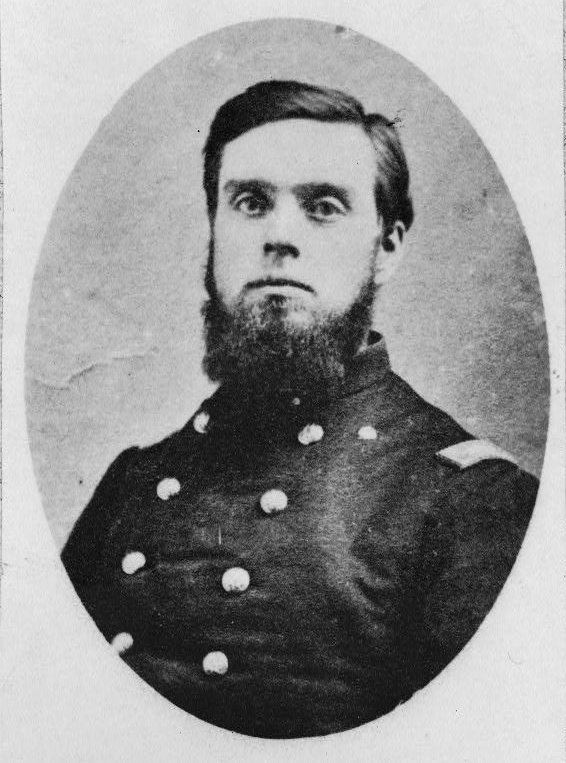
However, Hooker's attack was over. All his strength had been used up. He sent a message to Mansfield, who had now arrived, for him to try his hand at the attack. Joseph Mansfield was an old army soldier, but like many of his men this was his fist battle in war. Mansfield thought that Hooker's men were driving the Confederates, and that he was only coming to complete the victory. Advancing towards the rebel lines, he was surprised when he was fired upon, thinking he were being fired on by his friends. He discovered his mistake, but the Confederate line fired a volley, hitting Mansfield in the stomach. He was brought to the rear, and died the next day. His men continued on under the command of Alpheus Williams. They were able to push Hood's veterans back through the cornfield into the west woods. D. H. Hill wrote in his official report:
[O]ur progress was arrested by a lane, on either side of which was a high, staked fence stretching along our whole front.... The men, being formed along this fence, kept up an accurate and well-sustained fire, which visibly told upon the enemy's ranks; and, although we suffered greatly, as well from musketry in front as from a battery on our left ... not a man was seen to flinch from the conflict. ... [O]ur left being unprotected, we were about to be outflanked, when the order to retire was given and obeyed, the men withdrawing in tolerable order, and fighting as they fell back.

However Walker and McLaws arrived, and throwing their throwing into the fight Jackson was able to keep Williams's corps at bay. Williams was not able to press forward, and requested reinforcements from McClellan. Reinforcements were already coming up in the form the lead division of Sumner's corp. They did not go directly into the cornfield. They came further to the south through the edge of the East Woods, shifting the battle from the Confederate left to center. Sumner, in his eagerness to get his men into battle, made an important mistake. He neglected his flank. He stumbled into Confederates under McLaws and Walker, who happened to be at the right place at the right time. Their volleys tore through Sumner's men, who were virtually unable to defend themselves. Surrounded on three sides, Sumner's men held out for twenty minutes before breaking into a rout. Out of the 5,4000 soldiers who went into the fight, 2,200 fell. One regiment lost over 50% of its 600 men.
The corps of Hooker, Mansfield and part of Sumner's after three hours of heavy fighting had gained a foothold on the Dunker Church Plateau, but the Confederates by stripping men from the right had been able to prevent their line from being demolished. The cornfield in which much of the battle had taken place was covered with bodies, fallen down in rows marking the positions of the troops. It was called the Bloody Cornfield. Hooker wrote
In the time that I am writing every stalk of corn in the northern and greater part of the field was cut as closely as could have been done with a knife, and the slain lay in rows precisely as they had stood in their ranks a few moments before. It was never my fortune to witness a more bloody, dismal battlefield.
Jackson lost around 5,000 men. When Hood was asked where his division was, he said “it was dead on the field.” It did not seem as though they could put up much of a defense against another attack. However, the battle was over in Jackson's section of the line. Sumner was badly scared by his reverse, and was wounded in the hand. As ranking officer in the area, he would allow no more attacks, believing that he was about to be over run by a counterattack. As it was, the Confederates were doubting their own ability to resist another attack.


 On the Federal side although Mansfield's corps had not yet arrived, Hooker decided to go forward with his men anyway. He hoped to gain fame and renown for defeating Jackson without the help of Mansfield. Doubleday's division was on the right, Rickett's on the left and Meade's in the rear in reserve. They were heading for the Confederate artillery positioned at the Dunker Church. As they advanced forward they were struck with a crossfire from the Confederate artillery. Men began to fall, and soon after the start of the advance a Union Brigadier General was hit. The Federals soon saw Confederates ahead in the corn, their bayonets glistening in the air. Hooker brought up his artillery, opened fire on the Confederates, and ordered his infantry to charge. On the right of the turnpike the charge was spearheaded by the Iron Brigade, with their tall black hats and famous fighting powers. Under John Gibbon, a North Carolinian, they spearheaded the attack of Doubleday's division. The fighting was very heavy throughout the cornfield. Major Rufus Dawes of the Iron Brigade wrote: