head

Thursday, September 19, 2013

Battle of Chickamauga – Day 1

On September 18th Braxton Bragg's advance units encountered the Union army and captured a crossing over Chickamauga Creek. But as had been done several times during this campaign, the Confederates failed to exploit any surprise they might have gained. When he advanced on September 19th, 150 years ago today, the fighting would develop into one of the bloodiest battles in the Civil War.

As the Confederate units prepared to move toward the Yankees, they did not know the information on which their plan was based was faulty. The Federal troops were further north than they expected. Bragg had planned to strike Crittenden's crops, at Lee and Gordon's Mill, which he assumed was Rosecrans's left flank. What he did not know was that the Union command had moved Thomas's corps beyond Crittenden. The battle began almost by accident this morning, with a skirmish over water resulting in a Union division being sent to clear off what was believed to be a single Confederate brigade on the west side of Chickamauga Creek. In fact, it was the entire rebel army.

September 19, Morning
These northern soldiers encountered much more resistance than they anticipated from men which turned out to be Forrest's cavalry men on the Confederate flank. The battle swayed back and forth throughout the morning as each side, threw more men into the increasing fight on the northern portion of the battle. Colonel John T. Wilder wrote this portion of the fight lines which apply well to the entire battle:
All this talk of generalship displayed on either side is sheer nonsense. There was no generalship in it. It was a soldier's fight purely, wherein the only question involved was the question of endurance. The two armies came together like two wild beats, and each fought as long as it could stand up in a knock-down and drag-out encounter. If there had been any high order of generalship displayed, the disasters to both armies might have been less.
September 19, Afternoon
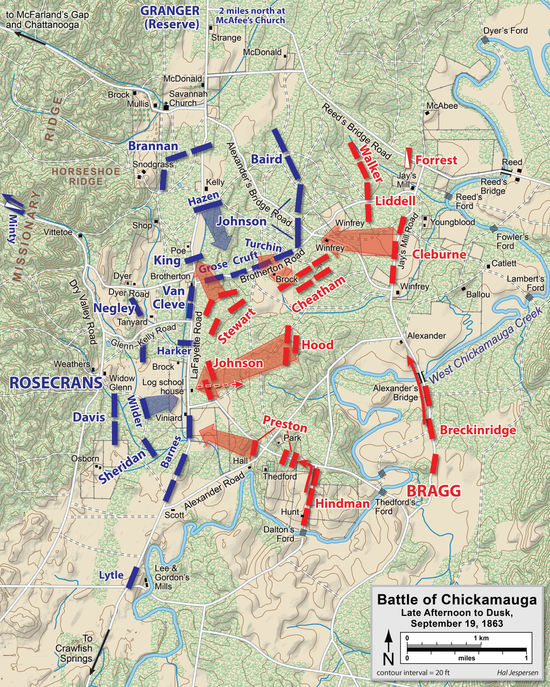
The fighting was furious in the thick woods of Chickamauga. In the rolling, wooded ground, commanders could see little, and it was what historian Steven Woodworth called “a soldier's battle.” As the day progressed, each side brought up more troops to add to the battle in the upper part of the field. The third wave of men Bragg threw into the fight was the division of Alexander Stewart. He was ordered to move to the Confederate right, but instead he attacked the left on his own authority. It was an opportune moment, and hitting three of Thomas's brigades around Brotherton Farm, he drove them into a rout after a fierce fight he drove them into a rout. The rebels rushed through the woods after the retreating bluecoats, and succeeded in crossing the Lafayette road. George Thomas brought up two more divisions and threw them into the fight against Stewart, driving the weary men back.

Brotherton Farm
Seeing an opportunity John Bell Hood ordered in his Texas division from Lee's Army of Northern Virginia to aid Stewart, striking on the left of his position. Hood's gallant boys chard through the woods and again broke the Federal line. Pressing forward, they penetrated so deep that some units were very close to Rosecrans's headquarters. But at this critical juncture two more Federal divisions arrived from the south, and falling into line, halted Hood's men and pushed them back some distance.

September 19, evening
As darkness was falling over the bloody field, Bragg ordered Patrick Cleburne's men to make another attack on the Union left, where there had been a lull in the fighting. Cleburne's three brigades stretched a mile through the woods, and they rushed forward, striking hard the blue line with twice their numbers. One Federal wrote of the attack:
On they come, in the very face of fire and lead, until the strike the right of our regiment... but when too close to load and fire, the rebels were clubbed over the head and checked for the moment, while, instinctively, both sides recoiled a few steps without breaking the lines, and with that cool, deliberate determination and recklessness which characterizes all soldiers after breathing an atmosphere strongly impregnated with powder smoke, these deadly foes practiced the art of loading and firing in a manner that I believe was never surpassed on any battle field during the rebellion.
Confederate attack
Cleburne's men pushed the Federals back, but were ultimately unable to break the line. When darkness made further fighting impossible, the men made camp all across the battlefield wherever they happened to be. The Confederates could hear the Federals digging entrenchments that they would have to attack the next morning. Both sides suffered as they lay on the fields over which they had fought. As one Yankee recorded,
How we suffered that night no one knows. Water could not be found; the rebels had possession of the Chickamauga, and we had to do without. Few of us had blankets, and the night was very cold. All looked with anxiety for the coming of dawn; for although we had given the enemy a rough handling, he had certainly used us very hard.
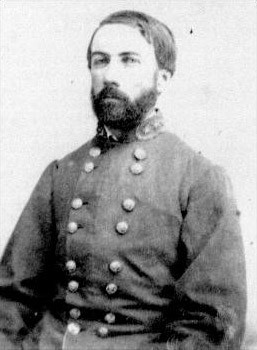
Daniel Harvey Hill
The day's fighting was over. The Confederates had hit the Federals hard. On several occasions they had even penetrated the line. But in the end, Union reinforcements arrived and the Confederates were unable to give the final blow to rout them. Confederate General D. H. Hill explained what he thought had hindered their success:
Unfortunately for the Confederates, there was no general advance, as there might have been along the whole line - an advance that must have given a more decisive victory on the 19th than was gained on the 20th. It was desultory fighting from right to left, without concert, and at inopportune times. It was the sparring of the amateur boxer, and not the crushing blows of the trained pugilist.
Bragg did not focus on one area of the Union line and throw all his strength into it. He had come close to victory, two attacks came within sight of the Federal headquarters, but not enough reserved arrived to finish the blow. He moved his focus the line. Aiming everywhere, he hit nowhere hard enough.

Although the attacks had been uncoordinated and the Federals had not been broken, the Confederates were hopeful for the morrow. More of Longstreet's men arrived from Virginia late that night, bringing fresh reinforcements to Bragg. Bragg reorganized the army into two wings, the right was given to Leonidas Polk and the left to Longstreet. This arrangement offended the testy, D. H. Hill, the other Lieutenant General on the field, who was angry that he was not made a wing commander.

On the other side of the field Rosecrans held a council of war with his generals. They agreed that an attempt to attack would be futile, as they had only a few fresh troops and were outnumbered by the Confederates. Rosecrans decided not to retreat, hoping that Bragg would fall back the next day, as he had at Perryville and Murfresborro. But Bragg would not retreat, and the terrible fighting would resume the next day.

The Chickamauga Campaign

In Tennessee in the summer of 1863, the Union Army of the Cumberland under William Rosecrans was still facing Braxton Bragg's Army of Tennessee. In the Tullahoma Campaign Rosecrans had brilliantly outmaneuvered Bragg and nearly without bloodshed forced him back to Chattanooga, on the Tennessee-Georgia border. Rosecrans did not follow Lincoln's instructions and continue to press the Confederates. The Confederate army held an important position at Chattnooga. It was surrounded by mountains, and was an important rail hub – the gateway to the southern heartland. There was much dissension in the Confederate command. Bragg had won some successes as a combat commander, but had alienated his subordinates by his unpleasantness and his tendency to retreat after victories. President Davis urged him to go on the offensive, but the terrain was difficult in the area, and he would rather wait for Rosecrans to move against.

Rosecrans
Towards the end of August that's just what happened. Rosecrans sent a cavalry unit called the Lightning Brigade, who were armed with repeating rifles and commanded by John Wilder to distract Bragg. They were positioned to the northeast of Chattanooga, and began shelling the town over several weeks. Meanwhile the rest of the Union army moved to the southwest of the city. When Bragg realized that he had been duped, he thought he had no choice but to retreat, abandoning Chattanooga on September 6th.


As the Confederates retreated into northern Georgia, Rosecrans pursued with three columns. He believed that the rebels were demoralized, and allowed his units to become separated in the mountainous terrain. The center Union column under George Thomas had rushed forward to seize mountain gaps, and Bragg ordered an attack on his men's position at Davis's Cross Roads in the front and flank. But expected reinforcements did not arrive to the units directed to make the attack, and their commanders agreed not to strike. Next morning more troops did arrive, but by that time the Union forces had been strengthened, and fell back skirmishing with the Confederates, having got word of the attack.

Bragg
In this mangled movement the Confederates had missed a major opportunity, and Bragg was infuriated with the failure of his subordinates to obey orders. Bragg turned his focus to try to isolate and attack the left-most column of the Federal advance. In this movement his ranks would be greatly strengthened. The Confederate War Department had decided to reinforce him with James Longstreet's First Corps from Robert E. Lee's Army of Northern Virginia. They would arrive by train in a few days, nearly stepping off of the cars into battle. In a council of war on September 15th Bragg and the other Confederate generals agreed on an advance towards Chattanooga and Rosecrans's rapidly concentrating army. This movement would culminate in a battle along Chickamauga Creek. Due to the sudden arrival of the Confederate reinforcements, the southerners would have the numerical advantage, one of the few times in the entire war.

Friday, September 13, 2013

Developments in Charleston Harbor


In the first weeks of September, 1863, the fighting continued as the Federals tried to overcome the Confederate defenses guarding Charleston, South Carolina. In July, the Union troops had landed on Morris Island and attacked Fort Wagner, but several attacks had been disastrously repulsed. They settled into a siege, maintaining a regular bombardment of the works. For two months the fort held out against the Union attacks. But near the end of August the Yankees were able to capture the line of rifle pits outside the fort, and began turning them into a siege lines. Subjected to constant bombardment, with only 400 men left to defend the fort and the Union lines drawing ever closer, P. G. T. Beauregard, Confederate commander in Charleston, ordered the fort abandoned on the night of September 6th. The next day the Federals occupied the works.

Ironclads Bombard Fort Moultrie
That same day the Union designs on Fort Sumter were moved forward. The first battle of the war had been fought there two years before when the Union garrison was forced to surrender after a bombardment. In subsequent fighting the walls had been reduced to a rubble, but still the garrison held firm. Beauregard withdrew the artillery crews from the position, as every gun had been dismounted, and replaced them with 320 infantry. The Union fleet demanded the surrender of the fort on September 7th, but the Confederates refused. The position was virtually useless, but it had great symbolic value.

Fort Sumter
The next night a naval landing party was sent to Fort Sumter. From all that they could tell from the ships, the Union commanders believed that the fort was a rubble and they would just have to brush away a few guards. One officer that attacked the fort wrote of the attack, saying,
As we neared Sumter we were hailed loudly by the enemy, but no answer was returned. Simultaneously a rocket was sent up from the fort, and almost as it exploded the air was filled with hissing, shrieking missiles from the James and Sullivan's Island batteries, which seemed alive with fire, while an iron-clad was pouring grape and canister into the boats and sweeping the approaches to the gorge. The parapets and crown of Sumter were filled with men pouring a murderous fire down on our defenseless party, and heavy missiles and hand grenades helped on the work of destruction. Before this fire had fully developed, two boats from the Powhatan and others had effected a landing. ... Under these conditions but one expedient was left - to effect an early withdrawal. ... We found [our loss] amounted to 124 killed, wounded and missing, out of 400 men.
The landing force had been completely defeated, and some who could not withdraw surrendered. Union bombardments continued, but the fort was held until Sherman advanced into South Carolina in February, 1865.

Union troops digging a trench

Sunday, August 25, 2013

Civilians Expelled from Northern Missouri

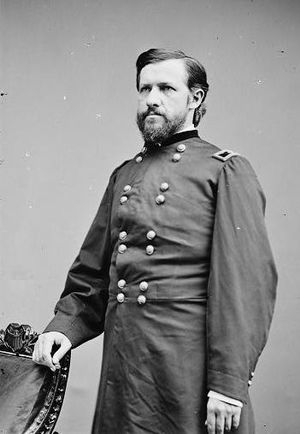
Ewing
After the massacre at Lawrence, Kansas on August 21th, it did not take the Federals long to respond. 150 years ago today General Thomas Ewing issued General Order No. 11, which said:
All persons living in Jackson, Cass, and Bates counties, Missouri ... are hereby ordered to remove from their present places of residence within fifteen days from the date hereof.

Those who within that time establish their loyalty to the satisfaction of the commanding officer of the military station near their present place of residence will receive from him a certificate stating the fact of their loyalty, and the names of the witnesses by whom it can be shown. All who receive such certificates will be permitted to remove to any military station in this district, or to any part of the State of Kansas, except the counties of the eastern border of the State. All others shall remove out of the district. Officers commanding companies and detachments serving in the counties named will see that this paragraph is promptly obeyed.

All grain and hay in the field or under shelter, in the district from which inhabitants are required to remove, within reach of military stations after the 9th day of September next, will be taken to such stations and turned over to the proper officers there …. All grain and hay found in such district after the 9th day of September next, not convenient to such stations, will be destroyed.
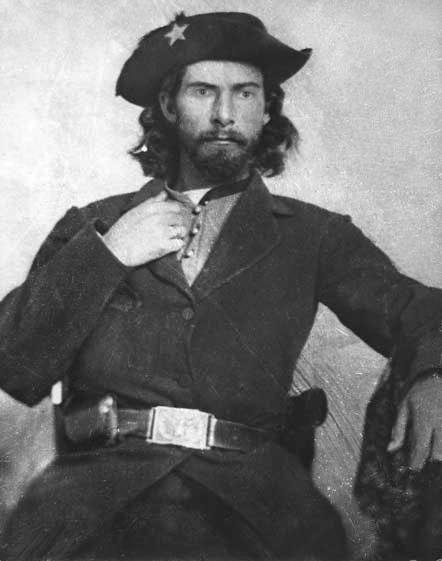
Bloody Bill Anderson, Confederate bushwacker
Ewing believed Buskwackers such as Quantrill were able to raid like they did because of the support of the local population. With this order he sought to strike at the root of the problem by forcing the population of Missouri into military stations or out of the area. He was also trying to stop the Union Jayhawkers, lead by Senator James Lane, who wanted to retaliate for Lawrence by destroying a pro-slavery town. But in doing so the Federal troops uprooted families, both southern and northern, destroying their property and leaving the area where they had once lived into “The Burnt District.” The order was also not effective in preventing Confederate guerillas. In fact it made supplies more readily available, as now there was no one to stop them from taking food from the abandoned farms of the settlers. The tragic situation in Kansas and Missouri resulted in great hardships for both sides. A pro-Union artist who was in the area at the time wrote:
It is well-known that men were shot down in the very act of obeying the order, and their wagons and effects seized by their murderers. Large trains of wagons, extending over the prairies for miles in length, and moving Kansasward, were freighted with every description of household furniture and wearing apparel belonging to the exiled inhabitants. Dense columns of smoke arising in every direction marked the conflagrations of dwellings, many of the evidences of which are yet to be seen in the remains of seared and blackened chimneys, standing as melancholy monuments of a ruthless military despotism which spared neither age, sex, character, nor condition. There was neither aid nor protection afforded to the banished inhabitants by the heartless authority which expelled them from their rightful possessions. They crowded by hundreds upon the banks of the Missouri River, and were indebted to the charity of benevolent steamboat conductors for transportation to places of safety where friendly aid could be extended to them without danger to those who ventured to contribute it.
The artist painted this scene of the Burnt District

Wednesday, August 21, 2013

Lawrence Massacre

There were few battles in Kansas turning the Civil War, but it was the scene of brutal guerrilla fighting. This had been occurring between the pro-slavery and anti-settlers since John Brown was here in the 1850s. 150 years ago today one of the most notorious guerrilla actions occurred – the Lawrence Massacre.

Quantrill
The Confederate in charge of the men who perpetrated the slaughter was William Quantrill. Although he was born in Ohio and anti-slavery, he became a drifter and ruffian in Missouri and Kansas and learned the profitability of turning in escaped slaves. His political views followed his pocketbook. When the war came, he joined a regiment of Cherokee Indians fighting for the Confederacy, and learned guerrilla tactics from them. After fighting in the Battle of Wilson's Creek he deserted the army and set out to form his own group of raiders. A handful of men joined him to attack the Union army and civilians along the Kansas-Missouri border. His men included Frank and Jesse James and the Younger Brothers, who would gain notoriety as criminals after the war.


In 1863 Quantrill decided to attack and destroy a Union town as retaliation for Union deprecations on a smaller scale. He picked the town of Lawrence, Kansas, which had been sacked already in the “Bleeding Kansas” fighting before the war. He convinced other Bushwakers to join him, and all told they numbered 300-400 men. Multiple columns converged on the town, striking early on the morning of August 21. There were no soldiers in the town at the time, and the raiders were free to ride through, looting, burning and plundering. The military age men and boys were stopped and killed. Quantrill had prepared lists of men and businesses to be specially targeted. At the top of the list was Senator James Lane, a leader who had led devastating raids into Missouri. He escaped only by running through a cornfield in his nightshirt.

Lane
After four hours of destruction the Buskwackers made their escape. A quarter of the buildings in the town were burnt, and about 200 men and boys lay dead. The raiders only lost one man, shot from his horse as they left the town. The column split up, effectively avoiding the weak Union pursuit.

Ruins of Lawrence
The issues of the guerrilla fighting were not as clear cut as they might seem. The southerners had suffered much at the hands of their pro-slavery neighbors. One boy, Riley Crawford, was sent by his mother to ride with Quantrill when he was only 13, because the Yankees had burned their home and killed his father. The Lawrence Massacre was certainly unwarranted, but the wrongs were not all one sided.

Friday, August 16, 2013

Rosecrans' Campaigns

After defeating Braxton Bragg's army at the Battle of Stone's River in January, William Rosecrans made no movement for six months. He wanted to make sure that he was completely prepared before he risked anything. After much urging from President Lincoln, Rosecrans finally launched a campaign against Bragg. He had 65,000 men to the Confederate's 46,000. Instead of trying a direct attack, he would try to destroy Bragg through maneuver.

Tullohoma Campaign
Bragg had his troops along the Nashville and Chattanooga railroad behind a ridge with only four passes. Rosecrans planed to outflank Bragg. He sent his main column through the east most gap, while at the same time another column would feint in the same direction. He hoped that Bragg would see the smaller column as a feint and look for the attack in the wrong direction. At the same time a detachment of mounted infantry drove deep into Bragg's rear. Rosecrans' plan worked perfectly. By the time Bragg realized that the movements on his right were really not a feint, he was convinced by the raid that he needed to retreat. He fell back all the way to the other side of the Tennessee river. Rosecrans, in what some had called the most brilliant campaign of the war, had driven Bragg from a strong position and out of Middle Tennessee. But the nearly bloodless victory was overshadowed by the capture of Vicksburg and defeat of Lee at Gettysburg, and Bragg's army was still intact, and a battle would still have to be fought.

Rosecrans
After this successful campaign, Rosecrans yet again halted. He again refused to move for several weeks to study the terrain and ensure that everything was prepared for another campaign. He would move next on Chattanooga, an important manufacturing and transportation center on the Tennessee-Georgia line.

Thursday, August 8, 2013

Lee Resigns

Lee
 150 years ago today, with the Gettysburg campaign over, Robert E. Lee wrote a letter of resignation to Jefferson Davis, president of the Confederacy. He had led the greatest invasion into Federal territory, but had been defeated. He said:
Camp Orange, August 8, 1863

His Excellency Jefferson Davis,
President of the Confederate States

Mr. President,
... We must expect reverses, even defeats. They are sent to teach us wisdom and prudence, to call forth greater energies and to prevent our falling into greater disasters. Our people have only to be true and united, to bear manfully the misfortunes incident to war, and all will come right in the end.

I know how prone we are to censure and how ready to blame others for the non-fulfillment of our expectations. This is unbecoming in a generous people, and I grieve to see its expression. The general remedy for the want of success in a military commander is his removal. This is natural, and in many instances, proper. For, no matter what may be the ability of the officer, if he loses the confidence of his troops disaster must sooner or later ensue.

I have been prompted by these reflections more than once since my return from Pennsylvania to propose to Your Excellency the propriety of selecting another commander for this army. I have seen and heard of expression of discontent in the public journals at the result of the expedition. I do not know how far this feeling extends in the army. My brother officers have been too kind to report it, and so far the troops have been too generous to exhibit it. It is fair, however, to
suppose that it it does exist, and success is so necessary to us that nothing should be risked to secure it. I therefore, in all sincerity, request Your Excellency to take measures to supply my place. I do this with the more earnestness because no one is more aware than myself of my inability for the duties of my position. I cannot even accomplish what I myself desire. How can I fulfill the expectations of others? In addition I sensibly feel the growing failure of my bodily strength. ... Everything, therefore, points to the advantages to be derived from a new commander, and I the more anxiously urge the matter upon Your Excellency from my belief that a younger and abler man than myself can readily be attained. I know that he will have as gallant and brave an army as ever existed to second his efforts, and it would be the happiest day of my life to see at its head a worthy leader -- one that would accomplish more than I could perform and all that I have wished. I hope Your Excellency will attribute my request to the true reason, the desire to serve my country, and to do all in my power to insure the success of her righteous cause.

I have no complaints to make of any one but myself. I have received nothing but kindness from those above me, and the most considerate attention from my comrades and companions in arms. To Your Excellency I am specially indebted for uniform kindness and consideration. You have done everything in your power to aid me in the work committed to my charge, without omitting anything to promote the general welfare. I pray that your efforts may at length be crowned with success, and that you may long live to enjoy the thanks of grateful people.

With sentiments of great esteem, I am, very respectfully and truly, yours,

R.E. Lee,
General
Davis

In this letter Lee exhibited some of his greatest characteristics. He did not try to blame others for his defeat, but accepted responsibility for his actions. He was grateful, thanking Davis for what he had done for him, and asked that a better man be appointed to his place. But Davis had no better man. He trusted Lee and had a relationship like he had with few other of his commanders. Throughout much of the war he would be fruitlessly searching for a competent commander for the west. Removing Lee would only make the command problem worse. Davis replied a few days later:
Richmond, VA., August 11, 1863.
General R. E. Lee,
Commanding Army of Northern Virginia.

General: Yours of the 8th instant has been received. I am glad that you concur so entirely with me as to the wants of our country in this trying hour, and am happy to add that, after the first depression consequent upon our disasters in the West, indications have appeared that our people will exhibit that fortitude which we agree in believing is alone needful to secure ultimate success.

It well became Sidney Johnston, when overwhelmed by a senseless clamor, to admit the rule that success is the test of merit, and yet there is nothing which I have found to require a greater effort of patience than to bear the criticisms of the ignorant, who pronounce everything a failure which does not equal their expectations or desires, and can see no good result which is not in the line of their own imaginings. I admit the propriety of your conclusions, that an officer who loses the confidence of his troops should have his position changed, whatever may be his ability; but when I read the sentence, I was not at all prepared for the application you were about to make. Expressions of discontent in the public journals furnish but little evidence of the sentiment of an army. ...

Were you capable of stooping to it, you could easily surround yourself with those who would fill the press with your laudations and seek to exalt you for what you have not done, rather than detract from the achievements which will make you and your army the subject of history, and object of the world's admiration for generations to come. …

But suppose, my dear friend, that I were to admit, with all their implications, the points which you present, where am I to find that new commander who is to possess the greater ability which you believe to be required? I do not doubt the readiness with which you would give way to one who could accomplish all that you have wished, and you will do me the justice to believe that, if Providence should kindly offer such a person for our use, I would not hesitate to avail of his services.

... To ask me to substitute you by someone in my judgment more fit to command, or who would possess more of the confidence of the army, or of reflecting men in the country, is to demand an impossibility.

It only remains for me to hope that you will take all possible care of yourself, that your health and strength may be entirely restored, and that the Lord will preserve you for the important duties devolved upon you in the struggle of our suffering country for the independence of which we have engaged in war to maintain.

As ever, very respectfully and truly,
Jefferson Davis

Confederate cabinet