head

Thursday, December 13, 2012

Battle of Fredericksburg – Sunken Road

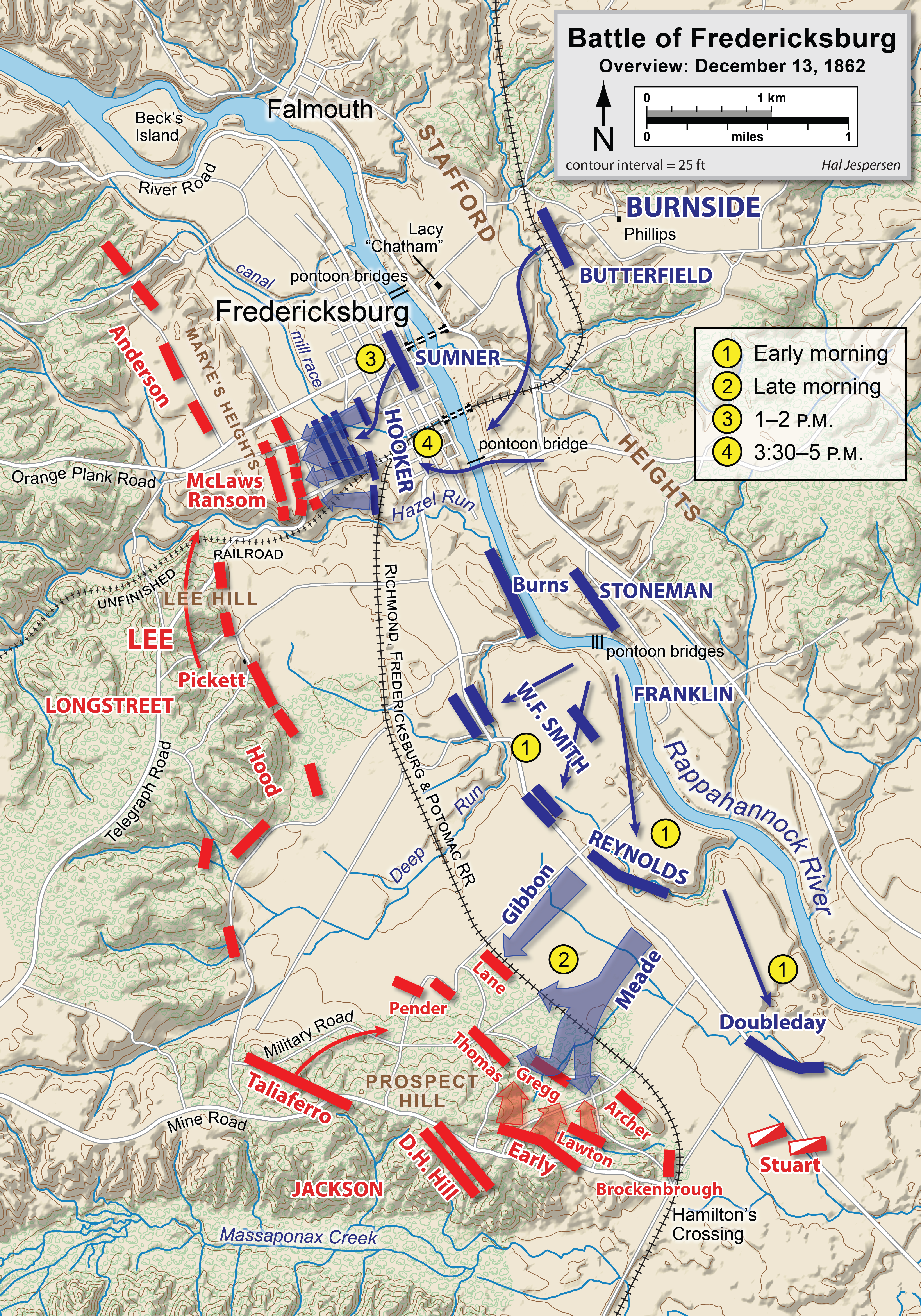
On the Confederate left the fight began at 11:00 am, when the Confederate artillery opened in an attempt to relieve pressure on the left. The Union artillery across the river replied and an artillery duel commenced. Corps commander James Longstreet, for one, earnestly hoped that Burnside would attack. Two hundred yards from the town was a canal, which the Federals could only cross by three narrow bridges. From there it was 400 yards and about 50 feet up to the Confederate line on Marye's Heights. There the men were placed in the sunken Telegraph Road. This natural entrenchment was improved with a 4 foot stone wall, and in some places a breastwork was even added on top of that. 2,000 Confederates were positioned along this line, with seven thousand more in reserve. It was a very, very strong position. Longstreet's chief of artillery reported:
General, we cover that ground now so well that we will comb it as with a fine-tooth comb. A chicken could not live on that field when we open on it.
Sumner's Attack
The first Union attack was launched at noon, with men from Sumner's grand division. They crossed the canal beyond the town, and hid behind a bluff, ordering their ranks for their changed. When they marched forward they were a grand display. They marched in perfect line of battle, with bayonets fixed, advancing toward the rebels. James Longstreet wrote of the scene:
The field was literally packed with Federals from the vast number of troops that had been massed in the town. From the moment of their appearance began the most fearful carnage. With out artillery from the front, right, and left tearing through their ranks, the Federals pressed forward with almost invincible determination, maintaining their steady step and closing up their broken ranks. Thus resolutely they marched upon the stone fence behind which quietly waited the Confederate brigade.... As they came within reach of this brigade, a storm of lead was poured into their advancing ranks and they were swept from the field like chaff before the wind. A cloud of smoke shut out the scene for a moment, and, rising, revealed the shattered remnants of a gallant, but hopeless charge.
Confederates at the Sunken Road
The Union battle line was decimated by Confederate volleys from the sunken road. 25% of the men in those lines were hit. The formation began to break at 125 yards from the wall, and no one came within 40 yards. The survivors could not even retreat. The Confederate fire was so heavy they clung to the hillside, hoping for a chance to get away. One Yankee remembered:
No one who has not witnessed such a scene can form any idea of the awfulness of that hour, the fearful screeching of the shells, the ominous buzzing and vicious whistling of canister and the endless 'ping ping' of the minie balls, while the reports of the musketry was one continual crash and, far above all, the thunderous tones of hundreds of cannon, completely drowned the encouraging shouts of the officers. The whole line was eveloped in a cloud of sulphurous smoke, almost hiding the regiments from each other and through which crimson flames from muskets and cannon darted fiery tongues. What carnage! comrades fell all around you, mangled and bleeding; the colors go down, but are raised to fall again and again, the line moves forward with decreasing speech until when past the centre of the plain it finally stops, fires a few spasmodic volleys, wavers, breaks and flees to the protection of the bank from whence it had started. Then, without delay, it re-forms, moves up the bank and the tragedy is renacted. Once more the scattered remnants form a regimental line and are led forward with the same result.
Union Attack
Two more brigades were sent forward to renew the attack. They suffered the same fate, half of the men being killed and wounded by the Confederate fire. The Confederates were often four deep along the Sunken Road. The men in the back would load rifles, handing them up to the men in front to fire, handing the weapons back to repeat the process. This meant they could pour a tremendous fire into the Federal ranks. An entire division had been sent forward, but they were stopped in their tracks and pinned down by the Confederate fire. Another division, that of Winfield Hancock, was sent in and they met the same fate. One of Hancock's units was the Irish Brigade under Thomas Meagher, a Irish revolutionary who had been exiled, and escaped from prison into the United States. It was made up of three New York regiments two others from Massachusetts and one from Pennsylvania. It was formed of Irish immigrants in the large northern cities. On the Confederate side of the line one of the regiments of Cobb's brigade was an Irish regiment. These two Irish units met on the fields of Fredericksburg. A northern Irishman wrote of the fight:
Officers and men fell in rapid succession. Lieutenant Garret Nowlenfell with a ball through the thigh. Major Bardwell fell badly wounded; and a ball whistled through Lieutenant Bob McGuire's lungs. Lieutenant Christian Foltz fell dead, with a ball through the brain. The orderly sergeant of Company H wheeled around, gazed upon Lieutenant Quinlan, and a great stream of blood poured from a hole in his forehead. ... No cheers or wild hurrahs as they moved towards the foe. They were not there to fight, only to die.
The Union Irish brigade was unsuccessful in its attack upon the Confederate Irish. They went into battle with 1,200 rifles, and when they rallied the next morning only 230 were left. 14 of its 15 field officers were gone. More men would straggle in later, but the brigade was a shadow of its former self.
Sunken Road

Two entire divisions had attempted to break the Confederate line, but all had failed, leaving the soldiers clinging to the ground. A third division, that of Major General O. O. Howard was sent in. The original plan war to send them to the right in an attempt to strike the Confederate left, but after receiving messages from the two divisions on the field urgently requesting help, the corps commander, Darius Couch, decided to send them straight up the hill. The regimental history of the 19th Massachusetts recorded of the advance:
The waiting line closes up, belts are tightened, all extra weights thrown away. Silence falls upon the ranks, for all know that they must traverse those heaps of dead; that they, too, must soon face that storm of death. They wait, and at last the order comes to advance. ... The wounded were moving to the rear in crowds, a sickening sight. The houses soon were further and further apart but the shells, on the contrary, came nearer and nearer. The air was full of missiles. Soon some fences were encountered and the men hastily crawled over, through or under them and then crossed several yards surrounding some of the hoses. Soon they reached the canal which intersects the city and found the bridges were crowded with fugitives, wounded men and stretcher bearers. The regiment pushed across the ditch, down one side and up the other, - and hurried forward, but soon filed to the right and formed in line of battle in a field, under cover of a steep bank.... The line of the Nineteenth Massachusetts had hardly formed when Capt. Weymouth ordered 'Forward.' Up the ascent they sprang, and on toward the ... enemy. The plain over which they had to charge was some four hundred yards in width and had gradual rise to the base of the Heights. With its colors well to the front, the regiment, - a mere handful of men, - advanced across the plain. ... When the men reached the crest of the bank they were in full view of the enemy's works from which the batteries and infantry opened upon them with such effect as literally to sweep them, reeling and staggering, back to cover. Shells and canister poured down upon them like rain, for not only did the line have to withstand the awful fire from the front, but was subjected to an enfilading fire from the batteries on the rebel left.

In the midafternoon there was a pause from these terrific assaults. Longstreet wrote:
Gen. Lee, who was with me on Lee's Hill, became uneasy when he saw the attacks so promptly renewed and pushed forward with such persistence, and feared the Federals might break our lines. After the third charge he said to me 'General, they are massing very heavily and will break your line, I am afraid.' 'General I replied, if you put every man now on the other side of the Potomac on that field to approach me over the same line, and give me plenty of ammunition, I will kill them all before they reach my line.'
Hooker's Attack

Burnside's attacks had failed. Four divisions had been broken trying to do what he had planned for one. 5,000 men were killed or wounded, and many of the survivors were lying on the ground to avoid the Confederate bullets. But against all reason he decided to continue the attacks. He ordered Joseph Hooker's Grand Division to attack, and the battle was resumed, with the same results. Every quarter of an hour another attack was launched, supported by artillery, but every one was a failure. The Washington Artillery from New Orleans, on the top of Marye's Heights, had been firing throughout the action, breaking up the Union charges. But now they were running out of ammunition. However other cannon were available and so they were pulled to the rear, and other guns were brought up, which continued to fire into the advancing blue lines. The Federal attacks continued until twilight. When they finally were stopped, the field was covered in blue bodies, in some places three thick. A few troops had made it within 25 yards, but not a man had reached the wall. Fourteen brave attacks had been made, but they were all failures. Looking upon the scene, Lee uttered his famous line, “It is well that war is so terrible, else we should grow too fond of it.” 6,000 to 8,000 Federals had fallen in this assault, while only 1,200 Confederates were hit. As night came many Federals were still lying on the field, unable or unwilling to retreat. One of them was Colonel Joshua Lawrence Chamberlin of the 20th Maine
[O]ut of that silence rose new sounds, more appalling still. A strange ventriloquism of which you could not locate the source. A smothered moan as if a thousand discords were flowing together into a keynote - weird, unearthly, terrible to hear, and bare - yet startling with its nearness. The writhing concord broken by cries for help - some begging for a drop of water, some calling on God for pity, and some on a friendly hand to finish what the enemy had so horribly begun. Some with delirious, dreamy voices murmuring loved names as if the dearest were bending over them. And underneath, all the time, the deep bass note from closed lips, too hopeless or too heroic to articulate their agony. At last, cold and depressed, I move two dead men a little and lay down between them, making a pillow of the breast of a third, drew the flap of his overcoat over my face and tried to sleep.
During the night the Northern Lights appeared, filling the sky with tongues of fire. Rare this far South, the Confederates saw it as a sign from God commending their victory.

Battle of Fredericksburg – Slaughter Pen

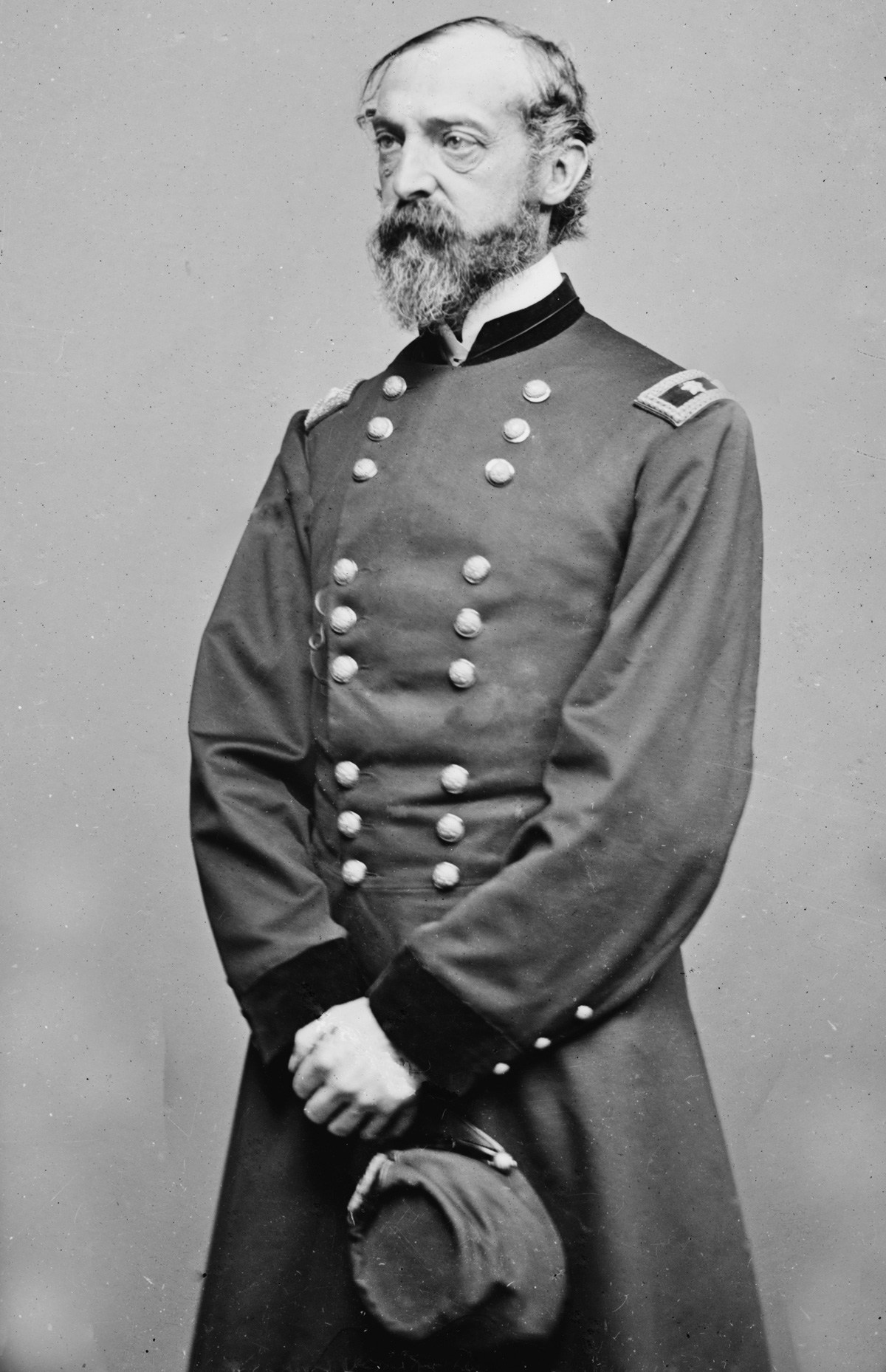
At around 1 pm George Meade resumed his advance toward the Confederate left, held by Stonewall Jackson. Jackson's men were ready for them, hidden along the wooded ridge. However, they did not know their position had a fundamental flaw. A. P. Hill's division held the front line, but a wooded, boggy section of the line between Archer and Lane was left unguarded. It was thought that the bog was impassable for infantry. However, the Federals soon proved that wrong. Meade's division pushed forward towards the gap, at first faltering upon encountering artillery fire and ditch fences which were dug to keep out animals. As the men struggled through these obstacles they were encouraged by their commander, George Meade, a West Point engineer with significant combat experience. On the Confederate side, James Archer, seeing the Federal advance, realized the Yankees were heading straight for the gap in the line. He threw one of his regiments into the gap, and sent back to the rear to call up another brigade of reinforcements.
Meade

Meade's first brigade rushed through the gap, climbing over a railroad embankment and turning to the right, struck Lane's brigade on the flank. The third Union brigade turned to the left, striking Archer. The second rushed in as well, supporting the other two. Archer and Lane's lines bent back under the heavy pressure on their flanks, but were not broken. Maxey Gregg's Confederate brigade was a little to the rear of the Confederate line. They were called up as reinforcements, but did not know exactly where to go. They lay down under artillery fire and stacked their muskets. Hearing musketry fire rolling towards them, they began to reform, but before they could even grab their rifles the Federals were upon them. Unprepared for the fierce attack by Meade's advancing men, the Southerners fled. Gregg, who was partially deaf, did not hear the Federals and was shot from his horse. The bullet cut his spinal cord and he died two days later.

Fredericksburg: Ready to March
Although the Confederate line had been pierced by Meade, there was a second line. The divisions of Jubal Early and William Taliaferro advanced forward to seal the gap. Lane and Archer's men rallied and poured their fire into Meade. Hit from three sides with no reinforcements arriving, the Federals could not hold. They abandoned the ground that they had gained and fell back. One of the brigade commanders was killed and another wounded, along with many of the men, and the formations were scattered and confused.
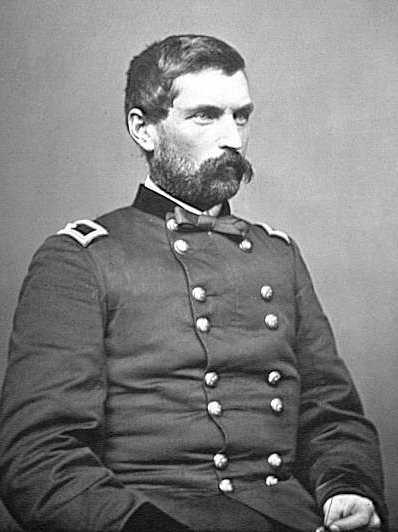
Gibbon

As Meade's division was recoiling from its defeat, John Gibbon was preparing to go forward on Meade's right. At 1:30 pm this division moved forward, but by that time it was too late to follow up on Meade's temporary success. Gibbon's moved across open fields toward the enemy, taking heavy casualties from the Confederates on the wooded hill. As they grew closer Gibbon halted his men, exchanging fire with the Confederates. Finally he ordered a charge.

View of the Slaughter Pen Farm
Slaughter Pen Farm
They hit the Confederates positioned along a railroad cut, a ready-made defense. The Confederate line held firm, and after the rifles were fired, both sides resorted to hard hand-to-hand fighting with bayonets and clubbed muskets. After a bitter fight the Confederates finally broke. However, Gibbon did not long remain in position in peace. The Confederates rallied and counter attacked. Gibbon's men were out of ammunition, and with more hand-to-hand fighting the Confederates were able to recapture the railroad cut. The Federals fell back, having been unable to hold on without reinforcements. Gibbon wasn't done trying however. He launched three more attacks, but was unable to gain any more success. After the fourth failure, he realized that without more troops, he could gain nothing but casualties.

Gibbon and Meade and been unsuccessful primarily because their initial gains were not supported with reinforcements. It was not for lack of men. Meade, coming back from his defeat, encountered David Birney with his division, and poured forth a slew of profanities at him for failing to move forward. The problem was not just with the lower echelons of command. Burnside ordered Franklin to continue his attacks, but Franklin refused saying all of his troops were already in action. However, this was not true. 5,000 Northerners had fallen as had 4,000 Confederates, but he still had 20,000 men available that had not fired a shot. This ended the battle on the Confederate right, and with it ended the Northern chance for victory at Fredericksburg.

It was this section of the field that the Federals had their best chance. They achieved a breakthrough, but troops were not available to make good that success. Franklin's refusal to attack doomed the battle for the Union. George Meade said:
For my part the more I think of that battle the more annoyed I am that such a great chance should have failed me. The slightest straw almost would have kept the tide in our favor.
 

Battle of Fredericksburg – Council of War


The battle began in earnest on the morning of December 13th. On the right, Jackson was confident that his men could successfully maintain their position. As he commented to a staff officer, "Major, my men have sometimes failed to take a position, but to defend one, never! I am glad the Yankees are coming."
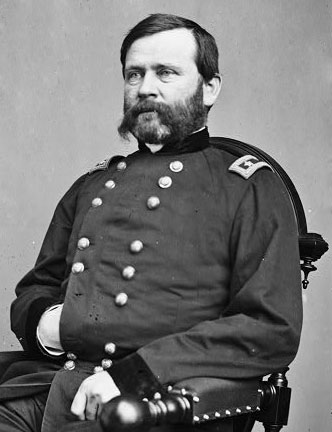
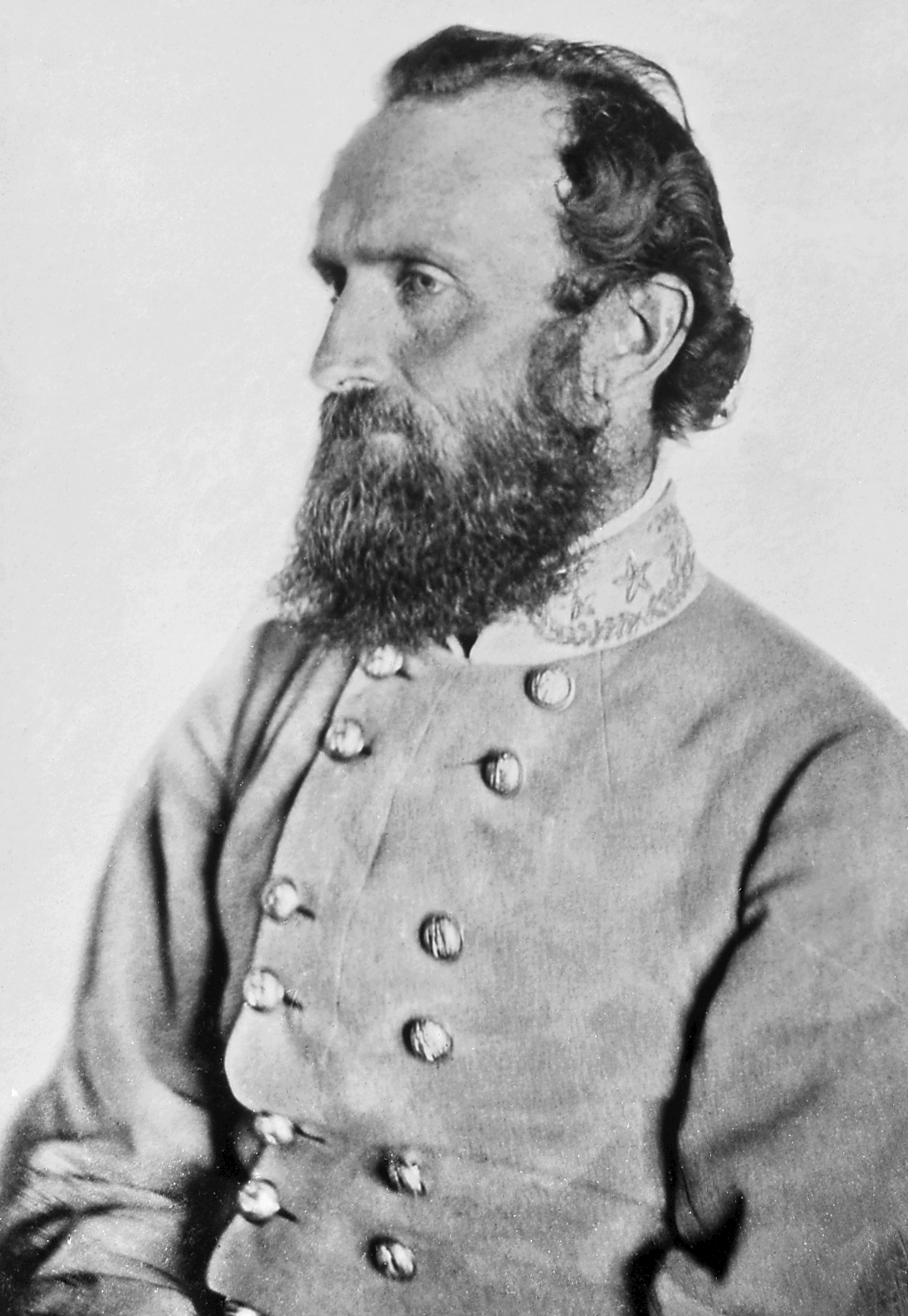
Jackson

That morning, Jackson joined Lee and Longstreet for a council of war. His appearance made quite the stir:
As he dismounted, we broke into astonished smiles.  He was in a spick and span new overcoat, new uniform with rank marks, fine black felt hat, and a handsome sword.  We had never seen the like before, and gave him our congratulations on his really fine appearance. He said he “believed it was some of his friend Stuart’s doings”.
Jackson and Stuart had one of the most unlikely friendships in the Civil War. At first look, they seemed exact opposites, Jackson, stern, reserved, careless in dress, Stuart, gay, outgoing and showy. However, they did have much in common. Both were firm Christians and aggressive in battle. The staff remembered that, "Jackson was more free and familiar with Stuart than with any other officer in the army, and Stuart loved Jackson more than he did any living man."
Stuart

As the conference of the Confederate generals was brought to a close, Longstreet shouted out, "Jackson, what are you going to do with all those people over there?" "Sir," Jackson replied, with one of his favorite phrases, "we will give them the bayonet."
John Pelham

The battle on the Confederate right began with the Yankees of George Meade's brigade advancing towards Jackson in long lines with their flags flying. A lone Confederate gun opened at 10:00 am on their flank. That gun was under John Pehlem, a brave young officer who had resigned from West Point to join the Confederacy, and commanded Stuart's horse artillery. His shots took effect, and another gun was brought up. Firing directly into a Union flank, he put a stop to the Union advance. Four Federal batteries on Stafford Heights opened on him, trying to knock him out so the advance could resume. One gun was disabled, but none the less, the gallant Pelhem continued to fire with the other. Lee, watching from a hill in the center of the Confederate line, commented that it was “glorious to see such courage in one so young.” The feat finally came to a close after about an hour when Pelhem ran out of ammunition. More Confederate artillery on Prospect Hill converged with Pelham. From these combined barrages the Federal advance was stalled for two hours.

Wednesday, December 12, 2012

Battle of Fredericksburg – Plan of Attack

Burnside
On December 12th, 150 year ago today, the Federals, as on the previous day, began with a bombardment. They crossed the river on the pontoon bridges they had built, and began digging rifle pits. Examining the Federal movements, Lee decided that this was indeed the real attack. He had been slow to arrive at that conclusion because he did not think Burnside would be foolish enough to attack Fredericksburg directly. But now he finally resolved to order up Stonewall Jackson's forces, which had been scattered to guard a large area. The two days Burnside had spent in preparing for the attack had thrown his plans into disarray and given Lee time to bring up his entire army. If he had attacked immediately, he may have caught Lee more off guard and had a better chance of success.
Battle overview

Burnside examined Lee's 8 mile long line and saw that it bowed inwards in the center. He could not attack there without coming under crossfire from the flanks. That left the two flanks, and he decided to attack both. However, his orders were not for the forceful attack his subordinates expected. Franklin, on the Union left, was instructed to send forward at least one division to seize the high ground, as was Sumner, supported by Hooker, on the right. Burnside thought that he would simply be able to brush Lee off without committing all of his forces. He would find out the next day how wrong he was.

Tuesday, December 11, 2012

Battle of Fredericksburg - Day 1

Movement to Fredericksburg
Burnside had moved his army to Fredericksburg in a hope to quickly cross the river and get around Lee's flank. But his plan had failed when the pontoon bridges did not arrive, and he did not move quickly to find another way across the river. Now, as the Federals began their river crossing 150 years ago today, they were facing Lee's entire army on the heights across the river.
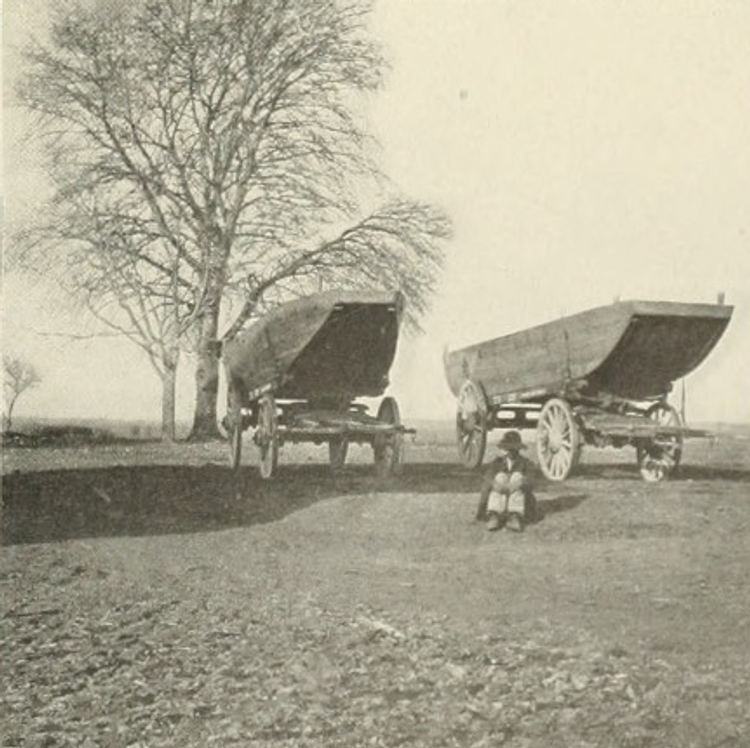
Pontoons

Burnside had several options for crossing the Rappahannock River, but he chose the one he thought would be least expected. Instead of attempting a flanking movement, he would strike directly across the river into Fredericksburg, hoping that Lee by guarding other crossings had weakened his center enough for Burnside to have a chance there. Fredericksburg would be a tough nut to crack. On either side of the river were high bluffs, Strafford Heights on the Federal side and Marye's Heights on the Confederate, and in between on the southern side of the Rappahannock was the town of Fredericksburg. Lee had over 70,000 men in his two corps, half the number of Burnside. They had recovered from their reverse at Sharpsburg and had, increased in numbers and morale. They were confident that they could put up a good fight and whip the Union army, even with its new commander.
Pontoon Crossings at Fredericksburg

On December 11th, 150 years ago today, the Union engineers began working to assemble the pontoon bridges around Fredericksburg. Their work would not go on unopposed. Guarding the town itself was the Mississippi Brigade of Brigadier General William Barksdale. His sharpshooters, hidden in the houses of the town, were well positioned to shoot down the Yankees working on the bridge. The Federals tried to meet this threat with an impressive bombardment, 150 cannon raining down shells into the town. But the Mississippians, protected by the houses, were mostly unhurt by the fire.

As the guns died down, the bridge builders rushed forward. Barksdale's men picked them off with their rifles, foiling several efforts to put the six pontoon bridges across the river. Lee had told Barksdale that he was free to retire, as all was ready on the heights to receive a Union attack, but Barksdale replied, "Tell General Lee that if he wants a bridge of dead Yankees, I can furnish him with one!" The Mississippians drove back nine Federal attempts to cross the river.
Henry Hunt

At this juncture Burnside was convinced by his artillery commander, Brigadier General Henry Hunt, to send landing parties across in boats to establish bridgeheads and clear out the sharpshooters. Colonel Norman Hall volunteered his brigade, and with the army commander's approval, set off in small boats. Although losing some men along the way, they were able to dash across the river, land and began a fierce house to house fight with the rebels. Falling back slowly, in constant contact with the Union troops, Barksdale did not return to the safety of the Confederate lines until after dark. One small Mississippi brigade had held up the entire Union army for a day. But it would take more than that for the Confederates to prevail in the coming days of the Battle of Fredericksburg.
William Barksdale

Friday, December 7, 2012

Battle of Prairie Grove

The Confederates forces under Thomas Hindman were moving toward the smaller Union army under James Blunt in northern Arkansas. However, the Confederates encountered a reverse, when a large cavalry column under John Marmaduke was driven back at the Battle of Cane Hill on November 28th. Undeterred, Hindman set out with his main body on December 3rd. He had 11,000 men and 22 cannon. Blunt, with only 5,000 men and 30 cannon, did not fall back. Instead, he telegraphed for other Union troops in Arkansas to join him, and remained in a defensive position around Cane Hill.
Hindman

Hindman's plan was to send Marmaduke with the rebel cavalry to strike Blunt from the south as a diversion, while he hit the Federal flank from the east. However, as he drew close to the Yankees he changed his mind and decided to continue on around Blunt, receiving word that the Union reinforcements were arriving. Francis Herron, upon the receipt of Blunt's order, relentlessly pushed his men on a forced march so that he could arrive in time for the battle. Hindman, loosing his usual aggressive nature, took up a defensive position in the low hills of Prairie Grove.
Blunt

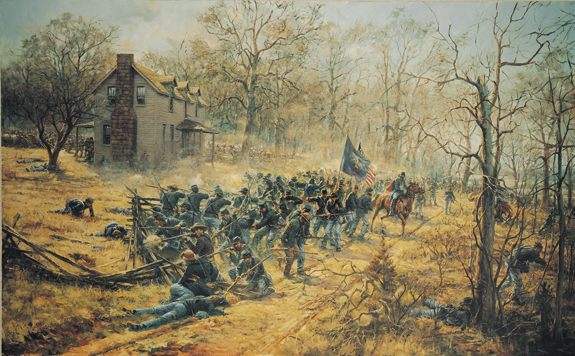
Herron began the Battle on December 7th, deploying his tired troops on Hindman's right and commencing a two hour artillery bombardment. Seeing that his artillery had been very successful, destroying the rebel guns and forcing the infantry to lie down on the reverse slope of the hill, Herron ordered an attack to make use of this opportunity without waiting for cooperation from Blunt's forces. However, the first two regiments set forward met disaster near the Borden House, meeting a counterattack from three sides. The Federals fell back, and soon were running back in disorder to their lines, having lost about half their number. Trying to make the most of this gain, the Confederates launched a disorganized attack on Herron's line, but were driven back by canister from the Yankee guns.

Herron ordered two more regiments to attack in the area of the Borden House, hoping to forestall any movements the Confederates might make. Again they were driven back after fierce fighting, and then drove back a southern counterattack. By this time Blunt realized that Hindman had bypassed his position, and so ordered his troops to march to the sound of fighting. Ignoring the roads and just marching through the fields, his leading elements arrived on the Confederate flank just as they were preparing to launch another attack. They surprised the Confederates and foiled their attack. The fighting continued to sway back and forth until nightfall put an end to the battle.
Herron

Although tactically the battle was a draw, neither army having won a clear victory, the Union certainly won strategically. The two Union forces had been able to join without being first destroyed by the Confederate attacks, and Hindman saw no choice but to retreat with no reinforcements or ammunition available to continue the battle on the morrow. He arrived with his defeated army in Van Buren, Arkansas on December 10th, and near the end of the month was driven out of the nortwest part of the state completely by an advance by the Yankee forces.

Wednesday, November 28, 2012

Battle of Cane Hill

In early 1862 the Battle of Pea Ridge, Arkansas had been fought, resulting in Confederate defeat. Now a Confederate army under General Thomas C. Hindman was advancing to try to regain that lost ground. He moved with 11,000 troops into the northwest corner of the state, where he planned to attack 5,000 Yankees under Brigadier General James G. Blunt, who were 70 miles from any reinforcements. Hindman sent Brigadier General John S. Marmaduke ahead with 2,000 cavalry to hold Blunt in place while the rest of the Confederates came into position.

Blunt, however, did not sit passively and wait for Hindman's plan to work. He headed south, and encountered Marmaduke 35 miles south of where the Confederates had expected. The outnumbered rebels were surprised by the Yankee attack on November 28th, 150 years ago today. Marmaduke ordered Col. Jo Shelby to delay Blunt and cover the retreat of the main Confederate force. Although the fighting stretched for nine hours as Blunt pursued the Confederates for 12 miles, there were few large clashes and the casualties were light. The Union lost 41 killed and wounded, and the South 45.

Although he was successful in driving back Marmaduke's thrust for the time being, the attack left Blunt even further from reinforcements. The campaign would culminate in the Battle of Prairie Grove, just nine days later.