head

Wednesday, September 19, 2012

Battle of Iuka

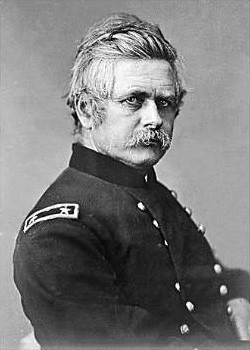
Edward Ord
There were two Confederate armies in Northern Mississippi, 15,000 men under Stirling Price in Iuka, and another army under Earl Van Dorn marching to join him. 150 years ago today Price was under attack. Grant had planned to envelop him by two columns attack on separate roads, Ord in the North and Rosecrans in the South. Ord was to coordinate his movement with the sound of battle to the south. Rosecrans attacked as planned, and Price responded by ordering several charges against the Federal forces. The third attack was successful, and the rebels captured part of a battery of artillery. The battle was turning against the Federals, for Ord was not in position. He had been in his appointed position, but due to a phenomenon called an acoustic shadow he did not hear the sound of fighting. Therefore he did not attack, thinking Rosecrans was not in position. He had seen the smoke of the guns, but had thought it was Price burning his stores in his retreat.
William Rosecrans
Through this providential mishap Price was able by hard fighting to hold his own against Rosecrans. During the night he left Iuke via an unguarded road. He had already been planning to leave, and now well-nigh surrounded he had few other choices. The Federals attempted a pursuit, but the tired Yankee cavalry was outrun and gave up the pursuit. The Union lost 790 men, 144 killed, 598 wounded and 40 captured, the Confederacy 1,516: 263 killed, 692 wounded and 561 captured, as well as a large quantity of stores. However, Price had saved his army, and he would be able to join up with Van Dorn and fight again another day.
Price

Battle of Boteler's Ford – Day 1

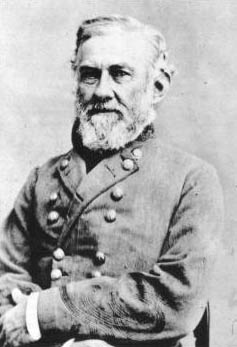
Pendleton
When Lee fell back across the Potomac he left behind to guard Boteler's Ford two infantry brigades as a rearguard, as well as 45 cannon under Brigadier General William Pendleton, the army chief of artillery. Around dusk 2,000 Federals advanced across the Potomac at Boteler's Ford. They struck the Confederate rearguard, gaining some success, and capturing four of Pendleton's cannon. Pendleton was a very competent officer. He lost track of his forces and panicked. He woke up Lee at midnight and reported that all of the cannon had been captured. The next day, it was found that only four guns had actually been captured. This incident brought much criticism upon Pendleton, and many jokes about the incident were spread through the army.

Tuesday, September 18, 2012

Lee Retreats

Lee
In the Battle of Antietam Lee's lines had been pressed hard, but had held firm. He decided to remain on the battlefield the next day and hazard a renewal of the battle. However, there was no fighting the next day. Lee was in no condition to fight, and although McClellan had fresh troops available, he was convinced that Lee was planning to attack him. After the a truce to remove the wounded, Lee retreated that night across the river back into Virginia.
Lee's first invasion of the north was over. The campaign had started out with brilliant prospects, but the discovery of Lee's lost orders spurred the usually sluggish McClellan into quick action. Lee was able to capture Harper's Ferry and reunify his army. In the Battle of Sharpsburg or Antietam he beat off uncoordinated Union attacks and McClellan did not continue to press with his superior numbers. Lee retreated across the river, his invasion beaten back. The campaign had turned upon the providential discovery of Special Orders 191. If that event had not happened, the campaign, and perhaps even the war, may well have turned out very differently.

Monday, September 17, 2012

Fall of Munfordville

The Confederates in Kentucky, having begun a siege of Munfordville, again requested the Federals surrender. Union commander Colonel John T. Wilder did not now what to do. With three regiments he was facing an entire Confederate army. So he did something that might seem strange today, but he asked Confederate Major General Simon B. Buckner for advice. Buckner said that he could not advise him what to do, but he could show him around the Confederate works. This did the trick. Wilder, after viewing Confederate attack preparation, had no doubt that an attack would mean certain defeat for him, so he surrendered his garrison of over 4,000 men 150 years ago today.
Buckner

Battle of Antietam - Conclusion

With Hill's counterattack the Battle of Antietam, or Sharpsburg as it was called by the south, was over. All along the line, the Northerners had pushed the rebels hard. The Confederates had come very close to defeat on the left, center and right, and had to shift reinforcements between positions. However, the attacks were not pressed or coordinated between the sections of the Union army. Burnside on the right took a long time to cross the creek and form his men, allowing A. P. Hill to arrive. McClellan still may have had a chance at victory if he had pressed the attacks. His men who had fought were broken, but he still had plenty of reserves. He had four divisions from Franklin and Porter's corps, 40,000 fresh men, but he refused to send them into the battle. He was afraid that the Confederates would counter attack. He was not willing to take the risk, as he explained in his report:
I am aware of the fact that under ordinary circumstances a general is expected to risk a battle if he has a reasonable prospect of success; but at this critical juncture I should have had a narrow view of the condition of the country had I been willing to hazard another battle with less than an absolute assurance of success. At that moment--Virginia lost, Washington menaced, Maryland invaded--the national cause could afford no risks of defeat. One battle lost and almost all would have been lost. Lee's army might then have marched, as it pleased, on Washington, Baltimore, Philadelphia, or New York. It could have levied its supplies from a fertile and not devastated country, extorted tribute from wealthy and populous cities, and nowhere east of the Alleghenies was there another organized force able to arrest its march.
If he had attacked, he probably would have destroyed Lee's army. Lee had thrown every unit available into the combat. At times, all that stood before McClellan was a few cannon and stragglers, but McClellan had convinced himself that Lee was reserving 100,000 men to deal him a fatal blow. By failing to press his successes, McClellan turned what should have been a resounding Union victory into a tactical draw.

The Confederates were considering a retreat, not an assault. They had no units or reserves left, but if they could defeat McClellan again, they could launch an offensive into the North with little to stand against them. Lee called a council of war at his headquarters, with Jackson, the Hills, McLaws, Walker, Good, Early and Longstreet. Each commander reported heavy losses, and there was little confidence of being able to hold their ground if attacked. Lee however, decided to rest and stay where he was.

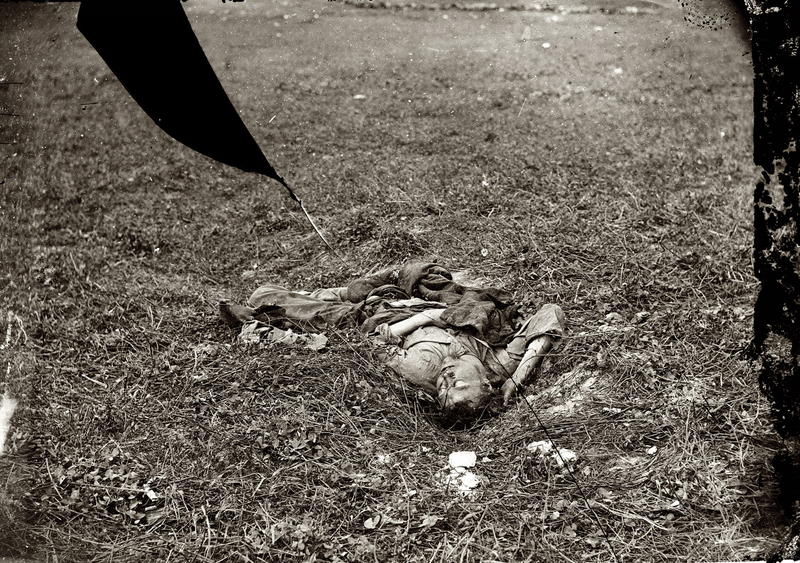
The day after the battle a truce was made to carry for the wounded. The losses had been heavy on both sides. The Confederates lost 2,108 killed, 9,540 wounded and 753 missing. The Federals lost 1,546 killed, 7,752 wounded and 1,018 missing. It remains the bloodiest day in American history. There were bloodier battles in the Civil War, but there have never been this many American battlefield casualties who all fell on a single day.
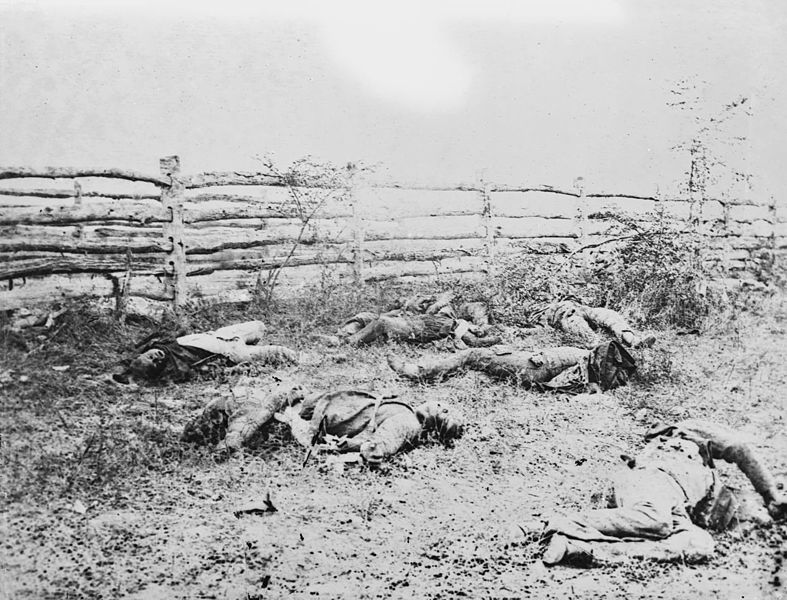
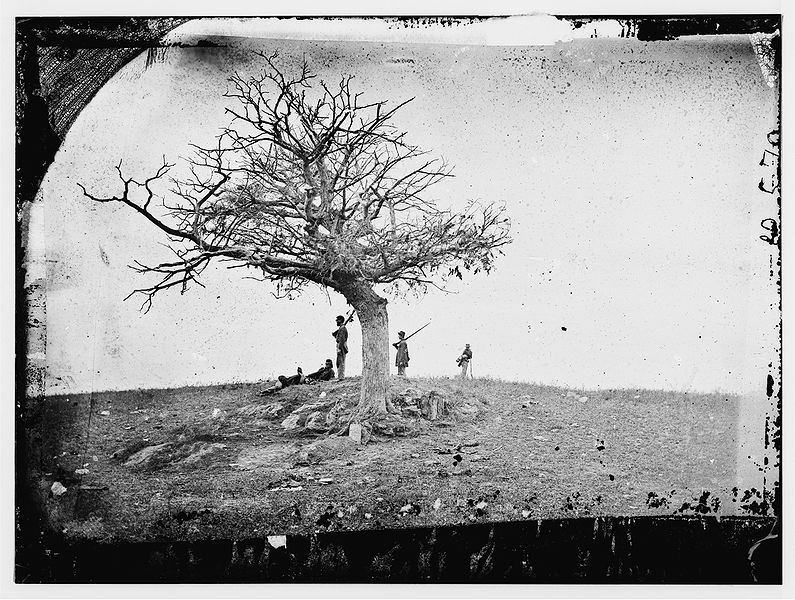
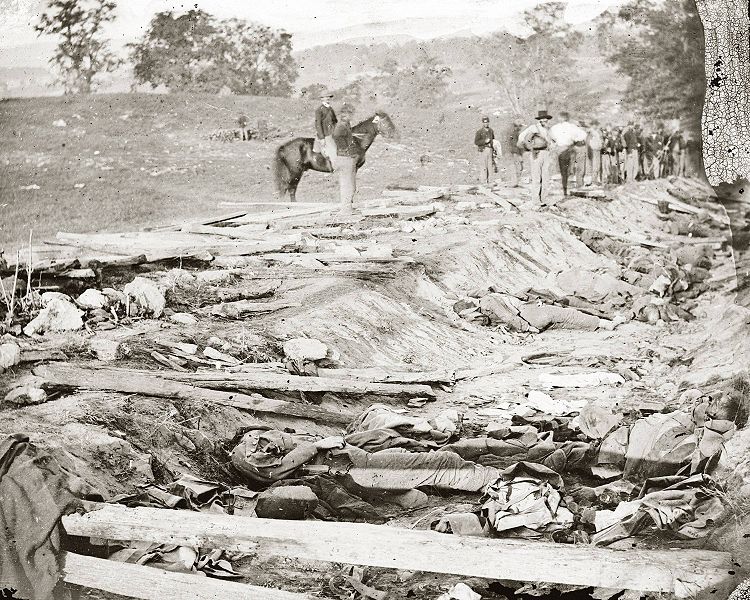
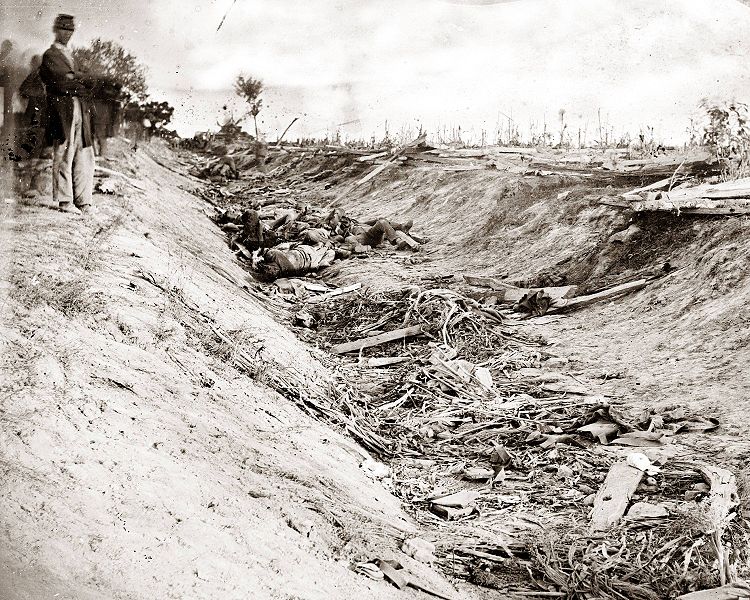
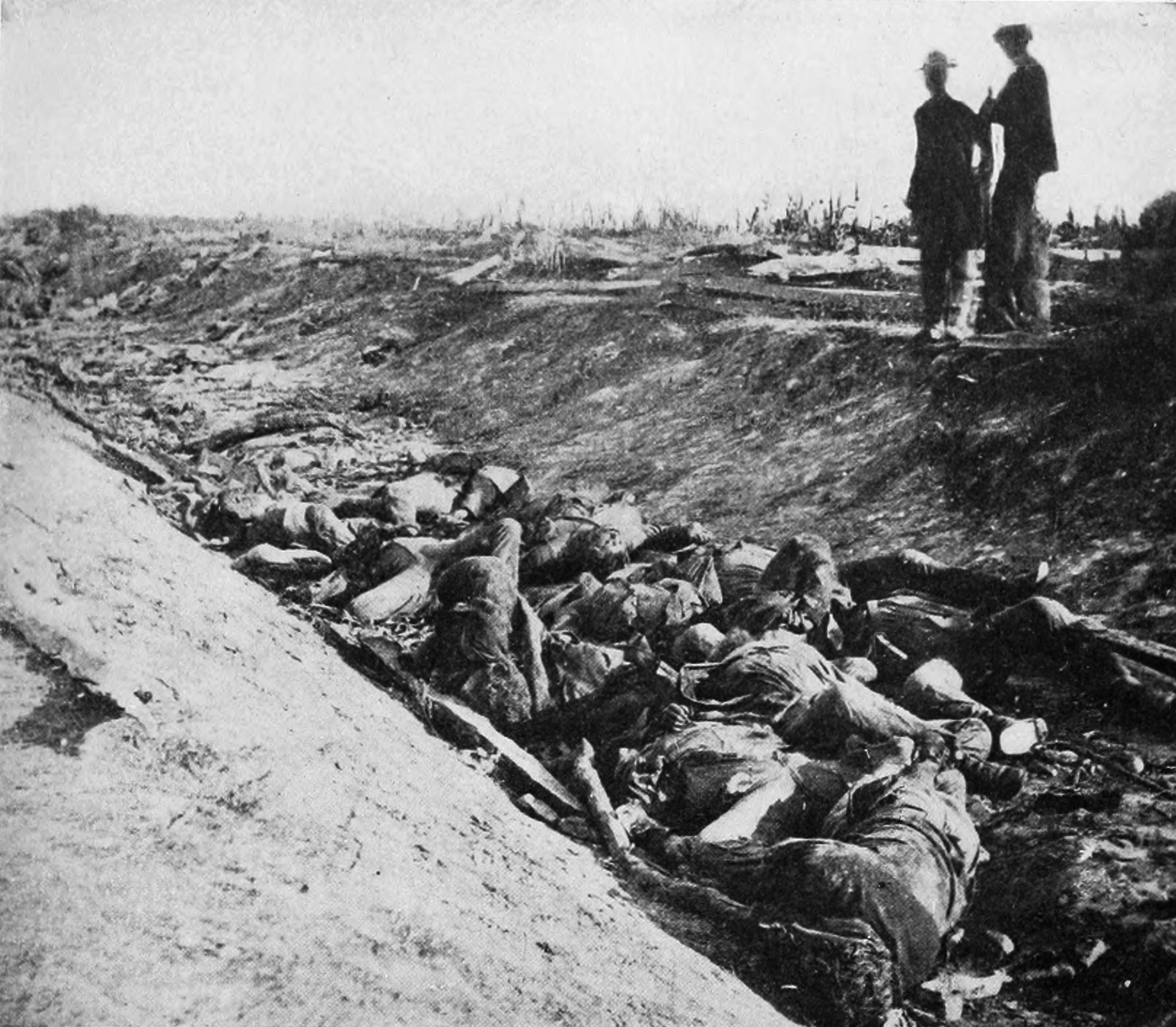
Union burial party

Battle of Antietam – Burnside's Bridge

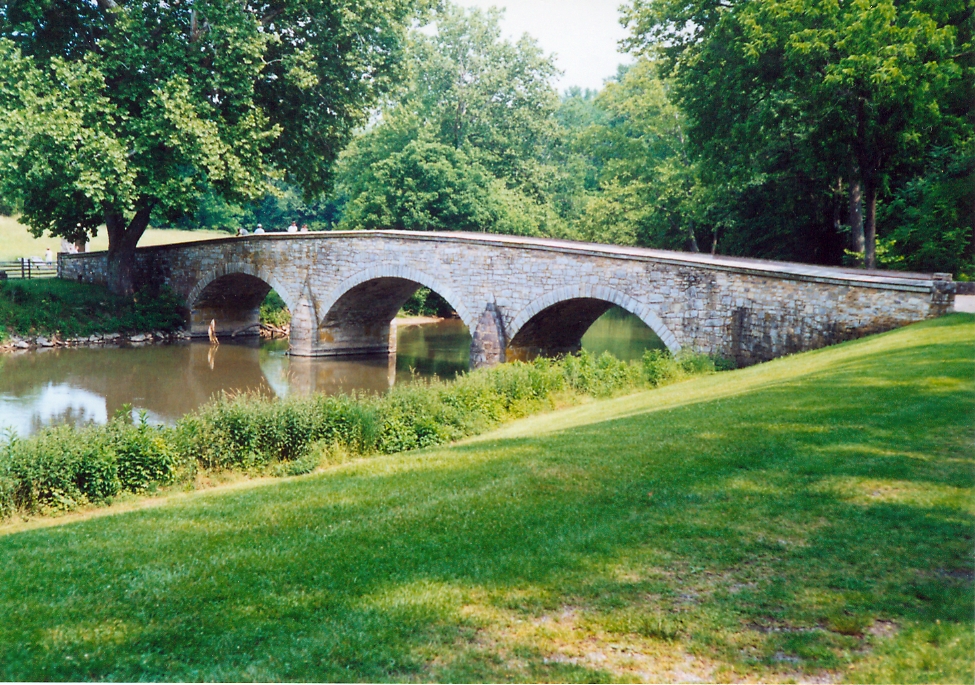
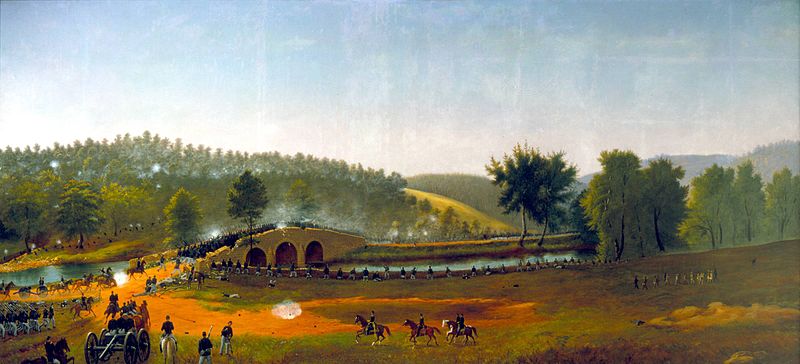
As the fighting around the Sunken Road died down on the Confederate right the battle continued. Burnside had been ordered to make a crossing of the creek and assault the Confederate line. Although he started early in the morning, not a man of his command had crossed the bridge before the battles on the left and center had wound down. Burnside had over 12,000 men and 50 cannon. All the Confederates had to stand up to him on the wide front to the right of D. H. Hill was the division of D. R. Jones. He had only 3,000 men and 12 cannon. All the rest of the troops in the area had been rush to the left to meet the attacks of Hooker, Sumner and Mansfield. The only troops positioned to guard the actual crossing was the 400 man brigade of Richard Toombs. The rest of Jones's force was positioned on Cemetery Ridge to the West. Toombs however held a strong position. At this point 100 foot bluffs rose very close to the creek, creating a good defensive position. Burnside focused his efforts to cross the creek on the lower or Rohrback's bridge, which would later be renamed after Burnside. The road ran along the side of the creek towards the bridge, giving the Confederates amble time to pick off advancing bluecoats. The creek at this point is only 50 feet wide, and there were many places Burnside could have sent his men across without being subjected to the Confederate fire. But while he did send a division down stream to look for a crossing point, he still spent much time and blood attempting to force this bridge. Henry Kyd Douglas, a staff officer for Stonewall Jackson, wrote this:
Since early morning General Ambrose E. Burnside with a crops of 13,000 men had been lying on the opposite side of the Antietam, looking for an opportunity to get across a bridge, which is now - is it sarcasm? - called Burnside's Bridge. Why the bridge? It was no pass of Thermopylae. Go look at it and tell me if you don't think Burnside and his corps might have executed a hop, skip and up and landed on the other side. One thing is certain, they might have waded it that day without getting their waist belts wet in any place.
None the less at 10 am Burnside began sending his troops forward in an attempt to capture the bridge. He planned or the 11th Connecticut to cover the bridge with their fire while a brigade from Ohio under Colonel George Crook would charge across. When the 11th Connecticut was opened on by Toomb's men within 15 minutes they were in retreat, having lost 140 men, a third of their strength. Meanwhile Crook's brigade got lost and never made it to the bridge. The attack was a decided failure. Burnside ordered another attack at 10:45, for the 16th New Hampshire and 2nd Maryland to charge down the road along the creek and across the bridge. One man of the 6th New Hampshire recorded the battle:
The road occupied by our troops came down to the creek nearly three hundred yards below the bridge; thence, turning at right angles, it ran along the bank, with only the narrow stream between it and the enemy's position, and then turned again at right angles to cross the bridge. The opposite bank was a steep, high bluff, covered on its stop and sides with forest trees. Behind these trees, and behind barricades of stone and logs, the rebels were strongly posted, their fire covering every inch of ground over which our troops must march to reach the bridge.
The two regiments were formed in a field below where the road came down to the creek, and some sixty or seventy rods below the bridge. ... They fixed bayonets, and moving at the double-quick, passed through a narrow opening a strong chestnut fence ... and charged in a most gallant manner directly up the road toward the bridge. As the attacking party, led by Colonel Griffin, debouched from the field into the road, the rebels, from their intrenched position, redoubled the fury of their fire, sweeping the head of the column with murderous effect. Of the first hundred men who passed through the opening of the fence, at least nine tenths were either killed or wounded. Such sweeping destruction checked, of course, the advancing column, but the men sheltered themselves behind logs, fences, and whatever other cover they could find, and bravely held the ground already gained.
Burnside had again failed the capture the bridge, the Confederate fire was too heavy for his men. All the time McClelling was sending Burnside messages urging him to attack, such as, "Tell him if it costs 10,000 men he must go now.” Burnside became annoyed by these messages. He snapped at one courier, "McClellan appears to think I am not trying my best to carry this bridge, you are the third or fourth on who has been to me this morning with similar orders."

At around 1 o'clock Burnside sent another attack forward. They had better artillery support, and charged straight down the bluff. With a rush they made it across the bridge, and laid down a fire on the Confederates. Toombs decided that it was time to retreat. His men were running low on ammunition, and his flank was being threatened by a division who were crossing the creek downstream. He fell back, having held back an entire corps for many hours with a few hundred men. They had killed or wounded 500 Yankees, loosing only 160 themselves. After forcing Toombs back, Burnside's attack stalled. He spent two hours moving his troops across the bridge and supplying them with ammunition. Although Burnside did not know it, every minute counted. Lee had no troops with which to reinforce Jones's weak division other than artillery. His only hope was for the arrival of A. P. Hill from Harper's Ferry. Every minute Burnside spent in preparing for his attack was another another minute closer to A. P. Hill's arrival. Burnside finally advanced at 3:15. Greatly outnumbered, Jones's men fought hard. They fired as fast as they could into the advancing Federals. A Union soldier wrote of the charge, saying,
The prospect was far from encouraging, but the order came to get ready for the attempt. Our knapsacks were left on the ground behind us. At the word a rush was made for the fences. The line was so disordered by the time the second fence was passed that we hurried forward to a shallow undulation a few feet ahead, and lay down among the furrows to re-form, doing so by crawling up into line. ... The battery, which at first had not seemed to notice us, now, apprised of its danger, opened fire upon us. We were getting ready now for the charge proper, but were still lying on our faces. Now and then a bullet from them cut the air over our head, but generally they were reserving their fire for that better show which they knew they would get in a few minutes. The battery, however, whose shots at first went over our heads, had depressed its guns so as to shave the surface of the ground. Its fire was beginning to tell. ... The suspense was only for a moment, however, for the order to charge came just after. Whether the regiment was thrown into disorder or not, I never knew. I only remember that as we rose, and started all the fire that had been held back so long was loosed. In a second the air was full of the hiss of bullets and the hurtle of grape-shot. The mental strain was so great that I saw at that moment the singular effect mentioned, I think, in the life of Goethe on a similar occasion - - the whole landscape for an instant turned slightly red.
The Confederates put up a good fight, but they had no chance. They were overlapped on their flank and greatly outnumbered. The Federals pushed on, coming over the ridge, sending fugitives running through the streets of Sharpsburg. Burnside's men were only 1200 yards away from  Finally, not a moment too soon, A. P. Hill's column from Harper's Ferry arrived. Hill had started his march that morning. Ignoring for the day Jackson's standing orders to halt ten minutes out of the hour, he pressed the men on, knowing that worn out men at the right moment would be better than rested men too late. Wearing his customary red battle shirt, he urged on men with his sword who faltered by the way. 2000 of his 5000 men had fallen by the wayside, but the rest arrived just in time. Riding onto the field Hill saw a Lieutenant hiding behind a tree. Riding up to the man, he broke the officers sword over his back. When General Lee met him he embraced him, and said, "General Hill, I was never so glad to see you, you are badly needed, put your force in on the right as fast as they come up."
A. P. Hill
Hill began positioning his brigades as soon as they arrived on the field. At around 4 he moved forward striking the Federals hard in the flank. Many of the men were wearing Federal uniforms captured at Harper's Ferry. The green Federal regiments were the size of Hill's brigades, but they were surprised by his attack. Hill's men struck hard, collapsing through the green regiments and pushing them back with rebel yells. Burnside's troops pulled back to the edge of the bridge, and they stayed there for the rest of the battle.
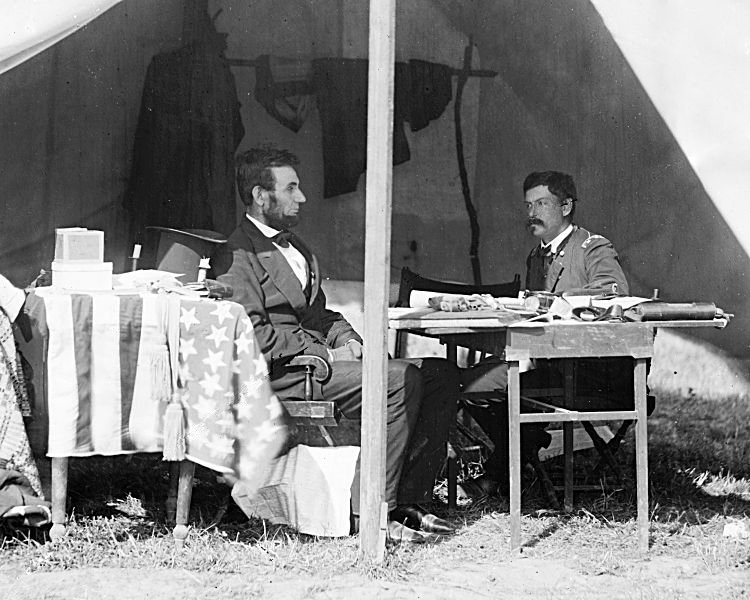
Lincoln meets with McClellan on Antietam Battefield

Battle of Antietam – Bloody Lane

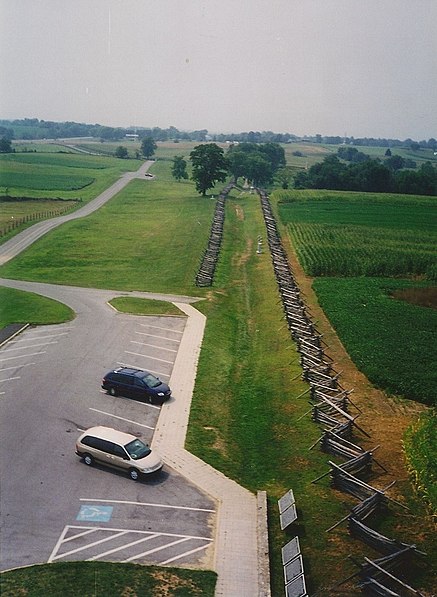
Meanwhile the battle shifted south to the center of the line. Instead of following up on what his men had fought for in the cornfield, McClellan made no efforts to focus his attacks there. Another of Sumner's divisions, under William French, had gotten lost when moving towards disaster and had veered off to the left. There, waiting for them, were D. H. Hill's men. They were in what was called the Sunken Road, or later, Bloody Lane. It was a naturally entrenched position, in which shelter the Confederates could simply meet the Federal attacks. Hill's men had already fought in the defense of the cornfield. But since the battle was now shifting south, they would fight again, this time against different Federals. When French encountered Confederate skirmishers, he eagerly put his men into line for the attack. There was little maneuvering they could make without opening a dangerous whole in the Union line, so they simply charged the road. The attack began around 9:30. As the Federals marched towards the Confederate line, the rebels jeered at them, telling them to go home. "The stillness was literally oppressive,” wrote Colonel John Gordon of the 6th Alabama,
as in close order, with the commander still riding in front, this column of Union infantry moved majestically in the charge. In a few minutes they were within easy range of our rifles, and some of my impatient men asked permission to fire. "Not yet," I replied. "Wait for the order." Soon they were so close that we might have seen the eagles on their buttons; but my brave and eager boys still waited for the order. Now the front rank was within a few rods of where I stood. It would not do to wait another second, and with all my lung power I shouted " Fire !" My rifles flamed and roared in the Federals' faces like a blinding blaze of lightning accompanied by the quick and deadly thunderbolt. The effect was appalling. The entire front line, with few exceptions, went down in the consuming blast. The gallant commander and his horse fell in a heap near where I stood--the horse dead, the rider unhurt. Before his rear lines could recover from the terrific shock, my exultant men were on their feet, devouring them with successive volleys. Even then these stubborn blue lines retreated in fairly good order. My front had been cleared; Lee's centre had been saved; and yet not a drop of blood had been lost by my men. The result, however, of this first effort to penetrate the Confederate centre, did not satisfy the intrepid Union commander.
The Sunken Road from above
French launched several more attacks trying to capture the Sunken Road, but all were failures. Not a man reached the Confederate position. Although he had twice Hill's numbers, French had lost 1,750 men and still could not capture the road. Reinforcements arrived for both sides. Lee decided to send forward his final reserve division under Richard Anderson to join Hill. French was reinforced by the fresh troops of Richardson's divisions. The first attack of an Irish Brigade was unsuccessful, but the next, the fifth brigade to go into the fight, attained more success. Some Federals attained a good position to fire on the Confederate right, and an order was given to bend back the right flank to meet the threat. However, the order was misunderstood, and all of the troops holding the Sunken Road began a retreat. The Confederate situation had been worsened by the loss of several important leaders. Richard Anderson had been wounded soon after arriving on the field, and Colonel Gordon collapsed unconscious after being wounded a fifth time. He may have drowned in his own blood if he had not been for a bullet hole in his cap allowing the blood to drain.
With the Sunken Road abandoned, there was a serious defect in the Confederate line. The Federals had broken through the center, and there was little to oppose their continuing on and rolling up to the right and left. Longstreet was on hand, and he worked desperately with Hill to delay the Federals as long as possible. They found two cannon, but their crew were soon hit by the numerous Federal cannon. So Longstreet's staff dismounted and manned the cannon while Longstreet held their horses. Meanwhile Hill was trying to find any infantry he could lay his hands on. He rallied a few fugitives and created a straggler line, and with this thin line kept the Sunken Road under fire. Hill, watching the Northerners in the road thought that they were about to attack him. Knowing this would be disastrous, he determined to strike first. He asked for volunteers to attempt a charge. None of the men would step forward, until finally one man said he would if Hill would lead them. So grabbing a rifle he set forward with only 200 men. As expected, they made no headway, but for whatever reason the Federals made no movement forward from the Sunken Road. Most of Franklin's fresh corps had arrived, 8,000 soldiers, but Sumner would not let him. Franklin protested, but Sumner told him that they were about to be attacked, and they should not even consider going on the offensive. When a messenger arrived from McClellan with a suggestion to attack, Sumner sent him back saying
Go back, young man, and tell General McClellan I have no command! Tell him my command, Bank's command, and Hooker's command are all cut up and demoralized. Tell him General Franklin has the only organized command on this part of the field!
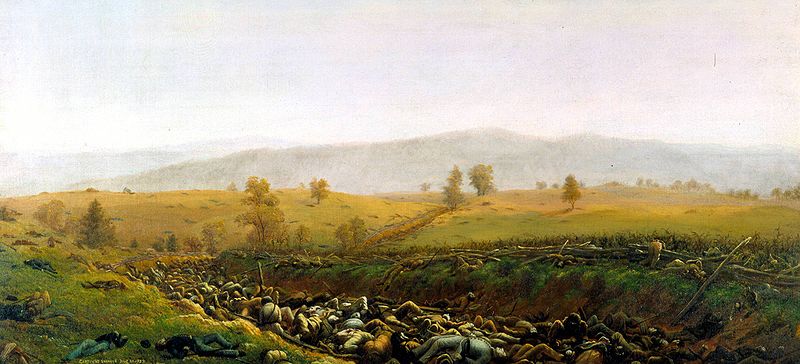
McClellan came from his headquarters himself to make the decision, and he sided with Sumner. He was too cautious to hazard an attack, and decided that they would just have to hold on to what they gained. He did not understand that he still outnumbered the Confederates, and the rebels were just holding on by a thin thread. No more attacks would be made on the left or center. Both sides had paid dearly for the fight over the Sunken Road. 5,600 men from both sides were either killed or wounded. So many Confederates had fallen in the road that it was said you cold walk from one end to the other on the bodies. After the battle it was given the ominous name of Bloody Lane.