head

Thursday, April 12, 2012

Fort Pulaski Captured


150 years ago today, Fort Pulaski, near Savannah, Georgia, surrendered to the Federals. Fort Pulaski was built by the United States before the war to defend the seacoast. It was begun in 1830, and finished fifteen years later. It was named after Casimir Pulaski, who had come over to America from Poland to fight in the Revolution. He served gallantly as a cavalry officer, dieing in the Battle of Savannah, and was granted honorary American citizenship. It was occupied by the Confederates, and for a time Robert E. Lee oversaw the the work on its improvement when he was in command of the southern defenses. It was thought to be impregnable, and the Joseph Totten, US army engineer, said "you might as well bombard the Rocky Mountains." The Federals determined to attack it none the less, as part of their efforts to recapture and close Southern blockade running ports, and to provide a base for the blockading squadron. The Northern advance began in earnest on November 24th, 1861. They began a regular siege of Pulaski, completely surrounding it, building batteries, and preparing a 10,000 man force to storm the walls if necessary.

On the morning of April 10th, 150 years ago yesterday, David Hunter, Union commander, sent a message to the fort's commander, Colonel Olmstead, requesting his surrender. Olmstead replied, “I am here to defend the fort, not to surrender it.” The Federal bombardment opened at 8:00, focusing their fire on the southeast corner, and the Confederate batteries replied. The bombardment continued throughout the day. The Federal fire was from rifled guns and mortars. Rifled guns, with their longer range and greater accuracy, were a rather new innovation in siege warfare. The fire from these guns were very effective. By nightfall a breach was beginning in the wall, and many of the Confederate guns were damaged.

The firing was resumed at 7:00 on the morning of April 11th, 150 years ago today. Olmstead rose the white flag over the fort at 2 PM. A large breach had been made in the walls, exposing the powder magazine. If the battle had continued much longer, the Union shots would have hit the magazine, resulting in a catastrophic explosion, probably demolishing the fort.

The Federals had built splinter-proof shelters which worked very well. Although the Confederate fire was fairly accurate, they only inflicted 1 killed and a handful wounded. The Confederates casualties were not very high either, but all of the approximately 400 men of the garrison of the fort were surrendered, as well has many guns.

The mortars were found to be not useful in destroying the structure of the fort, although they could be effective in destroying the troop's morale. Only 10% of the mortar shots hit the fort. The rifled guns however were very satisfactory. It was found that they could easily destroy a brick fort at 2,500 yards. The success of the rifled artillery was very surprising to the commanders on both sides. The Federals had spent many months in preparations that were completely unnecessary, and the Confederates expected that the fort could hold out until they ran out of provisions.

Union general David Hunter said,
"The result of this bombardment must cause, I am convinced, a change in the construction of fortifications as radical as that forshadowed in naval architecture by the conflict between the Monitor and Merrimac. No works of stone or brick can resist the impact of rifled artillery of heavy caliber."
As Hunter, guess, rifled artillery would revolutionize fort design. After the Civil War, forts were no longer built of brick, instead earthworks were used.

Although Savannah would not fall until many months later when Sherman captured it at the conclusion of the March to the Sea, the capture of Fort Pulaski made the harbor useless to the Confederacy. The South had lost the use of an important port for blockade running, and the North had gained a base to continuing their blockade of the rest of the forts.

Monday, April 9, 2012

Battle of Fallen Timbers

The day after the bloody battle of Shiloh, 150 years ago today, Grant sent Sherman forward to pursue the Confederates. He brought along two brigades of infantry and a few cavalry troopers, and Wood's division from Buell. Six miles from Pittsburg Landing, they encountered 350 Confederate cavalry under Nathan Bedford Forrest. Sherman sent infantry skirmishers through a 200 yard section of road covered by Fallen Timbers, from which the skirmish would take its name. Forrest ordered his troops forward, and they charged the Union skirmishers. They surprised the Yankees, cutting and slashing their way forward. This was Forrest's method of tactics. He knew little of traditional warfare, but developed his own methods that were very successful. His men riding through the disorganized Federals, captured 43 men, and almost Sherman himself. However, he suddenly stumbled upon the main body of Union infantry. The Confederates pulled up their horses, but Forrest kept riding, unaware of his men's halt. Ploughing into the Federal line, he soon realized he was all alone. He hacked and slashed the Federals with his pistol and saber as they tried to pull him down from his horse. Finally breaking free, he grabbed a soldier by the collar and rode back to his men, holding the Northerner behind him as a shield from bullets. He made it back to his amazed troopers, and it was found that he was seriously wounded with a bullet in his spine. He survived his wound and would continued to fight the Federals throughout the war. Sherman did not continue his pursuit much further, and he allowed Beauregard to return to Corinth, Mississippi without serious pursuit.

Saturday, April 7, 2012

Battle of Shiloh, Day 2

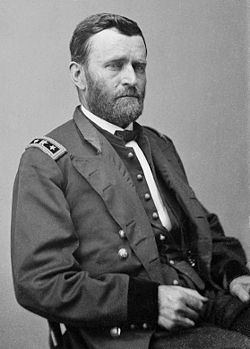
Grant
The day before, Grant's army at Shiloh, Tennessee had been struck by Beauregard and Johnston. His lines had been pushed back, but through the brave defense of Prentiss's division, he had not been dealt a fatal blow. Grant was optimistic about his situation, as Buell's army was on the way, "They can't force our lines around these batteries tonight. It is too late. Delay counts everything with us. Tomorrow we shall attack them with fresh troops and drive them, of course."

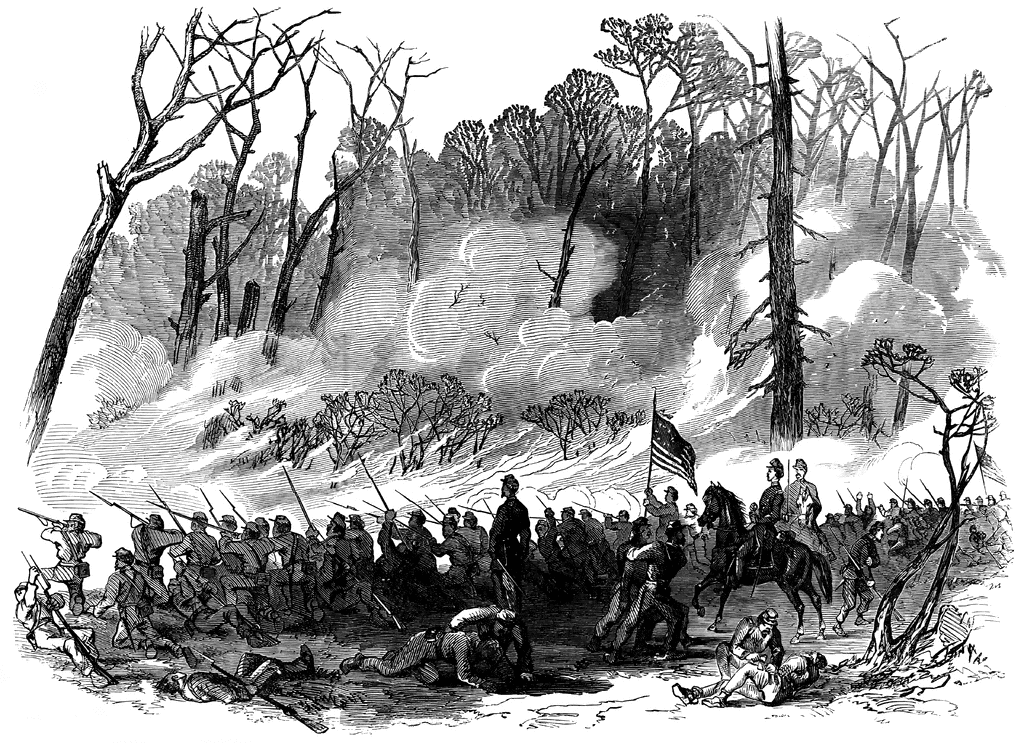
At 7:00 on April 7th, 150 years ago today, Grant and Buell advanced against the Confederate lines. The Confederates were surprised by this. They thought the Yankees were disorganized from the beating they had taken the day before, and were not prepared for an offensive. They gave ground rapidly, but as they approached the Peace Orchard and Shiloh church their resistance stiffened. Beauregard worked to get the Confederate line in order. He put Hardee on the right, then Breckinridge, Polk and Bragg. As Johnston had done the day before, he rode the lines, trying to inspire the men with his personal example.

Although the Confederates were no longer being driven back, they were barely holding on, and it was clear they could make no serious counter attacks. They were tired and greatly outnumbered. Beauregard's chief of staff asked him this, "General, do you not think our troops are very much in the condition of a lump of sugar thoroughly soaked in water - preserving its original shape, though ready to dissolve? Would it not be judicious to get away with what we have?" "I intend to withdraw in a few moments" Beauregard replied. He sent out orders, and a retrograde movement began. The retreat was managed very well. They did not panic, and took time to gather up the captured supplies and weapons. By 4:00 they were in retreat, with Breckinridge remaining as a rear-guard.
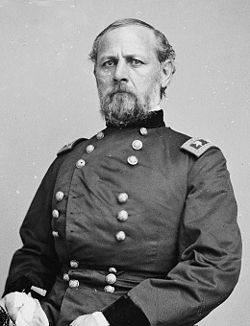
Buell

Grant did not pursue that day. The battle of Shiloh was over. The losses on both sides had been tremendous. The Union had lost 1754 killed, 8408 wounded, 2885 captured, just over 13,000 total. Confederates had 1723 killed, 8012 wounded, 959 missing, for a total of 10,600. One out of four of the 100,000 men who had entered this battle had been killed, wounded or captured. This was an incredibly costly battle. In two days about the same number of men had been lost as in the War for Independence, War of 1812, and Mexican War combined. And after all these deaths, the armies returned to the positions from which they had started, with nothing changed except the loss of many of their comrades. Both sides had proved that they could stand up and fight like professional soldiers. It had been shown in the West, like the East, that the War would be not over soon. It would be a long, drawn out struggle.
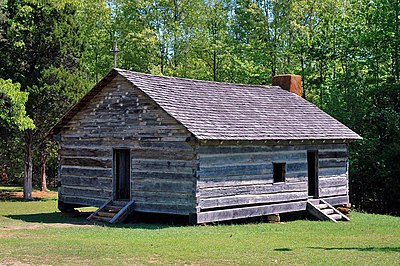
Shiloh Church, Confederate Headquarters

Grant later wrote this:
"Up to the battle of Shiloh I, as well as thousands of other citizens, believed that the rebellion against the Government would collapse suddenly and soon, if a decisive victory could be gained over any of its armies. Donelson and Henry were such victories. An army of more than 21,000 men was captured or destroyed. Bowling Green, Columbus and Hickman, Kentucky, fell in consequence, and Clarksville and Nashville, Tennessee, the last two with an immense amount of stores, also fell into our hands. The Tennessee and Cumberland rivers, from their mouths to the head of navigation, were secured. But when Confederate armies were collected which not only attempted to hold a line farther south, from Memphis to Chattanooga, Knoxville and on to the Atlantic, but assumed the offensive and made such a gallant effort to regain what had been lost, then, indeed, I gave up all idea of saving the Union except by complete conquest."
Both sides claimed victory, but the North was the real victor as they had beaten back the Confederate attacks. The Confederates had been closed to victory. If they had not lost a few days on the march to Shiloh, they may have been able to finish off Grant before Buell arrived. Grant and Sherman made serious mistakes. Sherman did not investigate the rumors of a force in the front, allowing Grant to be surprised. Many politicians wanted Lincoln to remove Grant, saying all he did was get men killed, and only won because others got him out of trouble. There were many rumors that Grant continued his habit of drunkenness that had gotten him dismissed from the army before the war. But reportedly when some politicians asked that he be removed because of it, Lincoln refused saying, "Well you needn't waste your time getting proof; you just find out, to oblige me, what brand of whiskey Grant drinks, because I want to sent a barrel of it to each one of my generals." Lincoln recognized that Grant had is problems, but he valued the fact that he moved quickly and got things done.

Friday, April 6, 2012

Battle of Shiloh - Day 1


At 6:00 am Albert Sydney Johnston's army was deployed to attack Grant at Pittsburg Landing, near the small country church of Shiloh, from which the battle would take its name. P. G. T. Beauregard was for retreating back to Corinth, Mississippi since he was certain that Grant had been alerted of their presence. He rode over to Johnston's headquarters to attempt to chance his mind. But as they were talking, they heard the sound of musketry from the front lines. Johnston, rising to mount his horse, said, "The battle has opened, gentlemen. It is too late to change our dispositions. Tonight we will water our horses in the Tennessee River."

Surprisingly, Beauregard was wrong. The Confederate attack had achieved almost complete surprise. One Colonel reported to Sherman that there were troops in his front. Sherman however disregarded the report, "Beauregard is not such a fool as to leave his base of operations and attack us in ours. There is no enemy nearer than Corinth." However, now, this morning, Sherman's lines were being over run. With rebel yells, the Southerners achieved complete surprise, throwing back the Federals. However, the Northerners were veterans. The men of Sherman, Prentiss and McClernand formed along a ridge and opened a destructive fire on the advancing rebels. Beauregard established his headquarters at the Shiloh church, the Hebrew name for peace. From here Beauregard managed the battle from the rear, while Johnston rode along the front lines, encouraging the men. The Confederate assault soon stalled. The men scattered through the Federal camps, eating the hot breakfasts that the Federals were in the act of eating when they were driven off. The confusion of battle had displaced the corps lines which looked neat on paper.

On the far right of the Confederate line they encountered strong Union resistance around a 10 acre peace orchard. A heavy line of blue infantry beat back several Confederate brigades. Johnston arrived on the scene, and seeing the situation, said, "Men! they are stubborn; we must use the bayonet. I will lead you!" Standing up in his stirrups he led another attack forward against the line. Rushing behind him, the Confederate troops crushed through the Union defenses.
Johnston

Riding out of the newly captured orchard, Johnston was elated at his victory. His coat was cut with bullets and a boot sole was cut in half, but he appeared unharmed. However, suddenly he began reeling in his saddle. The only staff officer with him was Governor Isham Harris of Tennessee, who had volunteered as an aide during for the battle. The governor asked if the general was hurt, and Johnston replied, "Yes, and I fear seriously." Laying him down on the ground, Harris soon found his wound. An bullet had cut an artery in his leg, and his boot was filled with blood. Harris did not know how to make a tourniquet, so he had to find a doctor. However, before the doctor could arrive, Johnston had bled to death. He died around 2:30 pm.


The fighting continued all along the Confederate line. In the center it was focused on a position called the Hornet's Nest, an open field bordered by a fence and a Sunken Road. From that road the Federals beat back wave after wave of gray attackers. However, with the capture of the Peach Orchard, there was a lull in the fighting as the Confederate shuffled their forces. The were able to get around the flank of the soldiers in the road, and 62 cannon were brought up to pour canister into the Yankee lines. When these guns opened, the Federal troops bent back in the face of the hard pressure. Wallace and Hurlbut's divisions broke towards the rear, only Prentiss's men remain firm. Surrounded on all sides, Prentiss continued to hold out. Finally at 5:30, after two hours of fierce fighting, Prentiss realized that further fighting was useless and surrendered his men, half of whom had been lost in the fighting. Although he had lost his command, Prentiss may have saved Grant.
Benjamin Prentiss

Beauregard and his army had done well today. Although they had lost their commander and many other brave soldiers, they had surprised Grant and driven his lines back, capturing dozens of cannon and his entire division. Beauregard decided to delay the attacks until the next morning. However, not everyone agreed with him. There was the danger that Buell's army might arrive during the night, giving Grant fresh troops to use the next day. Nathan Bedford Forrest had seen Buell's men arriving during the next at Pittsburg Landing. While the soldiers were trying to sleep in the falling rain, Forrest searched for Beauregard, urging every general he could find to launch a night attack before the new troops could be positioned. However, he never found Beauregard no one else would do it, so he gave up, convinced that the Confederates would be whipped the next morning.

Thursday, April 5, 2012

The Armies Move to Shiloh


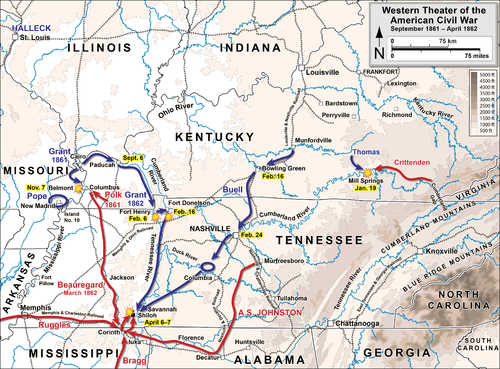
After Grant captured Forts Henry and Donelson, the Confederate position in the west quickly crumbled. Albert Sydney Johnston, the Confederate commander, found his thin line falling apart. His men were panicked, so he abandoned Nashville and headed south. Johnston and P. G. T. Beauregard collected the disorganized remnants of his forces at Corinth, Mississippi. The government in Richmond gave him every man they could spare, stripping men from the coastal defenses. Johnston's army grew to the size of 55,000, the largest army assembled by the South to that point in time. On the Northern side, Henry Halleck was rewarded for Grant's victories and Buell's Army of the Ohio was placed under his command. He ordered Buell to join Grant's Army of the Tennessee at Pittsburg landing, so that Grant would not be outnumbered by the large force Johnston was building. Grant had 43,000 men in six divisions, but he would soon be joined by Buell's 30,000.
A. S. Johnston

Johnston intended to strike before Buell arrived. Although he had the greater numbers, Grant's men were veterans while many of Johnston's had never fired a shot. He hoped to overcome this with a surprise attack. Grant was surrounded by marshes with a river to his back, and Johnston and Beauregard hoped to overpower him before he could make a resistance. The Confederates set out on the morning of April 3rd, at the insistence of Beauregard and Braxton Bragg, a Corp commander and Chief of Staff. However, the march was much slower than expected. They only marched 9 of the 20 miles which had been planned. They were not in position to attack until the evening of April 5th, 150 years ago today. Beauregard was for retiring, as he thought they had lost the element of surprise since the troops had been within earshot of the Federals for hours, practicing their shooting and rebel yells. However, Johnston, Polk and Bragg thought that the troops would be demoralized by retreating at that moment, so it was decided to continue with the attack the next morning. Johnston had issued this general order to his army:
"Soldiers of the Army of the Mississippi: I have put you in motion to offer battle to the invaders of your country. With the resolution and disciplined valor becoming men fighting, as you are, for all worth living or dying for, you can but march to a decisive victory over the agrarian mercenaries sent to despoil you of your liberties, property and honor. Remember the precious stake involved, remember the dependence of your mothers, your wives, your sisters and your children on the result; remember the land; broad and abounding and the happy homes and the eyes that would be desolated by your defeat. The eyes and hopes of eight millions of people rest upon you; you are expected to show yourselves worthy of your race and lineage --- worthy of the women of the South, whose noble devotion in this war has never been exceeded in any time. With such incentives to brave deeds, and with the trust that God is with us, your general will lead you confidently to the combat --- assured of success. A. S. Johnston."
Braxton Bragg

Wednesday, March 28, 2012

Battle of Glorieta Pass

Glorieta Pass
In New Mexico, after winning the battle of Valverde Ford, the Confederates continued north capturing Albuquerque and Santa Fe, leaving Colonel Canby in possession of Fort Craig in the Confederate rear. Brigadier General Sibley, Confederate commander, sent a force of 200-300 Texas soldiers under Major Charles Pyron and William Scurry to Glorieta Pass, an important position along the Santa Fe Trail. There met Union forces under Colonel John Slough with infantry from Colorado and detachments from the US regular cavalry. On March 26th skirmishing took place around Apache Canyon, at one end of the pass, ending in a small defeat for the Southerners. Reinforcements arrived for both sides, bringing the totals up to 1,300 Federals and 1,100 Confederates.


Both sides set out to attack on the morning of March 28th. Slough, the Federal commander, sent out a force to hit the Confederate flank. Unexpectedly, the Confederates attacked at 11:00 am, and after holding their ground for an hour the Federals fell back to another position strengthened by artillery posted on a hill. Scurry attacked all along the line, and the attacks held off by the Federals, and fierce fighting occurred along the line. Finally at 3:00 pm the Confederates successfully got around the Union right flank, and from what was later known as Sharpshooters Ridge, shot down the Federal cannoneers and soldiers. Their flank having been turned, the Federals fell back again, and were driven from a new position as the Confederates continued to press them. By the end of the day the Confederates remained in control of the field.


However, the Federal flanking party which Slough had sent out early in the day had happened upon the Confederate supplies. They burned the wagons and disabled the cannon, and returned to the main Federal force. So although the Confederates remained in control of the field and were the nominal victors, the destruction of their supplies meant that they could not advance further through the barren country. The Confederates fell back to Santa Fe, and eventually all the way to Texas. All of Sibley's grand plans for the capture of the American west fell apart for the simple lack of supplies. Never again would the Confederates seriously threaten New Mexico Territory.

Friday, March 23, 2012

Battle of Kernstown

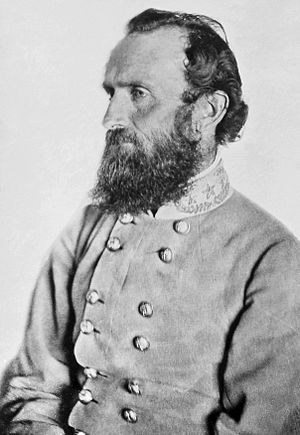
Jackson
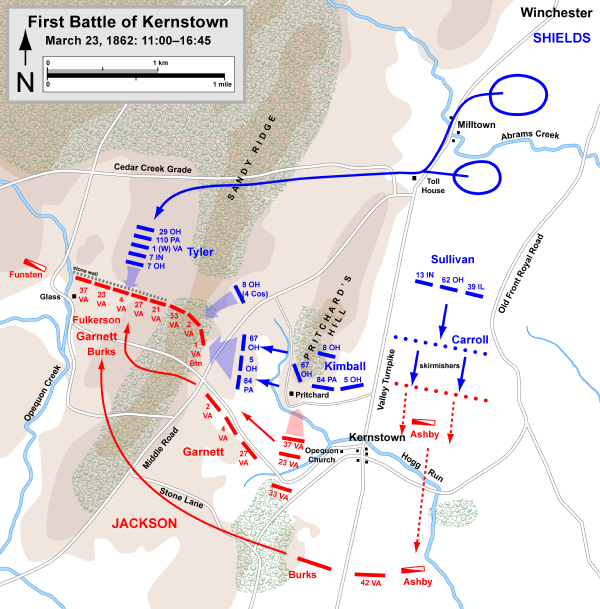
 150 years ago today the Battle of Kernstown was fought, marking the beginning of Stonewall Jackson's Shenandoah Valley Campaign, which would be one of the most famous campaigns in the Civil War. General Thomas “Stonewall” Jackson, who had gained fame at Manassas, had been placed with 4,000 men in the Shenandoah Valley of Virginia to guard it against a federal invasion. General Nathaniel Banks was sent to defeat him with 20,000. Jackson was the left flank of the Confederate army under Joseph E. Johnston. When Johnston retreated from Manassas, Jackson was ordered to keep federal troops in the valley without fighting a battle to prevent them from reinforcing McClellan who was attacking Richmond. Jackson kept a watch on Banks and his cavalry commander, Turner Ashby, reported on March 21st that Banks was moving North with virtually all his troops. While Banks was moving, it was only half of his troops he was sending to McClellan. However, Jackson, acting on the incorrect information, decided to attack Banks to prevent him from going to McClellan. By this time Jackson was down to 3,500 men, Banks, 8,500, commanded by Colonel Nathan Kimball.

Ashby opened the battle at 9:00 am. When Kimball moved his troops south, he saw the great strength of Pritchard's Hill, and placed 12 batteries of artillery there. After skirmishing with Ashby for 1 ½ hours, the Confederates fell back and reported to Jackson more forces would be required. Jackson came up with his men, and saw that Pritchard's Hill was key to the position. So putting his men in line, he decided to try to capture the hill by attacking it with two brigades. However, the Federal artillery broke the ranks of the assistants, defeating their attack. Jackson decided to instead try to flank the hill on the Confederate left by capturing Sandy Ridge, which was 100 feet higher. After an artillery bombardment, Jackson sent his men forward. Kimball reinforced the men on Sandy Ridge with a brigade under Colonel Erastus B. Tyler. When Tyler's men reached the ridge, they encountered just one regiment of Confederates behind a stone wall. He ordered his men to charge, without even moving into line of battle. The Confederate volleys broke the formation, and sent the men on their stomachs to escape the Confederate fire. However, the pressure of numbers soon began to toll, but another Confederate regiment came up at just the right time to stabilize the line. The line along the wall continued to be reinforced, and by 4:30 pm it was clear to Kimball that Tyler's brigade would not be able to break the Confederate line. He decided to send in three regiments of troops that had been guarding the artillery on Pritchard's Hill. They hit the Confederate right flank on Sandy Ridge, at right angles to the stone wall. A Federal soldier remembered this:
We were soon at the top-when a scene presented itself that I never will forget. Immediately in front of our whole lines, at a distance of perhaps 80 or 90 yards, was a long wreath of blue smoke settled over a low stone wall – out of this a fire flashed constantly. Between our line and this wall the dead and wounded lay in heaps, while clustered around the starts and stripes, a few heroic blue jackets still fought desperately-some standing, some kneeling, and other lying at full length; but all apparently determined to die right there.

The Union regiments charged and gained a foothold on Sandy Ridge, although they did not break the Confederate line. By this time it was 6:00. The Confederates had suffered heavy casualties and were running out of ammunition. Some soldiers decided to cease fighting and retreat. Jackson met one of these men going to the rear.
One of our company in going to the rear was encountered by General Jackson who inquired where he was going. He answered, that he had shot all his ammunition away, and did not know where to get more. Old Stonewall rose in his stirrups, and gave the command, "Then go back and give them the bayonet," and rode off to the front.
Soon it was not just a few privates that were retreating. Richard Garnett, commander of the Stonewall Brigade on Sandy Ridge, decided of his own accord to retreat without consulting Jackson. He was being attacked on the flank and was out of ammunition. With the Stonewall Brigade gone, the rest of the Confederates on the field soon followed their example. By this time it was getting dark, and a Federal pursuit was unable to catch Jackson while retreating.
Stone wall on Sandy Ridge
 In this battle the Union lost 181 killed, 389 wounded and 4 missing, 8% of their force. The Confederate suffered 139 killed, 312 wounded, 253 captured and 33 missing, 22% of their force. Jackson blamed his defeat on Garnett, and demanded a court-marshal. This trial was never completed because of the battles in quick succession, and Garnett's death in Pickett's charge at Gettysburg. However, it seems likely that Garnett would have been pronounced innocent. Perhaps the real cause for the defeat could be assigned to other factors. Jackson had attacked because of false information, his troops did not have enough ammunition and were tired from long marches. The Confederates were often uncoordinated, and Jackson was sending reinforcements up from the rear instead of leading the battle in the front. Although the Confederates were defeated, it was a strategic victory. The government in Washington feared that Jackson was being reinforced and was planning to attack Washington, so Banks was given 35,000 more men, men which McClellan said he needed for his attack on Richmond.

Pitchard's Hill
Rise in Sandy Ridge
For more resources on the Battle of Kernstown or other battles in the Shenandoah Valley Campaign, get our MP3 CD tour on Jackson's Valley Campaign of 1862.