After his
unsuccessful attacks on May 6, Grant decided that further efforts on
this front would be useless. The Confederates had dug strong
entrenchments, and he did not want to attack them. Instead, he
decided to try to march around Lee's right. Moving down the Brock
Road towards Spotsylavnia Court House, he hoped to get his men
between Lee and Richmond, forcing the Confederates to fight on ground
favorable to the Federals.
Movement to Spotsylvania
As the Union
troops began their march, many believed that Grant was retreating
just like all the other failed army commanders before him. But when
they turned towards Spotsylania, they were disabused of that idea.
“Instantly all of us heard a sigh of relief,” wrote one infantry
man. “We marched free. The men began to sing. The enlisted men
understood the flanking movement.” Grant would not turn back.
Although he had been unable to crush Lee's army, there would be no
turning back.
Unburied bones in the Wilderness
In this battle,
the Federals reported 2,246 killed, 12,037 wounded and 3,383
captured, totaling 17,666. These numbers were likely low, as high
casualty numbers were bad for public opinion on the home front. The
Confederates lost about 11,000 men. Although Grant's losses were much
higher, he could better afford to loose them. The Confederate supply
of manpower was nearly exhausted, and they had little opportunity to
raise more troops. A few more victories like this one, and Lee's army
would be destroyed.
On the other side
of the field there was only desultory fighting throughout the day.
However one Confederate commander, John B. Gordon, had a plan to
strike the Federal forces. He scouted around the Union right flank
and found it unguarded. Confederates could move undetected and roll
up the Union right, as Longstreet as their left. He presented this
plan to Ewell, who did not approve it for most of the day because of
reports of a force that could strike Gordon in the rear.
The Wilderness
Finally just
before sunset the plan was approved. Gordon set out on his march with
his own and two other brigades, totaling around 4,000 men. They
silently deployed and then charged. The Federals were completely
surprised. The two flank brigades were completely unprepared and were
driven into headlong retreat. But this was all Gordon could
accomplish. It was nearly impossible to keep an attack organized in
the woods, especially at night. By the time another attack was made
it was 10 pm, and the Federals were able repulse it. Gordon believed
that the delay in implementing his plan prevented a complete
Confederate victory on that day:
[H]ad [the attack] been made at an early hour in the day instead of at sundown, the 6th of May would have ended in the crushing defeat of General Grant's army.
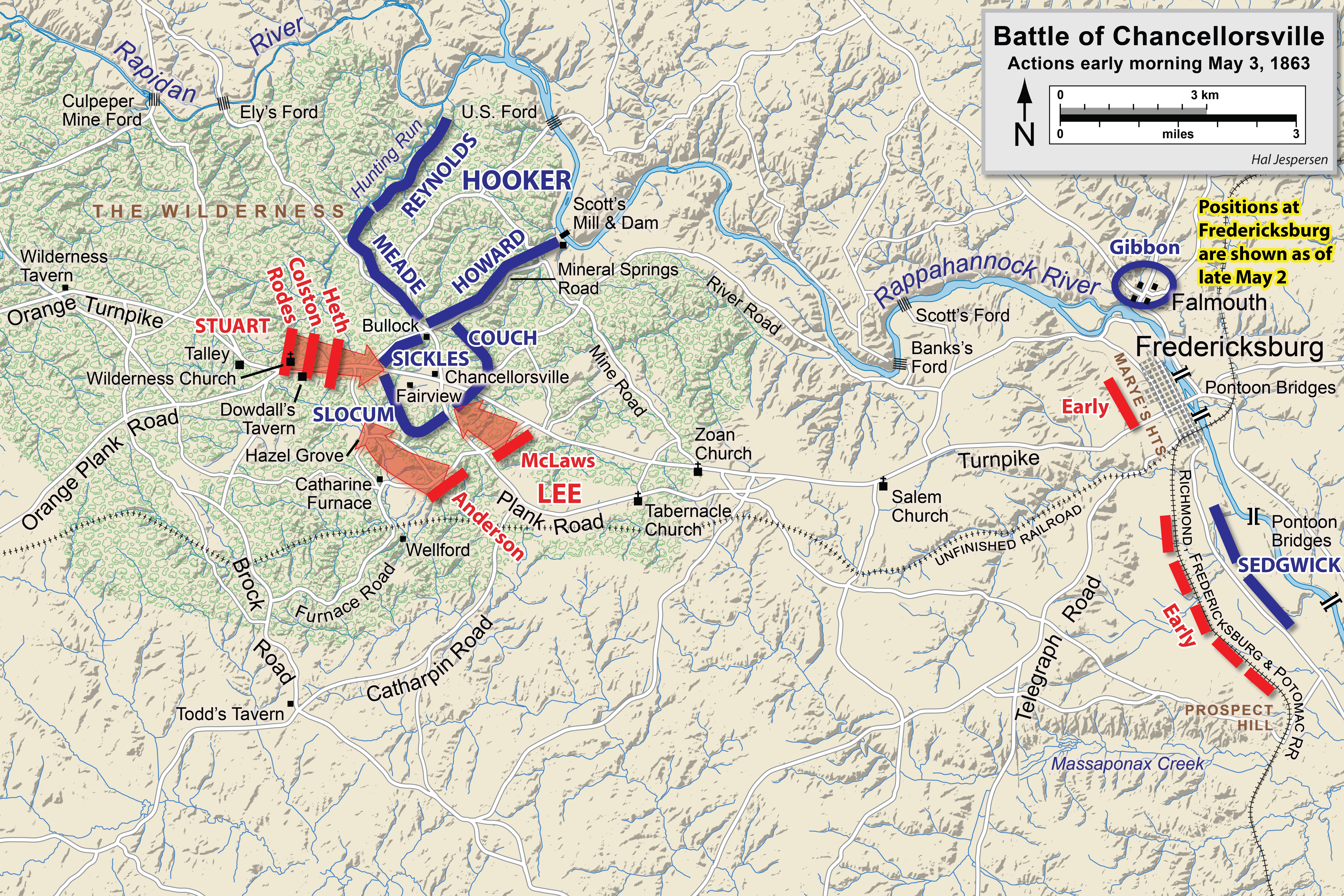
Although Howard's XI Corps of the Union army had been destroyed on May 2, Hooker still had many more men than Lee for the fighting the next day. He also had the better position, with Sickles holding the high ground at Hazel Grove that separated Stuart and Lee. From there his line curved back like a horseshoe, with each side anchored on a river, the right on the Rapidan and the left on the Rappohannock. There would be no more flanking today.
But Hooker did not recognize the importance of the position he held. He ordered Sickles to abandon Hazel Grove and fall back to the Plank Road. Sickles protested, but Hooker believed that it had to be done to simply the defense. Once Sickles fell back, the Confederates occupied Hazel Grove. It proved not only an opportunity to reunite the Confederate army, but also the key to the entire battlefield. Confederate artillery commander Col. E. Porter Alexander had spotted the site during the night and was ready to occupy it as soon as Sickles fell back. Over the winter Alexander had reorganized the Confederate artillery into battalions, and this centralized system allowed guns to be brought up quickly to man the valuable position. The Confederate cannons placed at Hazel Grove soon opened on the Union artillery position at Fairview, 1200 yards distant. 30 cannons converged with 54 elsewhere on the line, creating a very destructive fire. Some have called it the Army of Northern Virginia's best artillery position in the war, and Hooker had given it up without a fight.
Confederates attack Hazel Grove
With the powerful support of this artillery Stuart began his attack. His three divisions pushed in three lines through the woods, along side the field running between Fairview and Hazel Grove. He had abandoned the idea of cutting the Federals off from the river fords, as Meade's corps had been positioned to block the way. The first two divisions, those of Heth and Colston, met hard resistance by the Federal troops. J.E.B. Stuart rode along his lines, encouraging the men. As usual, he was in very showy apparel, wearing a brand new uniform, cape and plumed hat. He looked the ideal caviler. As he rode he sang a favorite song:
Ol' Joe Hooker, won't you come out of The Wilderness?
Come out of The Wilderness, come out of The Wilderness?
Ol' Joe Hooker, won't you come out of The Wilderness?
Bully boys, hey! Bully boys, ho!
Finally the Federal lines broke under a charge by the last division, that of Rhodes, combined with the effects of the tremendous bombardment. The victorious Confederates plunged forward with shouts of "Remember Jackson!"
It was at this moment, in the height of the battle, that the most important casualty of that day of fighting occurred – Joe Hooker himself. The Chancellor house, for which the battle would be named, was being used as Hooker's headquarters as well as a field hospital. The Confederate artillery pieces began throwing their shells into the area to disrupt Union communications and supplies. Just after 9:00 Hooker was standing on the porch of a house when a solid Confederate cannonball struck the pillar on which he was leaning, knocking him to the ground and throwing splinters everywhere. His staff put him down on a blanket and gave him some brandy. Eventually he felt well enough to stand up. Just as he did that another ball flew into the area and struck the blanket on which he had just been lying, demonstrating that this was no place for the commander of the army. Riding off, Hooker soon sent a message to summon Darius Courch. He turned over the command, as he had been badly shaken by the shock. Hooker said, "Couch, I turn the command of the army over to you. You will withdraw it and place it in the position designated on this map."
But even as he turned over the command, he gave Couch orders which Couch disagreed with. The army's new commander wanted to try to continue to hold the ground they still had. But Hooker had made up his mind to abandon the field, and there was little anyone else could do about it.
Lee cheered by his men
As the advancing Confederates reached the Chancellor House, the two corps of the army were reunited. One Confederate staff officer remembered the moment:
The scene can never be effaced from the minds of those that witnessed it. The troops were pressing forward with all the ardor and enthusiasm of combat. The white smoke of musketry fringed the front of battle, while the artillery on the hills in rear shook the earth with its thunder and filled the air with the wild shrieking of the shells that plunged into the masses of the retreating foe. To add greater horror and sublimity to the scene, the Chancellorsville House and the woods surrounding it were wrapped in flames. It was then that General Lee rode to the front of his advancing battalions. His presence was the signal for one of those uncontrollable bursts of enthusiasm which none can appreciate who has not witnessed them. The fierce soldiers, with their faces blackened with the smoke of battle, the wounded crawling with feeble limbs from the fury of the devouring flames, all seemed possessed with a common impulse. One long unbroken cheer, in which the feeble cry of those who lay helpless on the earth blended with the strong voices of those who still fought, rose high above the roar of battle and hailed the presence of a victorious chief. He sat in the full realization of all that soldiers dream of—triumph; and as I looked at him in the complete fruition of the success which his genius, courage, and confidence in his army had won, I thought that it must have been from some such scene that men in ancient days ascended to the dignity of gods.
The Southerners continued to press forward, routing the in some places and almost catching Howard's XI Corps in the flank as they had done the day before.
Sedgwick breaks through on May 3rd
A great victory had been won. The only thing preventing Lee from following up on it was news from Fredericksburg. Early had been left to watch the large Union force there under Sedgwick. This morning Sedgwick had advanced. Early had beaten back two attacks on Marye's Heights had been done at Fredericksburg in December, but a truce was called to remove casualties and the Federals saw how empty the Confederate position was. A third attack was launched and this one was successful. Early, obeying orders, retreated as slowly as possible. Lee had to delay a further attack on Hooker to shift troops to meet this threat.
Riding past the Confederate line, Jackson, A. P. Hill and their
staffs heard Federals up ahead around Fairview and Chancellorsville
cutting down trees for breastworks. After he listened to the sounds
for a time, Jackson turned around to ride back to the safety of the
southern lines. But then a volley of musketry crashed from the
Confederate lines through the dark woods. Seeing the horsemen ahead
and thinking they were from a Pennsylvania cavalry regiment that had
just been sighted, a jumpy Confederate officer had ordered his men to
open fire. Many bullets hit their marks. The road was filled with
dying horses and men. Hill yelled out to the men to cease fire, as
they were friends. "Who gave that order?" the Confederate
officer shouted, "It's a lie! Pour it into them, boys!"
The Plank Road, near where Jackson was shot
The Confederate soldiers reloaded and fired again, and the
Confederate officers continued to fall. Stonewall Jackson was hit
with three of the smoothbore bullets, two in the left arm and a third
in his right palm. His horse, spooked by the noise, took off through
the woods, and branches ripped across the general's face. Surviving
staff officers were able to catch the horse and help Jackson to the
ground. Putting him on a litter, they began to carry him towards the
main road.
But now the Union artillery near Fairview, hearing the confused
noise between the lines, opened fire, filling the air with bursting
shells. Jackson's litter bearers came under this fire, and they
dropped the wounded man several times. Finally they were able to make
it to a field hospital near the rear, and Hunter McGuire, Jackson's
staff doctor arrived to care for him.
A. P. Hill
Jackson's wounding created a command crisis in the Army of
Northern Virginia. His corps could not be taken over by A. P. Hill as
Hill had been wounded in the same volleys, hit in both legs. There
were no other veteran commanders on the Second Corps that Hill could
trust to take over, so he turned over the command to J.E.B. Stuart.
Stuart war was a cavalry officer and he had never commanded any
number of infantry, let alone an entire corp of them. But as a
natural leader of men, he adapted very quickly to the role. Even with
his skill, the night attack Jackson planned was out of the question.
Stuart worked through the night to acquaint himself with the
situation and commanders with whom he had never worked in this
setting. Lee wrote to him at 3:00 in the morning of May 3rd regarding
the battle plan for that day:
It is necessary that the glorious victory thus far achieved be prosecuted with the utmost vigor, and the enemy given no time to rally. As soon, therefore, as it is possible, they must be pressed so that we can unite the two wings of the army. Endeavor, therefore, to dispossess them of Chancellorsville, which will permit the union of the whole army. I shall myself proceed to join you as soon as I can make arrangements on this side, but let nothing delay the completion of the plan of driving the enemy from his rear and from his position.
By 5 pm, the Confederates were finally ready to attack. Soon
Jackson gave the order, and the grey line surged forward through the
woods, across the fields, onto the completely unsuspecting Federals.
Ahead of the thousands of advancing Confederates came a wave of
animals, frightened from the woods by the advancing Confederates. On
after them came the rebels, screaming the terrifying rebel yell.
The surprised Federals broke at once. But as the Confederates
swept through the camps pockets of resistance began to form. Union
officers urged their men to stand with their personal examples.
Howard himself grabbed a flag in his one remaining arm and stood on a
stump waving it to rally his men. But the Yankee troops that stood
and fought were not able to make a cohesive resistance, and they were
soon overwhelmed. Most of Howard's force turned into a mob, desperate
for survival. Jackson was at the front of the pursuit, urging the men
on. By nightfall Jackson's corp had driven Howard's XI corps over a
mile, inflicting 2,500 casualties, about 1/4 of Howard's men. Some of
Jackson's men could even see the Union headquarters at the Chancellor
house. However, the Confederates were disorganized from their rapid
advance and a further advance in their present condition was out of
the question.
Union retreat
Jackson planned to get his troops moving again and make a night
attack. Under the light of a full moon he would strike the Federals
while they were disorganized, driving further into Hooker's rear. He
planned to get between Hooker and the United States Ford to cut off
his retreat. This would leave Hooker surrounded, ready to be crushed
by Jackson and Lee. To make this attack he had four brigades of A. P.
Hill as a reserve. After ordering A. P. Hill to advance, Jackson went
forward with A. P. Hill and their staffs to investigate the Union
position. But that ride brought one of the greatest disasters of the
war for the Confederate arms.
Throughout the day on May 2, 150 years go today, Jackson's corps
pressed along on their move around Hooker's right flank. Jackson's
march had begun much later in the morning than had been intended. The
roads were good and the march progressed quickly. Jackson rode along
the column, urging his men to hurry saying "Press forward,
press forward." They did not go entirely unnoticed. Most of the
Union cavalry was far away on a raid, but the Confederate column was
sighted by infantry pickets. Some reports made it all the way to
Hooker's headquarters at the Chancellor House, but the army commander
did not act on the information. He was convinced that Lee was moving
across his front in a retreat. It didn't even occur to him that the
Confederates could be so bold as to attack.
Howard
The
force Jackson was positioning
to strike was
the XI
Corps
of Oliver O. Howard. Howard was from Maine and had attended West
Point. While in the army he was converted, and considered resigning
from the army to become a minster. However he remained and during the
Civil
War
was known as the Christian General. The corps he commanded
may
have been
the worst in the Union army. Most of them were German immigrants,
many of them unable to speak English. They disliked Howard because he
had replaced their hero, Franz Sigel. By placing these poor quality
troops here with their flank in the air, Hooker had shown little
concern for his right flank. Howard told Hooker he was prepared for
an attack on his right. These preparations consisted
of only two cannon and two regiments of infantry guarding the
turnpike. He thought the woods were too thick to permit an attack. On
his left there was a half mile gap in the Union line where a brigade
had been pulled out and not replaced. Howard had been receiving
messages of a large Confederate force in his front, but, like Hooker,
he ignored them. The
Union high command
thought they
knew the Confederate strategy, but it
wouldn't be long before they found out how wrong they were.
Fitzhugh Lee
As Jackson's troops approached their destination, Fitzhugh Lee of
the cavalry was out in front scouting. He later wrote,
Upon reaching the Plank road ... my command was halted and ... I made a personal reconnaissance to locate the Federal right for Jackson's attack. With one staff officer I rode across and beyond the plank road .... Seeing a wooded hill in the distance, UI determined, if possible, to get upon its top, as it promised a view of the adjacent country. Cautiously I ascended its side, reaching the open spot upon its summit without molestation. What a sight presented itself before me. Below me, and but a few hundred yards distant, ran the Federal line of battle. ... There were lines of defense, with abatis in front, and long lines of stacked armies in rear. Two cannon were visible in the part of the line seen. The soldiers were in groups in the rear, laughing, chatting, smoking and probably engaged here and there in games of cards and other amusements indulged in while feeling safe and comfortable.... So impressed was I with my discovery, that I rode rapidly back to the point of the Plank Road ... until I met Stonewall himself. 'General,' I said, 'if you will ride with me, halting your column here, out of sight, I will show you the enemy's right and you will perceive the great advantage of attacking down the Old Turnpike instead of by the plank road; the enemy's lines will be taken in reverse. ....' Jackson assented, and I rapidly conducted him to the point of observation. ... I watched him closely as he gazed upon Howard's troops. ... His eyes burned with a brilliant glow, lighting up a sad face. His expression was one of intense interest, his face was colored slightly with the paint of approaching battle, and radiant at the success of his flank movement.
Jackson had to adjust his movement based on this new information,
which took more time. It takes a long time for the thousands of men
to file in position.
As
the fighting wound to a close on May 1, 150 years ago today,
Stonewall Jackson met with Robert E. Lee near the Confederate line.
Jackson told Lee he thought that Anderson and McLaws were making too
easy progress. He thought that Hooker would soon retreat across the
river. Lee disagreed. “But,
General,” he replied, “we
must get ready to attack the enemy, if we should find him here
tomorrow, and you must make all arrangements to move around his right
flank."
Stuart
Lee and Jackson began planning what
would go down as one of the greatest Confederate feats of the war. If
Hooker remained, Lee planned to again break the established rules of
warfare and divide his force in the face of the superior enemy. While
this conference was progressing, JEB Stuart arrived with a report
from his cavalry. He said that Fitz Lee, a cavalry general and Robert
E. Lee's nephew, had discovered that the Federal right flank was in
the air. There was nothing to stop Jackson from marching around and
surprising the Federals. Lee decided that he would take this
opportunity. Studying the maps, they agreed on a route that Jackson
would take in his march early the next morning. Lee asked him what
troops he proposed to make the attack with. "With my whole
command," Jackson answered. Lee responded, "What will you
leave me here to hold the Federal army with?" "The two
divisions you have here," replied Jackson. Lee paused for a
moment, doubtless to consider the tremendous risks the plan would
entail. Jackson wished to leave Lee only two divisions to hold back
Hooker's fifteen. Lee quickly made up his mind. "Well, go
ahead," he said. This would be Jackson's most brilliant attack
of the war.
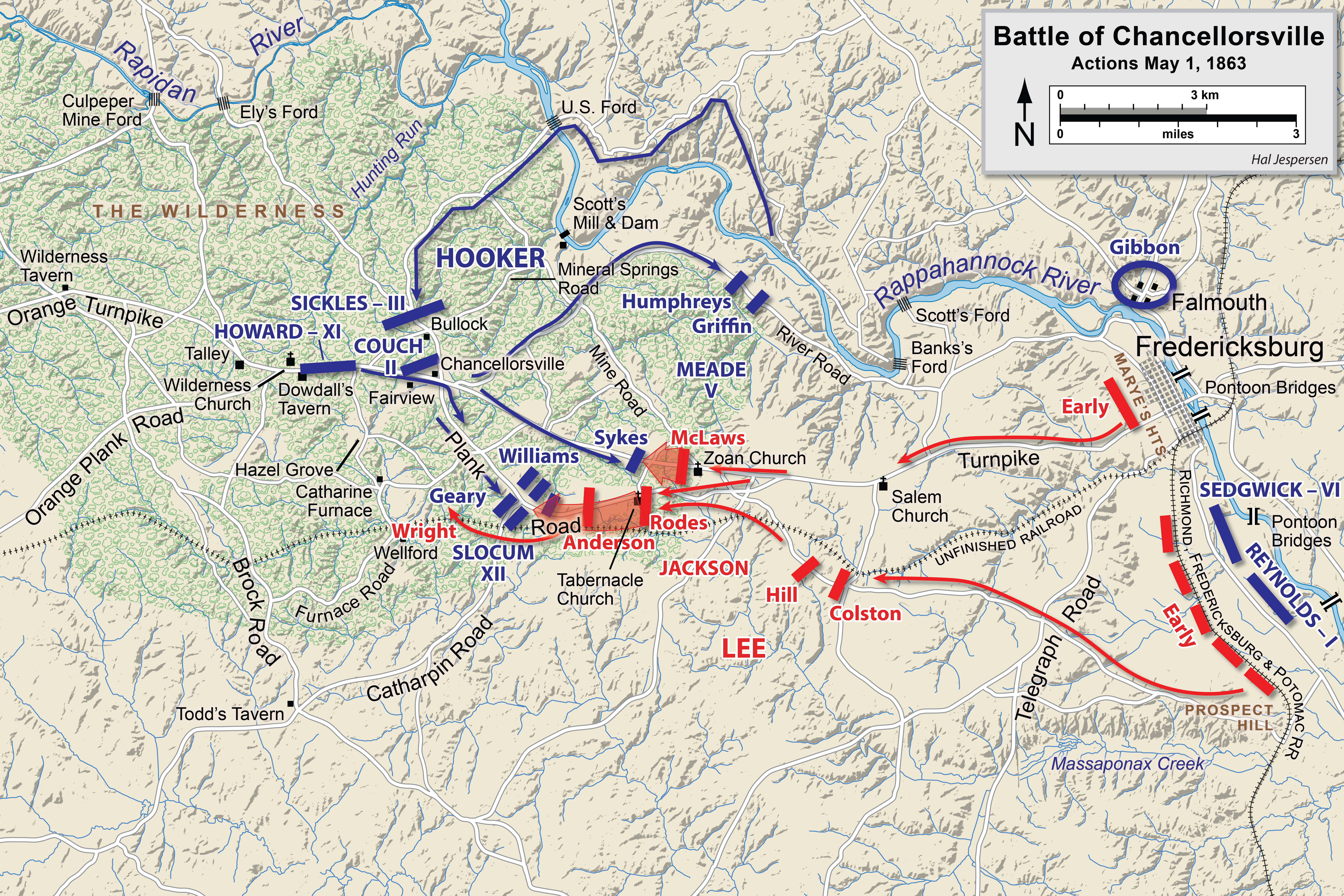
On May 1, 150 years ago today, Lee's Confederates got moving to meet
the Union force which had positioned themselves on their flank.
Waiting for them in the thick woods around Chancellorsville was the
main Union force under Gen. “Fighting Joe” Hooker, much larger
than the Confederates in numbers. The rebels were leaving behind in
Fredericksburg just a token force to resist the powerful Union
detachment under John Sedgwick.
Already facing Hooker were the divisions of Anderson and McLaws, the
remnant of Longstreet's corps which had been detached to southern
Virginia. Since their corps commander was absent, Lee was directing
these divisions personally. These greybacks were joined by the corps
of Lt. Gen. Stonewall Jackson. Together they advanced to meet the
Federals, who were also moving forward in a general advance under
orders from Hooker. Fighting broke out around 11:30 am, but it wasn't
long before Hooker called a halt.
Up to this point in the campaign he had been successful. He had
boldly moved around the Confederate position, and was admirably
positioned to drive back the smaller Confederate force opposing him.
But at this point he lost his nerve. Instead of continuing to pursue
an active attack, he ordered his troops back before they reached
their objectives, having determined on taking up a defensive position
around Chancellorsville. Hooker's subordinates were disgusted with
this decision. They were abandoning the high ground for little
reason. In a few hours Hooker had completely changed his plans from a
bold offensive to waiting to receive Lee's attack. Perhaps he thought
that he had made to much progress against Lee, and that he was
falling into a trap. On the other hand he may have simply been scared
and unprepared too control the huge army.
Couch
Union Corps commander Darius Couch made his way to headquarters to
report on his movements. He later wrote:
Proceeding to the Chancellor House, I narrated my operations in front to Hooker, which were seemingly satisfactory, as he said: 'It is all right, Couch, I have got Lee just where I want him; he must fight me on my own ground.' The retrograde movement had prepared me for something of this kind, but to hear from his own lips that the advantages gained by the successful marches of his lieutenants were to culminate in fighting a defensive battle in that nest of thickets was too much, and I retired from his presence with the belief that my commanding general was a whipped man.
Couch was right. Hooker's decision to halt the advance was one of the
major turning points of the campaign. He was giving Lee the
opportunity he needed to launch one of the greatest attacks of his
career.