|
| Confederates in Charleston |
In April 1863, the
United States Navy turned its attention to Charleston, South
Carolina. Charleston was an important city in the Civil War. Not only
did it have military importance, as a center of blockade running, but
it also had a vast political importance. It was where the war began
with the bombardment of Fort Sumter in the harbor, and its capture
would prove a major hit to Confederate morale and the town was also
very supportive of secession.
 |
| Samuel Du Pont |
For these reasons
it was decided by the Federal government to make an attempt to
capture the town. The command was given to Samuel Du Pont. Du Pont
had been sailing since the age of 12, and by the Civil War was a
captain. He was on his way toward retirement, holding a post as
commander of the Philadelphia Shipyard, but, when the Civil War came,
he was returned to active service. He was promoted to flag officer,
and after commanding the navy at the capture of Port Royal, he was
promoted to rear admiral.
 |
| Ironclads advance |
The
expedition would be primarily naval in nature. Du Pont was given nine
ironclads to make the attack. The flagship was the massive New
Ironsides.
It had been designed independently of the Monitor,
was
very similar to the French ironclad Glorie.
It
carried 18 guns and had masts as well as a steam engine. Accompanying
the New Ironsides
in the attack on Charleston were seven sister ships of the Monitor
and
an experimental ironclad, the Keokuk.
 |
| Burnside |
Charleston was
commanded by General P. G. T. Beauregard. He had gained his fame in
the town by leading the capture of Fort Sumter. He was assigned to
duty elsewhere, but was sent back to South Carolina when he did not
preform to the satisfaction of Richmond. The Confederate batteries
and forts were well suited for the defense of Charleston from an
attack from the sea. They had also placed barriers and torpedoes in
the harbor, and although the defenders knew they were defective, the
Yankees did not.
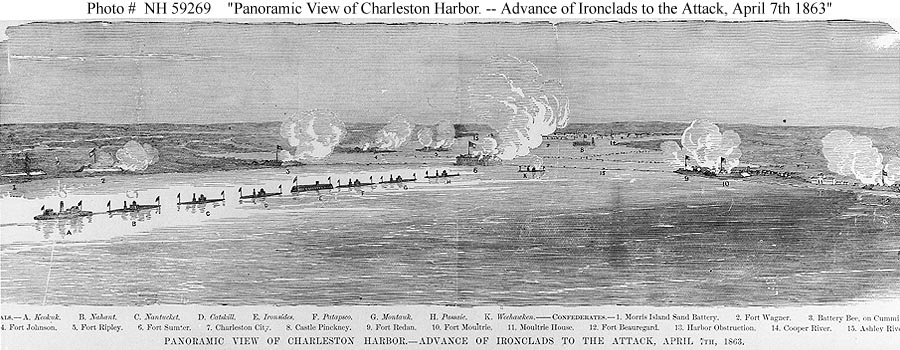
The Federal navy came out to battle on April 7th, 150 years ago
today. Time was lost as the ships met delays in their preparations.
As the ships moved forward, one after another, problems were
encountered with the
New Ironsides.
The sailors had difficulty maneuvering her, so she was pulled out of
line and anchored, so the rest of the ships could proceed.
Unknowingly, the New Ironsides
was anchored directly over a huge Confederate torpedo. But, when the
rebels pulled the electric switch to activate it, nothing happened.
It is not known exactly why the torpedo failed, but a great
opportunity was missed to destroy an important Union ship.
 |
| New Ironsides |
As the rest of the ships
continued on, Du Pont's battle plan fell apart. The ships
became disordered and came under a tremendous fire from the
Confederate batteries. The fire was intense, and the ships remained
far away from the Confederate batteries, rendering their fire
inaccurate. When the tide began to turn, Du Pont ordered his fleet to
retreat. The Confederate batteries had fired about 2000 shot, hitting
520 times. The Union ships had fired only 154 shots.
Different Union ships received differing amounts of damage. The
Keokuk was hit the worst. She
was shot 90 times, 19 below the waterline. She was taking on water as
she withdrew from the fight, and despite the efforts of the crew, she
sunk the next morning. Although the Union ships had been badly
damaged, the actual casualties were light. On the ships only one was
killed and 21 wounded, with the Confederates losing five killed and
eight wounded.
When Du Pont held a council of
war the next day, his captains were unanimously against a renewal of
the battle, and so he called of another attack. The government
in Washington was not happy with Du Pont for giving up so easily,
after loosing only a handful of men. He was removed from command.