head

Saturday, April 13, 2013

Battles of Fort Bisland and Irish Bend

Banks
In Louisiana, Union general Nathaniel P. Banks was preparing to attack Port Hudson on the Mississippi River. But, before he did so he needed to drive back 5,000 Confederates on his flank who were under the command of Richard Taylor, who had fought under Stonewall Jackson in the Shenandoah Valley. Banks undertook this in what is called the Bayou Teche Campaign. Banks moved with two divisions to attack Taylor’s force at Fort Bisland, while Brigadier General Cuvier Grover embarked in boats to sail across Grand Lake and land on Taylor’s flank.
Richard Taylor

Taylor would spend April 13, 150 years ago today, fighting off Bank’s forces to his front. Then, realizing he was nearly trapped, he would pull out during the night. He would fight another battle the next day, this time against Grover. While his trains were pulling out he held on in the Battle of Irish Bend. His trains having pulled back, Taylor successfully made his escape. Grover lost 353 men. Taylor’s casualties were less, but not known with certainty.

Burnside Cracks Down on Copperheads

Burnside
Ambrose Burnside, after his disastrous defeat at the Battle of Fredericksburg, was appointed commander of the Department of Ohio. From there he set out to deal with the Copperheads, the Northern Democrats who wanted to bring an end to the war. 150 years ago today he issued his General Order No. 38, prescribing harsh punishments for those who helped the Confederacy:
[H]ereafter all persons found within our lines, who commit acts for the benefit of the enemies of our country, will be tried as spies or traitors, and if convicted will suffer death. This order includes the following class of persons.

Carriers of secret mans.

Writers of letters sent by secret mails.

Secret recruiting officers within the lines.

Persons who have entered into an agreement to pass our lines for the purpose of joining the enemy.

Persons found concealed within our lines, belonging to the service of the enemy, and, in fact, all persons found improperly within our lines who could give private information to the enemy. All persons within our lines who harbor, protect, conceal, feed, clothe, or in any way aid the enemies of our country.

The habit of declaring sympathies for the enemy will no longer be tolerated in this Department. Persons committing such offences will be at once arrested with a view to being tried as above stated, or sent beyond our lines into the lines of their friends.

It must be distinctly understood that treason expressed or implied, will not be tolerated in this Department.
Vallandigham
This order was directed not only at those who were doing legitimately treasonous things, such as recruiting for the Confederacy, but also those who even so much as expressed sympathy for the Confederate cause. It didn’t take long for Burnside to implement this, with the arrest of Clement Clement Vallandigham, the leading Copperhead politician, and the closing of the Chicago Tribune. Burnside and the government would meet a lot of backlash for this order, and the actions taken because of it.

Thursday, April 11, 2013

Siege of Suffolk

Longstreet
After the Battle of Fredericksburg in December, 1862, the decision had been made to send Longstreet and his troops away from the rest of the Army of Northern Virginia. There wasn’t an immediate need to defend against a Federal attack, supplies were low in Northern Virginia, and there were other places troops could be used. For these reasons, Longstreet was made commander of the Department of Virginia and North Carolina. His missions were to protect Richmond, gather supplies, and capture Suffolk, Virginia, if possible.

Siege Gun

Longstreet began moving to Suffolk 150 years ago today. He had about 25,000 men against a garrison of 20,000, under the command of John Peck. Confederate reconnaissances and probes showed that a frontal attack was unlikely to succeed. Therefore, the Confederate troops dug entrenchments and their commanders looked for an opportunity to strike. The siege lasted until May 1st, when Longstreet withdrew to support Lee at the Battle of Chancellorsville. There were several engagements in the fighting around Suffolk in which the Union troops attacked several Confederate positions. However, none of them were decisive in breaking the siege. Casualties totaled for the Union about 50 killed and 200 wounded, for the Confederates 500 killed and wounded, and 400 captured.

Sunday, April 7, 2013

Battle of Charleston Harbor

Confederates in Charleston
In April 1863, the United States Navy turned its attention to Charleston, South Carolina. Charleston was an important city in the Civil War. Not only did it have military importance, as a center of blockade running, but it also had a vast political importance. It was where the war began with the bombardment of Fort Sumter in the harbor, and its capture would prove a major hit to Confederate morale and the town was also very supportive of secession. 
Samuel Du Pont
For these reasons it was decided by the Federal government to make an attempt to capture the town. The command was given to Samuel Du Pont. Du Pont had been sailing since the age of 12, and by the Civil War was a captain. He was on his way toward retirement, holding a post as commander of the Philadelphia Shipyard, but, when the Civil War came, he was returned to active service. He was promoted to flag officer, and after commanding the navy at the capture of Port Royal, he was promoted to rear admiral.
Ironclads advance
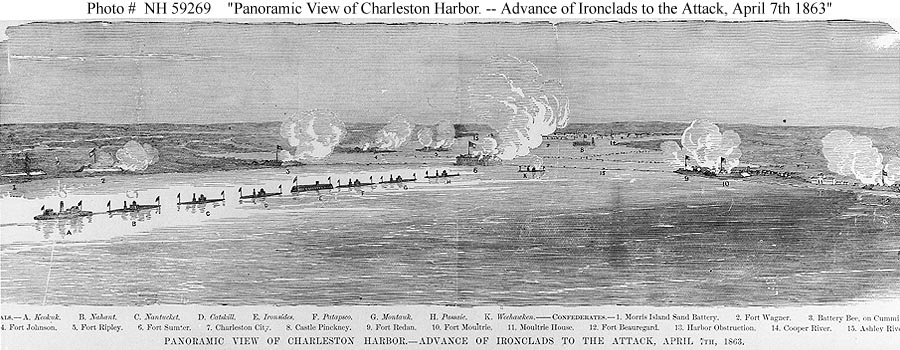
The expedition would be primarily naval in nature. Du Pont was given nine ironclads to make the attack. The flagship was the massive New Ironsides. It had been designed independently of the Monitor, was very similar to the French ironclad Glorie. It carried 18 guns and had masts as well as a steam engine. Accompanying the New Ironsides in the attack on Charleston were seven sister ships of the Monitor and an experimental ironclad, the Keokuk.
Burnside
Charleston was commanded by General P. G. T. Beauregard. He had gained his fame in the town by leading the capture of Fort Sumter. He was assigned to duty elsewhere, but was sent back to South Carolina when he did not preform to the satisfaction of Richmond. The Confederate batteries and forts were well suited for the defense of Charleston from an attack from the sea. They had also placed barriers and torpedoes in the harbor, and although the defenders knew they were defective, the Yankees did not. 

The Federal navy came out to battle on April 7th, 150 years ago today. Time was lost as the ships met delays in their preparations. As the ships moved forward, one after another, problems were encountered with the New Ironsides. The sailors had difficulty maneuvering her, so she was pulled out of line and anchored, so the rest of the ships could proceed. Unknowingly, the New Ironsides was anchored directly over a huge Confederate torpedo. But, when the rebels pulled the electric switch to activate it, nothing happened. It is not known exactly why the torpedo failed, but a great opportunity was missed to destroy an important Union ship. 

New Ironsides
As the rest of the ships continued on, Du Pont's battle plan fell apart. The ships became disordered and came under a tremendous fire from the Confederate batteries. The fire was intense, and the ships remained far away from the Confederate batteries, rendering their fire inaccurate. When the tide began to turn, Du Pont ordered his fleet to retreat. The Confederate batteries had fired about 2000 shot, hitting 520 times. The Union ships had fired only 154 shots.


Different Union ships received differing amounts of damage. The Keokuk was hit the worst. She was shot 90 times, 19 below the waterline. She was taking on water as she withdrew from the fight, and despite the efforts of the crew, she sunk the next morning. Although the Union ships had been badly damaged, the actual casualties were light. On the ships only one was killed and 21 wounded, with the Confederates losing five killed and eight wounded. 
 
When Du Pont held a council of war the next day, his captains were unanimously against a renewal of the battle, and so he called of another attack. The government in Washington was not happy with Du Pont for giving up so easily, after loosing only a handful of men. He was removed from command.


Friday, April 5, 2013

CSS Alabama - Confederate Raider


150 years ago the CSS Alabama sailed the seven seas, spreading fear through the Union fleet. Learn about her career and demise in this video by Discerning History!

Tuesday, April 2, 2013

Grant Develops a Plan to Capture Vicksburg

Grant
Over the last several months, Grant had tried many strategies to try to capture Vicksburg. But at every turn he had been rebuffed by the Confederates or the nature of the difficult terrain of the area. But 150 years ago he decided to abandon his efforts to capture Vicksburg by moving around it through the bayous and swamps, and instead to try to run the batteries, and land below the fortress where the terrain would be less formidable. Although the ground would be easier for operations, the army would have to run much peril to get there. They would need transports to cross the river, and these would have to run by the formidable batteries on the bluff at Vicksburg. The transports were made of wood, and would be very vulnerable to the Union shot. It was a bold and risky plan, but Grant believed it would give him the best chances to capture Vicksburg.

Richmond Bread Riot

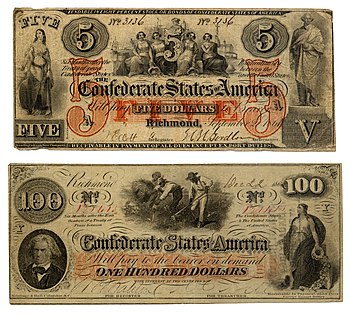
Confederate Money
Although the majority of southerners supported the war effort and voted for secession, it was not unanimous. There was a sizable belt of opposition centered in the Appalachian Mountains from West Virginia down to western North Carolina. West Virginia. The opposition during the war was fueled by the Confederacy’s financial problems. 

One problem both sides faced during the war was rampant inflation. They turned to printing paper money to help pay for the war. However this increased the money supply, raising prices and decreasing the value of everyone's money. The problem was more acute in the Confederacy. The North approximately doubled its money supply during the war, the South increased theirs by 20 times. Inflation rapidly increasing prices in the south, quickly doubling, tripping and quadrupling. At the beginning of 1863 a barrel of flower could be bought for $70, but by the end of the war it would cost $250. That barrel of flower would have been only $10 when the war began.

Richmond Bread Riot
Complaints from the southern people came to a crisis in Richmond on April 2nd, 1863. There had been a drought in 1862 and much of the food that was grown was destroyed by moving armies. Food was scarce and very expensive. The riot began when a woman named Mary Jackson riled up a crowd by complaining of the cost of food. Pulling out a revolver and bowie knife, she led a crowd of 300 women with shouts of "Bread! Bread!" The governor came out and read the Riot Act, but the mob ignored him, smashing the windows of shops and stealing not only food, but anything they could lay their hands on. A company of milita was brought out, and Jefferson Davis himself came to try to disperse the crowd. Reached into his pockets, he pulled out all the money he had and thew it to the rioters, shouting:
You say you are hungry and have no money. Here is all I have. It is not much, but take it. We do not desire to injure anyone, but this lawlessness must stop. I will give you five minutes to disperse. Otherwise you will be fired on.
The women, knowing that Davis was not making an idle threat, began to disperse. Davis was able to quell this riot with the threat of the soldiers rifles, but there were others elsewhere throughout the south. Similar events occurred in Georgia, Alabama and North Carolina. Although they turned out not serious in and of themselves, they were signs of growing discontent with the government.
Jefferson Davis