head

Friday, October 19, 2012

McClernand Appointed to Command a New Army

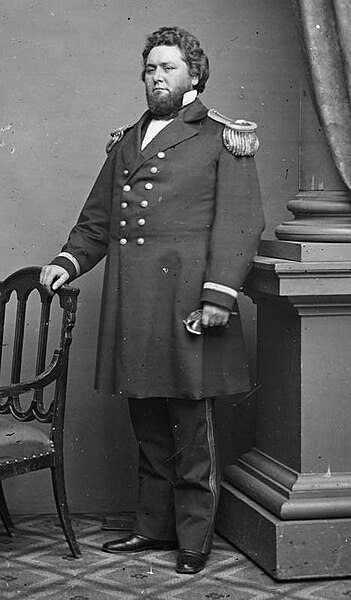
McClernand
A few months back the Federal naval forces had moved in to Vicksburg, but after several weeks of combat had retired, having discovered it would take a major military force to capture the “Gibraltar of the West.” It seemed that Grant would be the man for the job but he had not yet moved, having spent his time fighting Van Dorn and Price in northern Mississippi. But 150 years ago today another man was appointed to make an attempt at it, and that was John Alexander McClernand.

McClernand was an Illinois lawyer whose career had been very similar to that of Abraham Lincoln, the president. Although he was a Democrat and Lincoln a Republican, they were still friends. When the war came he was appointed a political general, helping Lincoln to win support from the Illinois Democrats. 150 years ago today he obtained leave to visit Lincoln in Washington, DC, and convinced him to give him his own independent command to make an attack on Vicksburg, Mississippi. This news would spurn Grant into action. He did not want McClernand to gain the great fame that would come from the capture of Vicksburg, which Grant expected to be his own.

Thursday, October 18, 2012

Morgan captures Lexington, Kentucky

John Hunt Morgan
 Although the Battle of Perryville was a tactical victory for the Confederates, Gen. Braxton Bragg refused to follow up on it. Ignoring the protests of subordinates like Kirby Smith, he ordered the army to fall back to Tennessee through Cumberland Gap. Confederate cavalry under John Hunt Morgan fought hard to cover his retreat and gain whatever success they could.

On the morning of October 18th, 150 years ago today, Morgan got word that there were Federals camped around Ashland, the estate of the great politician Henry Clay. He was able to completely surprise the Federals, 300 men of the 3rd and 4th Ohio, catching them asleep with his 1,800 men. The battle was over within 15 minutes, with four Union troops killed, 24 wounded and 290 captured. The Confederate success was complete, suffering few casualties themselves.

Friday, October 12, 2012

Stuart Again Rides Around McClellan

 After successfully warding of McClellan in the Battle of Antietam and recrossing the Potomac into Virginia, Lee's army quickly recovered. Troops which had scattered returned to the army, and the men rested and refitted. McClellan, meanwhile, was characteristically slow, and weeks passed without him launching a pursuit. Lee was so encouraged that he even considered again invading Maryland. Although he gave up that idea as too dangerous, he planned for Stuart to go on another of his famous raids to get information as to McClellan's position and plans.

Stuart set out on October 9th with 1,800 picked troopers. He crossed the Potomac River and ride all the way to Chambersburg, Pennsylvania, temporarily cutting McClellan's supply line. He pushed his men hard and fast, rounding up horses and getting all the information he could. 150 years ago today he returned to the bank of the Potomac River, only to find two hundred Pennsylvania infantry blocking his way. Stuart sent out skirmishers, and ordered Pelham to deploy his artillery. The cannon shots quickly scattered the Yankees blocking their way. The rebel cavalry began crossing the river, their rear guarded from Federal pursuers by Pelham's guns.
The Gallant Pelham at West Point in 1858

Stuart's raid was successful, having ridden 120 miles in 60 hours without loosing a man. He had captured 1,200 horses and inflicted about a quarter of a million dollars worth of damage. It had been very successful as far as it went, bringing new glories on Stuart and the south, and scaring and embarrassing the Federals. When Lincoln was asked about the raid he drew a circle in the ground and said, "When I was a boy we used to play a game, three times round and out. Stuart has been round him twice; if he goes round him once more, gentlemen, McClellan will be out!"

Monday, October 8, 2012

The Battle of Perryville

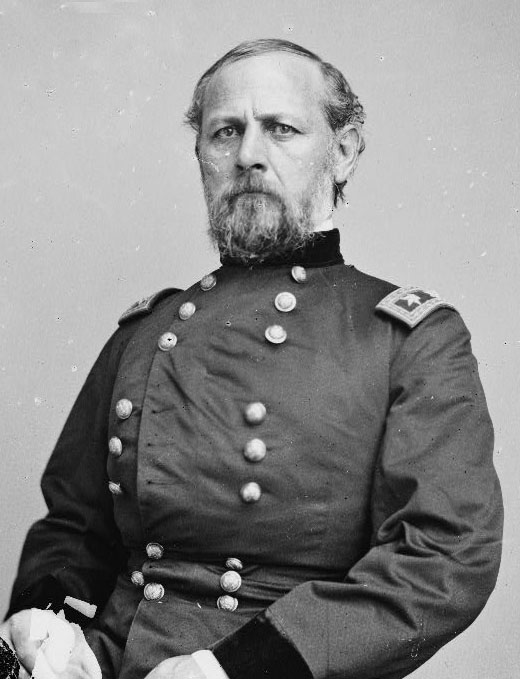
Buell
The Union troops opposing the Bragg and Kirby-Smith's invasion of Kentucky were the Army of the Ohio under Don Carlos Buell. His first response had been to fall back quickly in face of the Confederate advance. The government in Washington was not satisfied with this, and orders were sent removing him from command and replacing him with George Thomas. However, the civilian authorities would not stand for this. They saw Buell as the savior of Ohio, as the Confederates had not left Kentucky, and would not stand to see him fired. This, added to the fact that Thomas did not want the post, allowed Buell to keep his position, although it was clear that if he did not move quickly, he would soon loose his army.

Buell left Louisville on October 1st. He had 75,000 freshly reorganized men, significantly more than Smith and Bragg combined. He organized his 10 divisions into three corps, the first under Alexander McCook, a seasoned army officer, the second under Thomas Crittenden, whose brother was a general on the Confederate side, and the third under Charles Gilbert. Gilbert's promotion was very bizarre. Just days before he had been only a captain. But one of Buell's subordinates was badly wounded during the Battle of Richmond and a replacement was needed. Several generals refused the position, so Buell decided to promote Gilbert to a Major General over the heads of many others because he had some experience. His promotion was later denied by Congress. Buell's forces marched in three columns so as to confuse Bragg of their true purpose. The federals came in contact with Bragg at 1 PM on October 4th, the noise of cannon interrupting the inauguration ceremony of Richard Hawes as Confederate governor of Kentucky.
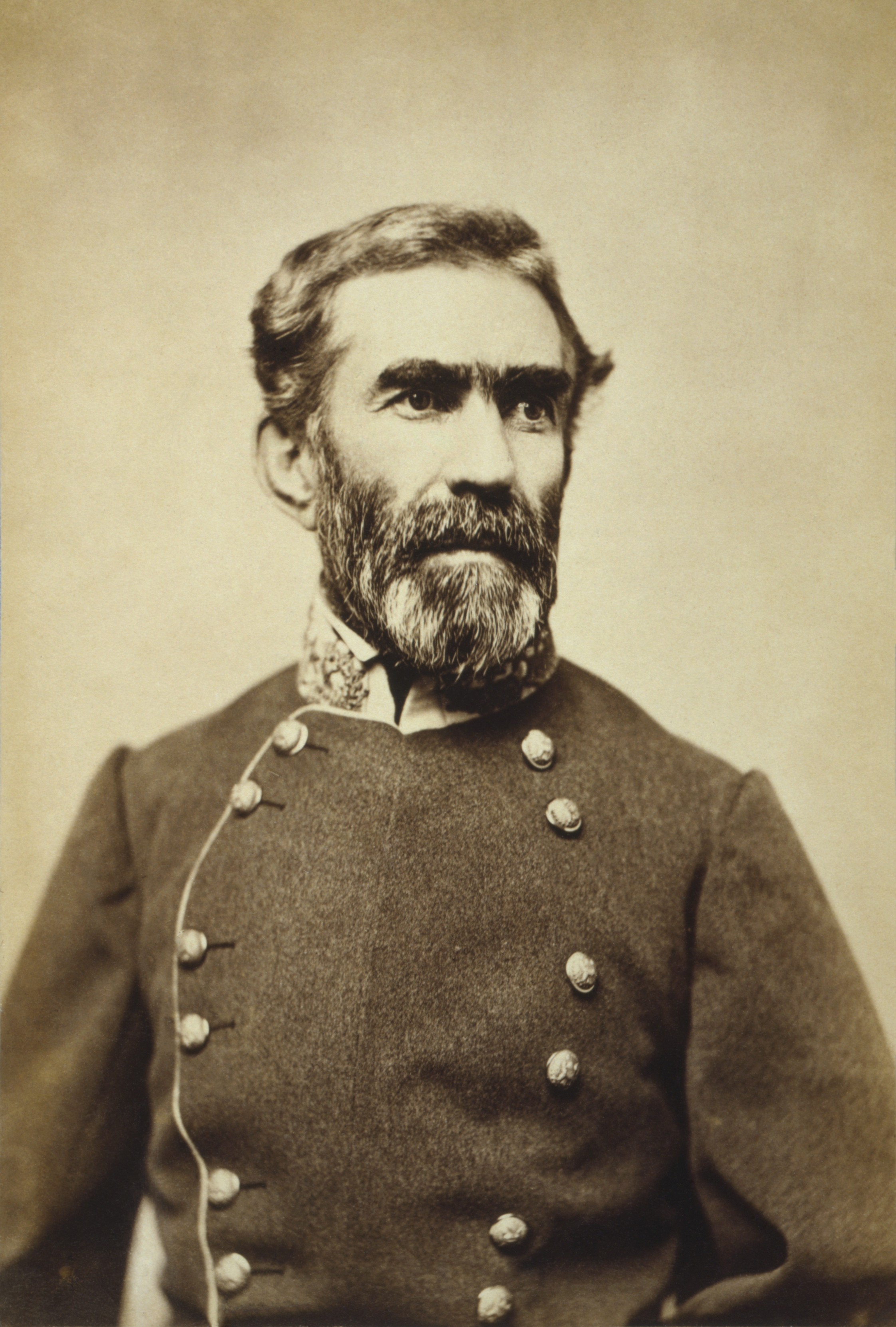
Bragg

Bragg decided to concentrate his forces at Perryville and fight Buell. Buell arrived at Perryville with the head of his column on October 7th, but neither army was present on the field in its entirety. Bragg ordered his troops to march on Perryville and attack the next day, October 8th, hoping to strike the confederates before they could bring up their entire army. However, further developments caused him to push that date out to October 9th. He ordered his corps commanders to avoid a general engagement and retired to his headquarters, unable to oversee the positioning of his army due to a fall from his horse.
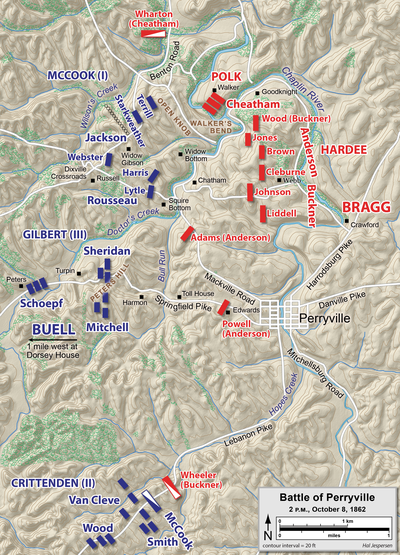
The Battle of Perryville began on the morning of October 8th as Yankee troops pressed towards the Confederates under Hardee. The battle began over water. At the time there was a drought in Kentucky, and the Union soldiers were very thirsty. The Confederates were driven from the water, and Buell positioned his forces in preparation to attack Hardee the next day. Bragg arrived at Perryville and, conferring with Hardee, decided to attack on the Union left.

The greybacks moved forward at 1 pm, undetected by the Federals. Advancing, they hit McCook's Federals as they were deploying, having just arrived on the field. Letting out their rebel yell, the Confederates quickly crushed the first brigade of green troops, its commander falling dead, and continued to press on, assaulting the next units they encountered. The Confederate artillery pounded the fleeing Yankees, and McCook soon found both of his divisions in full flight. McCook requested that Gilbert, to his right, send him reinforcements. The Confederates facing Gilbert were very weak, but the inexperienced commander had not been able to discover that, and he refused aid. The Confederates on the southern portion of the field kept his 20,000 men occupied with just more than a tenth of that number. Buell was of no help, for through a strange trick of the terrain the noise of the battle did not reach his headquarters, even though they were close by.

Having attained much success, the rebel attack became disorganized in their rapid advance as they began taking fire from the Union artillery. The fighting became confused, and many instances of friendly fire and confused identity occured. Confederate General Polk captured a Union brigadier who thought Polk was his commander, and Polk was later almost captured himself when he mistook a Federal brigade for his own.

The battle was very trying for the troops. Sam Watkins, private from the 1st Tennessee remembered his experiences in his famous book Co. Aytch:
We did not recoil, but our line was fairly hurled back by the leaden hail that was poured into our very faces.  Eight color-bearers were killed at one discharge of their cannon.  We were right up among the very wheels of their Napoleon guns.  It was death to retreat now to either side.  Our Lieutenant-Colonel Patterson halloed to charge and take their guns, and we were soon in a hand-to-hand fight – every man for himself – using the butts of our guns and bayonets ... Such obstinate fighting I never had seen before or since.  The guns were discharged so rapidly that it seemed the earth itself was in a volcanic uproar.  The iron storm passed through our ranks, mangling and tearing men to pieces.  The very air seemed full of stifling smoke and fire which seemed the very pit of hell, people by contending demons…
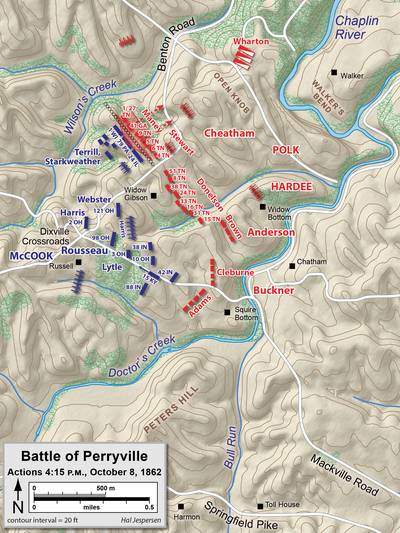
The day finally drew to the close, with the Federals driven back, but not whipped. Buell had allowed himself to be mauled by a force one third of his size. 4200 Federals and 3400 Confederates fell in this battle. Bragg had done well in the conduct of the battle itself, but he did not want to press the fight. He pulled his men out after midnight to link up with Kirby Smith.

Smith urged Bragg to attack Buell, and Bragg agreed to do it. However, the prospective attack never came to be. Braxton Bragg changed his mind and decided to withdrawl instead. He explained his position by saying:
With the whole southwest... in the enemy's possession, my crime would have been unpardonable had I kept my noble little army to be ice-bound in a northern clime, without tents or shoes and obliged to forage daily for bread.
It was here that Bragg made his fundamental mistake of the campaign. He had done well in his advance, making his way all the way through Kentucky. He had crushed one wing of Buell's army with a much smaller force. But when the critical time came he would not risk another battle. He withdrew instead, bringing with him the huge number of supplies he had captured. While it was a very successful raid, it was a failure as a campaign. He said:
Though compelled to yield to largely superior numbers and fortuitous circumstances, a portion of the valuable territory from which we had driven the enemy, the fruits of the campaign were very large and have had a most important bearing upon our subsequent military operations here and elsewhere.
With the campaign over, both generals were reprimanded by their superiors. Bragg was called to Richmond by Davis, who although he had received letters from his subordinates asking that he be removed from command, allowed Bragg to keep his army. Buell on the other hand was removed from command and replaced by Major General William Rosecrans.

Saturday, September 29, 2012

General Jefferson Davis shoots Bull Nelson

Jefferson C. Davis

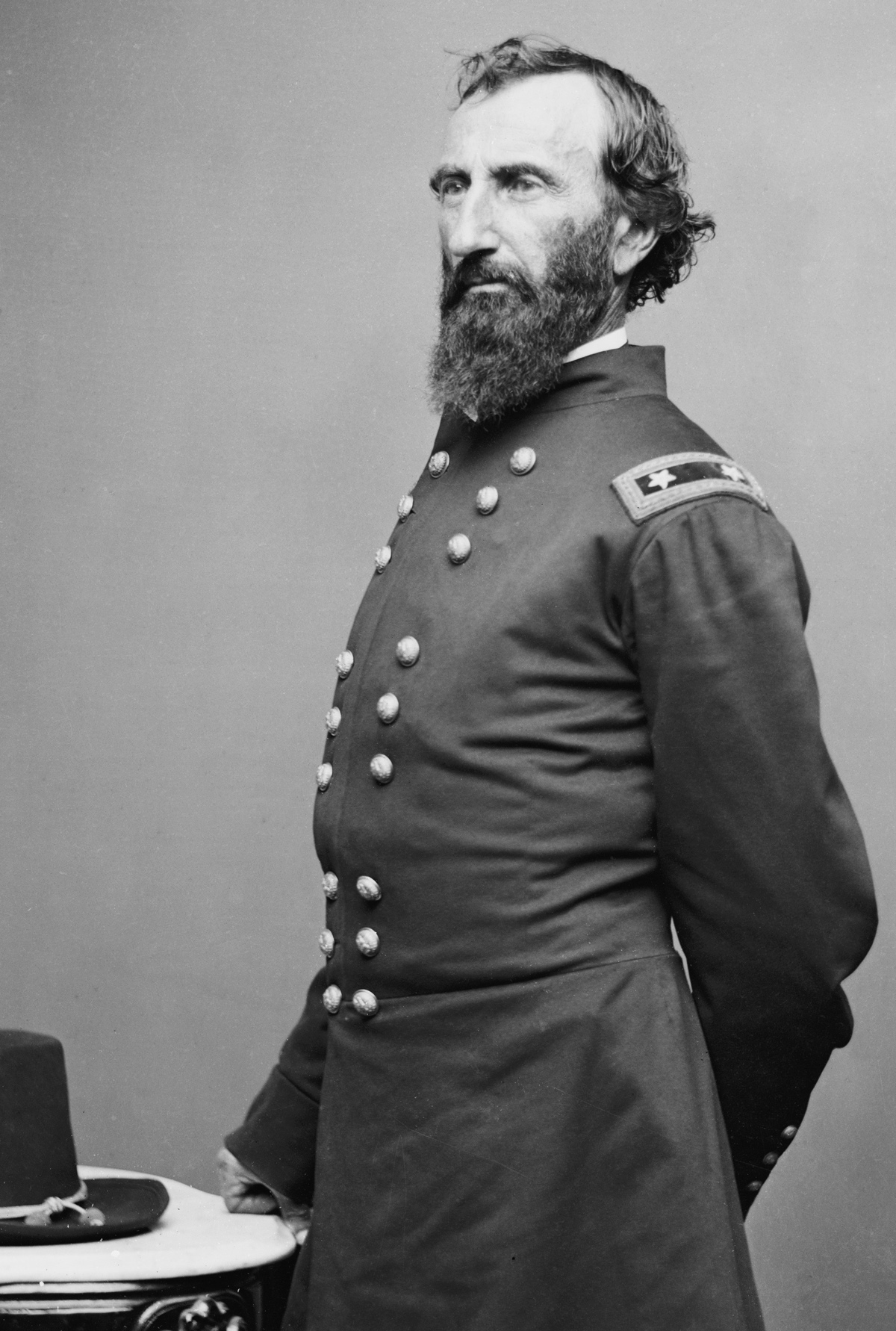
There were two important Jefferson Davis's in the Civil War. The most famous one was Jefferson Davis of Mississippi, President of the Confederacy. However, there was another one, Jefferson C. Davis, a general in the Union army. Today he is known only for his name, and for an incident which took place 150 years ago today.
Nelson

Davis had been in the United States garrison at Fort Sumter during the battle which began the war. He was soon promoted to captain and then colonel. He fought at the Battle of Wilson's Creek and was promoted to Brigadier General. However, he fell sick and went on sick leave. But when Bragg invaded Kentucky and there was a treat of an attack on Louisville and Cincinnati, he rose from his sick bed to help with the defenses. Davis had an ongoing feud with William “Bull” Nelson, commanding the Union forces preparing to meet the threat to Louisville, Kentucky. Nelson removed Davis from temporary command of a brigade of Home Guards, so Davis appealed to the governor of Indiana Oliver Morton, and Morton came with him to see Nelson.

At 8:00 am on September 29th Davis met Nelson in the lobby of the Galt house and confronted him, and harsh words were exchanged. The argument culminated with Nelson slapping Davis across the head. Embarrassed, Davis borrowed a revolver from a friend, and as Nelson turned to head down the stairs, he challenged him to a fight. Nelson was unarmed, but nonetheless Davis fired one shot, which killed him.

Davis was immediately placed under arrest for the murder of General Nelson. Incredibly, he was never prosecuted for his crime. He was released from prison and returned to his command, as at the time it seems that the need for experienced commanders was greater than their need to justice to be served to murderers.

Saturday, September 22, 2012

Lincoln Issues the Emancipation Proclamation

Lincoln reads the Emancipation Proclamation
150 years ago today Abraham Lincoln issued he most important document of the Civil War, the Emancipation Proclamation. When Lincoln was elected president he was clearly anti-slavery, but he said he had no intention of interfering with slavery where it existed, only choking it by stopping it's spread into the territories. When the war, came he said that it was only to save the Union, and “if I could save the Union without freeing any slave I would do it, and if I could save it by freeing all the slaves I would do it...." At this point, however, Lincoln's intentions are hard to know. He may have been saying this because he actually meant it, or he might have just being trying to gain popular support for emancipating the slaves. We don't know, because although he may be called Honest Abe, he was not actually honest when it came to politics.

Lincoln had been planning for some time to issue an emancipation proclamation, but he had been waiting for a Union victory so that it would not look like a last ditch attempt to win. Antietam, although not as great a victory has he hoped for, gave him the opportunity he was looking for.

Lincoln's proclamation said:
I, ABRAHAM LINCOLN, President of the United States of America, and commander-in-chief of the army and navy thereof, do hereby proclaim and declare that hereafter, as heretofore, the war will be prosecuted for the object of practically restoring the constitutional relation between the United States and each of the states and the people thereof, in which states that relation is or may be suspended or disturbed.
That it is my purpose, upon the next meeting of Congress, to again recommend the adoption of a practical measure tendering pecuniary aid to the free acceptance or rejection of all slave states, so called, the people whereof may not then be in rebellion against the United States, and which states may then have voluntarily adopted, or thereafter may voluntarily adopt, immediate or gradual abolishment of slavery within their respective limits; and that the effort to colonize persons of African descent with their consent upon this continent or elsewhere....
That on the first day of January, in the year of our Lord one thousand eight hundred and sixty-three, all persons held as slaves within any state or designated part of a state, the people whereof shall then be in rebellion against the United States, shall be then, thenceforward, and forever free; and the Executive Government of the United States, including the military and naval authority thereof, will recognize and maintain the freedom of such persons, and will do no act or acts to repress such persons, or any of them, in any efforts they may make for their actual freedom.
That the Executive will, on the first day of January aforesaid, by proclamation, designate the states and parts of states, if any, in which the people thereof, respectively, shall then be in rebellion against the United States; and the fact that any State, or the people thereof, shall on that day be, in good faith, represented in the Congress of the United States by members chosen thereto at elections wherein a majority of the qualified voters of such state shall have participated, shall, in the absence of strong countervailing testimony, be deemed conclusive evidence that such state, and the people thereof, are not then in rebellion against the United States.
Lincoln said he had authority to do this because it was a war measure. However, the whole war for the preservation of the Union was based upon the principle that the states attempting to secede were really part of the Union. If that is true the president did not have the right do emancipate the property of southerners if he could not do it in peace time.
The Emancipation Proclamation was not a humanitarian document. It only declared the slaves free in territory not under the control of the United States. Therefore, unless the Union army was victorious in the war, the slaves would remain in their servitude. It also gave the Confederates the chance to save their slaves by returning to the Union before January 1st, 1863. or receive compensation for them through an (unconstitutional) act of Congress.
Lincoln
This proclamation had vast impact. It changed the cause of the war in the mind of the world from preservation of the Union into a war to abolish slavery. Everyone was not happy that. Some soldiers, in fact, deserted because they did not want to fight to end slavery. In any event the Union army eventually supported it, as it gave them a higher motive to fight for than to coerce the southern states. The impact in foreign policy was also great. European nations had been considering recognizing the Confederate States. But with the proclamation Lincoln was able to change their perception of the war to one over slavery, and although they might have been willing to aid in the separation of the Union, they would not aid in the preservation of slavery. The Emancipation Proclamation destroyed the south's best hope for victory – foreign recognition. From then on they would have to look to their own armies for victory.

Thursday, September 20, 2012

Battle of Boteler's Ford – Day 2

Fitz John Porter
On September 20th the Federals continued to push forward from Boteler's Ford. A bridgehead was established, but they were soon under attack. Lee countermarched A. P. Hill's “Light Division” and sent them forward. The Federals were under heavy attack, and word reached Fitz-John Porter, the Union Corps commander, that his men were outnumbered. He ordered them to withdraw back across the river. However, the colonel of the 118th Pennsylvania, an inexperienced regiment, refused to retire until the orders went through the proper chain of command. The rest of the Yankees were happy enough to retreat, and the 118th was left stranded. As the Confederates attacked, the outnumbered regiment panicked, and the men scattered, scrambling down the cliffs to the river and crossing the forward as fast as possible. The regiment suffered heavily, loosing 269 out of 737. Over these two days of skirmishing, the Yankees lost 363 men, the Rebels 291.