head

Saturday, May 5, 2012

Jackson Marches to McDowell


In the battle of Kernstown in March Stonewall Jackson's army had been defeated by the forces of Nathaniel Banks in the Shenandoah Valley. However, Jackson accomplished his objective of keeping Federal troops away from the attack on Richmond. In the first weeks of April Banks moved south, up the valley, and Jackson fell back before him, retreating all the way to Harrisonburg. At the time there were four main Union forces, Fremont in the mountains to the west, Banks in the Shenandoah Valley, McDowell near Fredericksburg and McClellan on the Virginia Peninsula. Resisting these were Allegheny Johnson in the mountains, Jackson in the valley, Field and Ewell guarding McDowell, and Johnston on the Peninsula. Robert, E. Lee, who was at this time military adviser to Jefferson Davis, developed a plan to strike a blow by giving Ewell's men to Jackson:
"I have no doubt an attempt will be made to occupy Fredericksburg and use it as a base of operations against Richmond. Our present force there is very small, and cannot be re-enforced except by weakening other corps. If you can use General Ewell's division in an attack on General Banks, and to drive him back, it will prove a great relief to the pressure on Fredericksburg; but if you should find General Banks too strong to be approached, arid your object is to hold General Ewell in supporting distance to your column, he may be of more importance at this time between Fredericksburg and Richmond. I do not know whether your column alone will be able to hold Banks in check and prevent his advance up the valley; but if it will, and there is no immediate use for General Ewells command with yours."
The aggressive Jackson jumped at the opportunity to attack. He was sure with Ewell's troops that he could crush Fremont or Banks. It was decided that Ewell would secretly replace Jackson's men threatening Banks at Swift Run Gap, while Jackson moved to join Johnson and defeat an insulated part of Fremont's army, which was preparing to join Banks. Although the Federal forces greatly outnumbered the Confederates, if the Confederates could combine two armies against one Union force, they could get the superior numbers on the field. That is just what Jackson was planning to do by marching to join Allegheny Johnson in the Blue Ridge Mountains.

Battle of Williamsburg


When McClellan learned that Johnston's men had retreated from the Yorktown entrenchments, he ordered his men to pursue, led by Stoneman's cavalry. There was nothing more than skirmishing on May 4th as the armies moved north, but Johnston decided that he needed to put up a rear guard action to prevent his slow moving wagon train from having to be abandoned. Brigadier General James Longstreet was ordered to delay the Federals at Williamsburg on May 5th. Because of the narrowness of the Yorktown Peninsula at that point and the position of creeks in the area, Longstreet only had to defend two miles of ground. To do this he had his men, along with the men of Jones, Smith and D. H. Hill. The Confederates had an advantage of prepared entrenchments, which had been constructed as a fall back position by Magruder, centering around a fort named after him.
"Fighting Joe" Hooker

The Federals had two divisions, those of Joseph Hooker and Baldy Smith, on two parallel roads a mile apart. Complicating the situation was the fact that the two divisions were from different corps, and Sumner, a wing commander, was on the field, totaling five commanders over two units. On the rainy morning of May 5th, 150 years ago today, Hooker entered the battle with infantry and artillery. He would not make a full scale attack on Fort Magruder, however, without support from Smith's division to his right. Longstreet was not content to let the battle continue in a stalemate. He ordered Wilcox to move against Hooker's men. More troops were committed and fierce fighting took place along the left of the Federal line. Troops exchanged volleys at 30 paces in the wet woods. On the right Sumner refused to send in Smith's troops to help Hooker. However, Philip Kearny's division arrived on the left half of the field to reinforce Hooker. Although Sumner refused to send troops to help Hooker, he was finally convinced to send Hancock's brigade on the right to investigate a report that there was an unguarded road leading to the Confederate flank. While these troops marched off on this mission, the battle continued on Hooker's front. The Federals began to run out of ammunition, and soon the Southerners, charging with a rebel yell, broke through the Union line. They captured 10 Northern cannon, and were able to bring off four of them. Hooker rode to the front and led his men forward yelling to his men, "Don't fall back – the rebels are whipped! Reinforcements will be here in the few minutes." General Samuel Heintzelman, Smith's corps commander who had come over to this section of the line in disgust over Sumner's refusal to fight, did what he could to rally the fugitives. Finding remnants of a regimental band, which were common at this stage of the war, he rallied them and set them to playing Yankee Doodle and other marching tunes, encouraging the men to rally under this martial music. What really saved the battle here for the Federals was the arrival of Phillip Kearny's division. He was the most experienced commander in the battle, having lost an arm while fighting in Europe. He led his division forward, hitting the Rebels and stopping any further advance. Hard fighting continued to occur on this section of the line.

At 3:00 pm while this fight was occurring, Hancock's brigade was positioned on the Confederate left flank. Halting his men and guns, he sent word back to Smith of a good opportunity for a flank attack and waited for reinforcements. However, he received several repeated orders to fall back. Longstreet had sent Jubal Early from D H. Hill's division to guard the Confederate left. Hearing Hancock's men and guns, he proposed a flanking movement. Hill agreed, and they set off at around 5:00 pm. However, when they found the Federal cannon, they turned out to be half a mile away from where they had thought, putting Early and his men in their front, instead of on their flank. However, the aggressive Early wheeled his first regiment around and charged at their head. Charging forward with cries of "Bull Run!" they hit heavy Federal resistance. Men fell on every side, including Early himself, shot through the shoulder. D. H. Hill called off the attack, realizing the Federal position was too strong to be attacked haphazardly. Hancock was not content to remain where he was. Although he had received several orders to fall back, he took the Confederate attack as liberty to pursue the course he wished, and ordered a charge. They moved forward "with a terrible yell ... and pursed in a volley following it up with a steady fire.... The enemy, who doubtless thought we sprung form the earth, halted with terror and amazement, their dead were dropping like tenpins, one after another...." Terrible casualties were inflicted on the fleeing Confederates. Early's brigade lost over 500 of its men. The 5th North Carolina who suffered the majority of the casualties lost 68% of those who went into the battle. Hancock lost exactly 100.
McClellan arriving on the battlefield late in the day

As the sun set the battle all along the line wound to a close. The Confederates had lost 1,682 men, the Union 2,283. Both sides claiming a victory. McClellan claimed another glorious defeat of Johnston, however the Confederates actually gained greater success, having hampered the Army of the Potomac's pursuit allowing the retreat to be continued safely.
James Longstreet

There were many famous generals involved in this battle, which has become somewhat of a footnote in history. Longstreet, Early, D. H. Hill, Hancock, Hooker, Sumner and many more would all see much more fighting later in the war. There were various standards of performance. In general, the Federals did not very well. "Fighting Joe" Hooker's division had been left unsupported. McClellan did not hasten to the field and with Sumner's refusal to fight, Hooker had lost many men while 25,000 troops stood idly by. The Confederates in general had done better, excepting Early's bloody attack on Hancock. Although publicly he claimed the battle as a victory, McClellan was not satisfied. He complained to his wife of "the utter stupidity & worthlessness of the Corps Comdrs... Heaven alone can help a General with such commanders under him." Sumner had "proved that he was ever a greater fool that I had supposed & had come within an ace of having us defeated."

Thursday, May 3, 2012

Johnston Abandons Yorktown Lines

In early 1862, General George B. McClellan with his grand Union Army of the Potomac had been transported by sea to Fort Monroe on the Virginia Peninsula, in an attempt to get closer for a strike at Richmond. Moving up the Peninsula he had encountered 15,000 men under "Prince" John Magruder. Although they were no match for McClellan's 125,000 soldiers, McClellan could not believe the Confederate forces were that week so he decided to settle in for a regular siege. Joseph E. Johnston, commander of the main Confederate army, wrote to Robert E. Lee that, "No one but McClellan could have hesitated to attack."

150 years ago today after just under a month McClellan's siege lines were finally complete. His men had spent weeks digging entrenchments, building roads, and hauling forward dozens of heavy artillery. McClellan was prepared to unleash a terrific bombardment on the morning of May 5th to prepare for an eventual infantry assault. Allan Pinkerton, in charge of the army's intelligence, reported a minimum of 100,000 Confederates in the opposing works.
Union mortars

The Confederates however were not going to be waiting for the attack. Johnston, who had joined Magruder on the Peninsula was actually outnumbered two to one by McClellan. He had written a few days before, "The fight for Yorktown ... must be one of artillery, in which we cannot win. The result is certain; the time only doubtful.... I shall therefore move as soon as can be done conveniently...." Now with the Federal trenches approaching the Confederate lines, was a convenient time. Therefore, 150 years ago tonight, Johnston ordered a bombardment of the Union trenches, his heavy guns firing randomly at McClellan's lines. Under the cover of this fire, the infantry pulled out, leaving empty trenches and 70 pieces of antiquated heavy artillery for McClellan's men to find the next morning. As found, written on the wall of a tent in the abandoned camp was a message from a rebel, "He that fights and runs away, will live to fight another day." That fighting would soon come as the Confederate army retreated north toward Richmond.

Tuesday, April 24, 2012

Farragut's Ships Under Attack

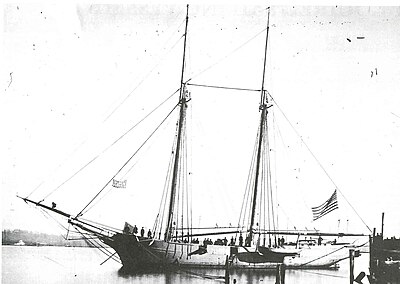
USS Varuna
 This is part of a series of posts on the capture of New Orleans. Seem them all here. 
The Union fleet finally made it past the fort with minimal damage, but the battle was not yet over. The Confederates had a small fleet of gunboats, and the small ironclad, the Manassas, which had sent the blockading squadron into flight in the battle of Head of Passes. She and the other Confederate vessels went out to take part in the fight. The Manassas turned on the Brooklyn.
The ram, the ram!" Craven called out, "... Put your helm to hard-a-starboard!" Then I saw the smokestacks of the Manassas and the flash from her gun, and the next moment I was nearly thrown on the deck by the concussion, caused by her striking us just amidships. I ran to the No. 10 port, the gun being in, and looked out, and saw her almost directly alongside. A man came out of her little hatch aft, ... and locked to see what damage the ram had done. I saw him turn, fall over, and tumble into the water ... I asked the quartermaster, who was leadsman in the chains, if he had seen him fall. "Why, yes, sir," said he, "I saw him fall overboard, - in fact, I helped him; for I hit him alongside of the head with my hand-lead." ... It was not until the coal in the starboard bunker had been used up and the side of the ship was uncovered that we realized what a blow she had received from the Manassas. On the outside the chain had been driven its depth into the planking, and on the inside, for a length of five feet or more, the planking was splintered and crushed in. The only thing that prevented the prow of the Manassas from sinking us was the fact that the bunker was full of coal.
After this unsuccessful attack the Manassas continued down stream, but the forts opened fire on her, mistaking her for a Union ship in the smoke. She eventually ran aground and the crew abandoned her, having failed to sink a single one of Farragut's ships. However, the other small Confederate steamers made attacks on the Federal fleet. The CSS Governor Moore, called a cotton clad as cotton was put on her decks for armor, encountered the USS Varuna ahead of the rest of the Federal fleet. Although much weaker, the Governor Moore boldly gave battle and rammed twice, taking many casualties. The Varuna, seriously damaged, sank near shore. This was the only large ship Farragut lost. Jubilant at his victory, the captain and most of the crew of the Governor Moore wanted to continue and take on the rest of the Federal fleet. However, the Lieutenant, would have none of it. It was wounded, as were most of the crew, and ignoring the captain's orders turned the ship towards shore. The Federal fleet opened on her, and she was abandoned.

Morning dawned on a victorious Federal fleet. Farragut had lost one large ship, the Varuna, and three smaller ones, and had lost 37 killed and 149 wounded. The Confederates had lost 12 killed and 40 wounded from the fort, along with the entire Confederate flotilla and most of the crew. But more importantly for both sides, the ships had run the fort. They were now in a position to easily capture the forts, and sail up river and subdue New Orleans.

Farragut's Fleet Runs the Forts

Mortar Boat
 This is part of a series of posts on the capture of New Orleans. Seem them all here. 

The Federals began their attack with a bombardment from Porter's mortar boats. They opened on April 18th and began firing steadily for the next few days. The mortars were a failure. Porter at thought the boats would complete their work in 48 hours, but in six they had not finished their work. The big shells at first scared the garrison, but they soon realized that although terrifying, the projectiles caused few casualties and little serious damage. The mortar crews themselves had even harder work, with the terrible concussion of firing the huge mortars every few minutes. The fire was finally stopped as the mortar crews were completely worn out, and it seemed useless to continue.
Mortar Boat

With the first part of the plan having failed, Farragut decided to try with his wooden ships. He had sent two of his ships forward, and they had been able to open a gap in the chain boom across the river. The ships would advance in two columns and when the forts opened fire, they would answer them, but their main focus would be to get past them as fast as possible. In preparing the ships chains were brought up to cover the critical parts, protecting them from Confederate shot, fire brigades were trained and the ships were covered with mud so that they could advance as far as possible without being seen. As was customary in sea battles, the decks were covered in sand so that the sailors would not slip in their comrade's blood.

The fleet set off at 2 am on April 24th, 150 years ago today. They were undetected until they reached the boom. At that moment the forts opened on the ships with tremendous noise, and the Federal ships soon replied. "Imagine all the earthquakes in the world, and all the thunder and lightnings together in a space of two miles, all going off at once." Farragut said the bombardment was "as if the artillery of heaven were playing upon earth." Farragut's ships were sucessfully making it through the gap in the chain, but they suffered under the fire from the forts. John Bartlet captain of the Brooklyn, wrote,
"As we came to the obstruction the water-battery on the Fort Jackson side opened a most destructive fire, and here the Brooklyn received her first shot. We gave the water-battery a broadside of grape. With our own smoke and the smoke from the vessels immediately ahead, it was impossible to direct the ship, so that we missed the opening between the hulks and brought up on the chain. We dropped back and tried again; this time the chain broke, but we swung alongside of one of the hulks, and the stream-anchor, hanging on the starboard quarter, caught, tore along the hulk, and then parted its lashings. The cable secured us just where the Confederates had the range of their guns, but somebody ran up with an axe and cut the hawser, and we began to steam up the river. ... There were many fire-rafts, and these and the flashing of the guns and bursting shells made it almost as light as day, but the smoke from the passing fleet was so thick that at times one could see nothing ten feet from the ship. While entangled with the rafts, the Brooklyn was hulled a number of times; one shot from Fort Jackson struck the rail just at the break of the poop and went nearly across, plowing out the deck in its course. Another struck Barney Sands, the signal quartermaster, and cut his body almost in two."
The Confederates were launching fire rafts, attempting to set the wooden vessels on fire. The flag ship ran aground, and a fire ship rammed into her. For a few minutes it appeared, that Farragut, the ship, and the entire crew would be engulfed in flames, but the crew was finally able to blow up the fire raft and get the ship afloat.

The Attack on New Orleans.

This is part of a series of posts on the capture of New Orleans. Seem them all here.

Soon after the North began the blockade of southern ports they began planning for an attack on New Orleans, the largest city in the south. One of their first goals of the war was to capture the Mississippi River, and s of course New Orleans, at the foot of the river, was a necessary part of that. The commander that was chosen to lead the fleet was David Farragut, an old sailor. His adopted brother, David Porter, was to lead a fleet of 20 new mortar boats with a thousand shells each to subdue the Confederate fortifications. Then Farragut would run past the forts with the rest of the fleet. 18,000 Northern troops were also brought along to aid in the siege. The government was not always confident in its choice of Farragut. Even his brother, David Porter, said,
"Men of his age in a seafaring life are not fit for important enterprises, they lack the vigor of youth. He talks very much at random at times and rather underrates the difficulties before him without fairly comprehending them I know what they are, and as he is impressible hope to make him appreciate them also. I have great hope in the mortars if all else fails.
The fleet arrived in position on April 16th.
Plan for Fort Jackson

The most important Confederate defenses of New Orleans were Forts Jackson and St. Philip, on opposite banks of the Mississippi river south of the city. They were positioned on a bend in the river, so that their 170 guns would have plenty of time to fire on slow moving ships. Chains were stretched across the river, giving the forts time to destroy the ships while attempts were made to cut them. Every moment was precious for the Confederate defenders, because two monster ironclads were being built in New Orleans. The Louisiana, 260 feet long with 16 cannon and the Mississippi 20 guns and 3 inch thick armor. The Louisiana was very close to completion. Her engines were installed, but the engineers could not get them to work. She was towed down to the forts to lend her firepower until her engines could be got working. The Mississippi was waiting on her machinery, which was being finished by the Tredgar ironworks. When they finally arrived, she would be the fasted ship in naval history. If these two ships could be let loose among Farragut's wooden navy, the fleet could put up little defense. The forts just had to hold out long enough for the ironclads to be completed.
Fort St. Philip

Thursday, April 12, 2012

The Great Locomotive Chase

The Raiders
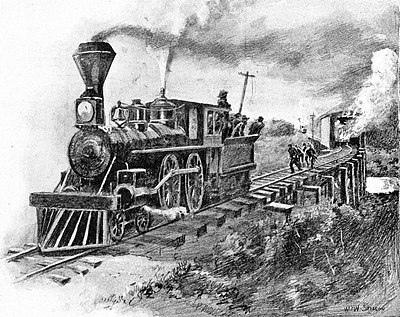
 150 years ago today occurred one of the most exciting and romantic events of the Civil War, the Great Locomotive Chase. Federal Major General Ormsby Mithcel was planning an attack on Chattanooga, on the Tennessee-Georgia line. However, an attack would be difficult as Chattanooga was protected by high mountains and the Tennessee River. James J. Andrews, a Northern civilian, developed a plan for a raid that would cut the important railroad connecting Chattanooga, Georgia, to Atlanta, Georgia. Mitchel could then more on Chattanooga without it being able to be reinforced by rail.

Andrews convinced 22 soldiers to volunteer for the mission, along with several civilians. They went behind the Confederate lines in civilian clothes, and all but two met at their rendezvous in Marietta, Georgia without behind detected. On the morning of April 12th, they hijacked the train the General in a small town with no telegraph, while the train was stopped for the pass angers to eat. Andrews set out, planning to destroy as much of the railroad as he could along the way. He was pursued by William Fuller, the conductor, along with several other men on a handcar. He stopped a train and was able to use it to chase Andrew's raiders. At Adairsville he encountered a break in the track made by the raiders, and so he ran on foot to the other side and commandeered the Texas coming south, and started her backwards towards the General. He was still not far behind the General, because the raiders had to keep to the train's schedule to avoid an accident with a southbound train. Along the way Andrews cut the telegraph wire to keep the Confederates from letting the stations and men up the line know of the captured train. As the raiders approached Chattanooga, they were unable to destroy the tunnels and bridges because the Texas was so close behind.

The General finally ran out of fuel near Ringgold, Georgia, just 18 miles from Chattanooga. Anderson and his men scattered, but they were not able to make their escape. Within two weeks all had been rounded up and put on trial as spies, since they were wearing civilian clothing. Eight of them were hung in the first weeks of June, and then the rest tried to make their escape to avoid a similar fate. Eight were successful in traveling the many miles back to the Union lines, and the rest were treated as prisoners of war and exchanged. These men were some of the first recipients of the Medal of Honor. All but two of the soldiers were awarded it, those two being somehow lost in the shuffle. The civilians who participated, including Andrews, did not receive it since as civilians they were ineligible.