The Confederate position at Island No. 10 was critical to their defense of the Mississippi River. The town of New Madrid was at an S curve in the river on the Kentucky, Tennessee border. Three forts at the town covered one bend, while Island No. 10 covered the other. P. G. T. Beauregard wrote, "The fall of Columbus and of Island No. 10, must
necessarily be followed immediately by the loss of the whole
Mississippi Valley to the mouth of the Mississippi River." After the capture of Forts Henry and Donelson the attention of the North turned to Island Number 10. An army under John Pope laid siege to New Madrid, and captured the place after one day of bombardment.
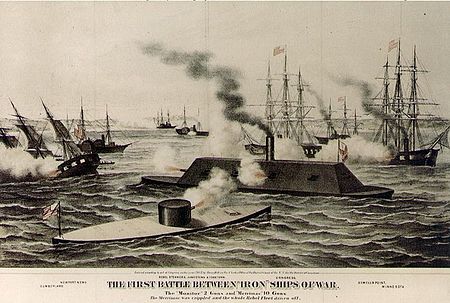
The naval flotilla under Foote attempted to reduce the batteries on Island Number 10 with a bombardment starting 150 years ago today, March 17th, 1862. He had seven gunboats and and 11 mortar boats, carrying one 13 inch mortar each. High hopes were placed in these boats, but they were failures. Their long range fire inflicted no casualties and caused no damage to the fort. Foote declared that he would not risk running the powerful batteries of the fort, as he was convinced they would blow his ships to shreds. Another way would have to be found to bypass Island Number 10.
Saturday, March 17, 2012
Bombardment of Island No. 10
Labels:
battle,
bombardment,
fort,
gunboat,
ironclad,
John Pope,
Kentucky,
Mississippi River,
Tennesse
Wednesday, March 14, 2012
Battle of New Bern
| Federal gunboats |
![]() |
| Battle Map |
Labels:
Ambrose Burnside,
battle,
North Carolina
Sunday, March 11, 2012
McClellan Removed as General in Cheif
| Lincoln left, McClellan right |
"The intelligence took me entirely by suprise, and the order proved to be one of the steps taken to tie my hands in order to secure the failure of the approaching campaign."11. McClellan's Own Story, p. 225
Labels:
Abraham Lincoln,
George McClellan
Friday, March 9, 2012
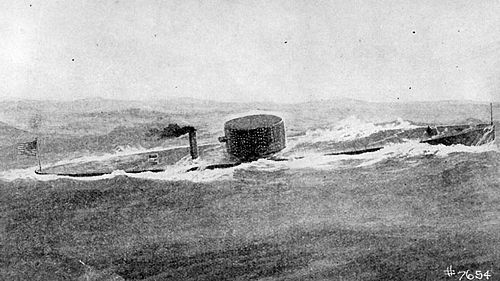
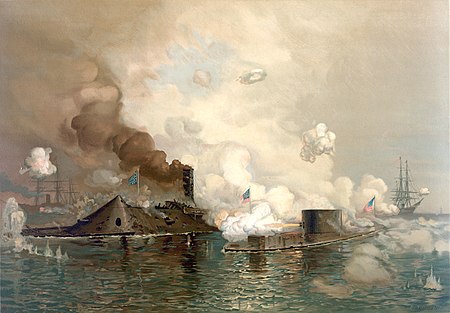
Monitor vs Virginia
| USS Monitor |
But both ships had their disadvantages. The Virginia had not brought solid shot, only exploding shells. While shells were good for wooden ships, they did not do much against the Monitor's iron sides. The Monitor's pilot house had been put in a bad position. The captain was severely wounded when a shell exploded outside the opening while he was looking out.
The battle continued for several hours, with no serious damage being done on either side. The Virginia's ram was broken, but they tried to get alongside to board, hoping their larger crew would carry the day, but the more maneuverable did not let the ships come together. At one point the Virginia ran aground, but they were able to get it afloat again. Although neither ship was being destroyed, it was a hard fight for the men inside their iron sides. The blood ran from their ears from the pounding of the shots on the side and the noise of their cannon firing, and inside the Monitor the boltheads were knocked loose and flew around inside.
At one point Lt. Jones of the Virginia came down to the guns and saw that they were not firing. "Why are not you firing, Mr. Eggleston?" he asked. The officer questioned replied, "Why, our powder is very precious, and after two hours' incessant firing I find I can do here about as much damage by snapping my thumb at here very two minutes and a half." A Federal officer wrote this:
"I triced up the port, ran out the gun, and taking deliberate aim, pulled the lockstring. The Merrimac was quick to reply, returning a rattling broadside (for she had ten guns to our two), and the battle fairly began. The turret and other parts of the ship were heavily struck, but the shots did not penetrate; the tower was intact, and it continued to revolve. A look of confidence passed over the men's faces, and we believed the Merrimac would not repeat the work she had accomplished the day before. The fight continued with the exchange of broadsides as fast as the guns could be served and at very short range, the distance between the vessels frequently being not more than a few yards. Worden skillfully man|uvred his quick-turning vessel, trying to find some vulnerable point in his adversary. Once he made a dash at her stern, hoping to disable her screw, which he thinks he missed by not more than two feet. Our shots ripped the iron of the Merrimac, while the reverberation of her shots against the tower caused anything but a pleasant sensation."Finally, after fighting for six hours, both ships realized that it was useless to continue. They both ended the drawn battle, and went back claiming victory. The Virginia hoped to get solid shot and try again the next day, but the expected rematch never occured. The Monitor never accepted a challenge of single-handed combat, and soon the superior resources of the North built more ironclads to contain the Virginia.
While the battle was a draw, it is clear who were the strategic winners. The Monitor had put a stop to the feared Virginia. No more did the North fear the Virginia sailing to Washington and pounding the government into submission. Never again would a Confederate ironclad have the same chance as the Virginia to completely change the course of the war. Although most of the Union navy was obsolete for naval combat, they could bring their superior resources to bear and build ironclads that could fight anything the South could hope to build.
Labels:
battle,
ironclad,
navy,
technology
Thursday, March 8, 2012
The Virginia Attacks the Northern Fleet
| CSS Virginia |
| Ramming the Cumberland |
The Union blockading squadron at Hampton Roads consisted of the Congress, Cumberland, St. Lawrence, Roanoke and Minnesota along with some smaller boats. Although they were all wooden, they were some of the most powerful ships the United States had. When the Union fleet saw the Virginia approaching with her sister ships, they went out to meet her. The St. Lawrence and Roanoke ran aground before reaching the Virginia. The Virginia picked out the Cumberland and charged in an effort to ram. The Cumberland opened fire on the Virginia, but the shots just bounced off the ironclad's armor. Getting in range, the Virginia sped up to ram the Cumberland. Ashton Ramsey, an officer on the Virginia, remembered the experience:
"There was an ominous pause, then a crash, shaking us all off our feet. The engines labored. The vessel was shaken in every fiber. Our bow was visibly depressed. We seemed to be bearing down with a weight on our prow. Thud, thud, thud, came the rain of shot on our shield from the double-decked battery of the Congress. There was a terrible crash in the fire-room. For a moment we thought one of the boilers had burst. No, it was the explosion of a shell in our stack. Was any one hit? No, thank God! The firemen had been warned to keep away from the up-take, so the fragments of shell fell harmlessly on the iron floor-plates. We had rushed on the doomed ship, relentless as fate, crashing through her barricade of heavy spars and torpedo fenders, striking her below her starboard fore-chains, and crushing far into her. For a moment the whole weight of her hung on our prow and threatened to carry us down with her, the return wave of the collision curling up into our bow port. The Cumberland began to sink slowly, bow first, but continued to fight desperately for the forty minutes that elapsed after her doom was sealed, while we were engaged with both the Cumberland and the Congress, being right between them. We had left our cast-iron beak in the side of the Cumberland. Like the wasp, we could sting but once, leaving it in the wound."With the Cumberland sinking from the Virginia attack, the Congress attacked next. Not being able to ram, the Virginia traded broadsides with her. The Congress's shots bounced harmlessly off the Virginia's iron sides. The shells from the Virginia, however, tore through the wooden sides of the Congress, inflicting many casualties. Finally she surrendered, knowing the fight was hopeless against the seemingly impregnable Virginia. The Congress was set on fire, and it burned through the night, finally exploding and sending flames high into the air. As it was late in the day, the Virginia retreated back up the river, ready to return the next day and finish off the rest of the Federal ships.
| USS Congress |
In this one day the Virginia changed naval history. Although it was known that ironclads were the future of warfare, an ironclad had never fought a wooden ship. The Virginia had shown what ironclads could two. The Virginia had sunk two of the best ships of the United States navy, inflicting 300 casualties, while she remained almost completely unharmed. There was nothing forseeable in the minds of the North prohibiting the Virginia from sailing to any Northern port and blasting it into submission. Stanton, Lincoln's secretary of war, said this:
"The Merrimac will change the whole character of the war; she will destroy, seriatim, every naval vessel; she will lay all the cities of the seaboard under contribution. I shall immediately recall Burnside; Port Royal must be abandoned.... I have no doubt that the monster is at this minute on her way to Washington, and not unlikely we shall have a shell or cannonball from one of her guns in the White House before we leave the room."
| CSS Virginia |
Labels:
battle,
ironclad,
navy,
technology
Battle of Elkhorn's Tavern - Day 2
During the night, Curtis, realizing he was being attacked by a full force in his rear, brought his entire army up to Van Dorn's front, and made sure his men had food and ammunition. Van Dorn's men remained disorganized. They had no food except what could be found on the bodies of the Northern dead, and the ammunition trains had been misplaced. When morning dawned on March 8th, Van Dorn did not take the initiative and attack. So Curtis assembled his artillery and opened a terrific bombardment on the Confederate forces with his 50 cannon. The noise was so loud it could be heard in towns 50 miles away. The Confederates hid in whatever shelter they could find to escape from the bursting shells, which killed or wounded many of their comrades. After inflicting two hours of this on Van Dorn's men, Curtis attacked. They advanced in a mile long line with flags flying, drums beating, and bugles sounding.
“That beautiful charge I shall never forget. With banners streaming, with drums beating, and our long line of blue coats advancing upon the double quick, with their deadly bayonets gleaming in the sunlight, and every man and officer yelling at the top of his lungs. The rebel yell was nowhere in comparison.”The disheartened Confederates could not stand up to this impressive attack. Van Dorn ordered a retreat at 11:00 am, and the Battle of Elkhorn Tavern, or Pea Ridge as it is also called, was over. Van Dorn's men retreated for a week, suffering terribly from lack of supplies. Curtis did not pursue. He had lost 200 killed and 1000 wounded. Van Dorn's complete casualties are not known, but they were probably significantly higher.
![]() |
| Elkhorn Tavern |
| Earl Van Dorn |
This battle was lost by the failure of Confederate leadership. Van Dorn was bold and successful in his movement into the Federal rear, but he and his staff horribly mangled logistics. No food or ammunition was provided for his army, greatly discouraging them. He split his army in face of the enemy, and when two commanders were killed, one half was rendered practically useless for the crucial day. Van Dorn moved too cautiously, and by the time he broke the Federals, there was no time to continue on and rout them from the rest of their positions.
Wednesday, March 7, 2012
Battle of Elkhorn Tavern
150 years ago today in Arkansas a 16,000 man Southern army under under General Earl Van Dorn attacked the flank of a 10,000 man Federal army under Samuel Curtis. Van Dorn's night march had placed them directly in the rear of the Northerners. Van Dorn decided to divide his army, sending McCulloch to attack by a different road. However, the Federals were not where he expected them to be. Curtis did not think Van Dorn would be rash enough to march into his rear, but he still sent one third of his army north to Elkhorn Tavern to protect his supply wagons from the Confederate column.
| McCulloch |
The other half of the Confederate army under Price and Van Dorn also encountered Federals before they reached the entrenchments. Van Dorn was surprised at this, and although he was usually very aggressive, this day he moved cautiously. He did not organize a general attack until one hour before dark. The Confederates became disorganized as they moved forward, and the Federal troops started out holding their own, but finally Van Dorn's greater numbers crushed the Northern line. The Confederates chased the Federals through the buildings around Elkhorn tavern, and formed a line on the high ground there. Van Dorn could not find McCulloch's division, which he should have met there. However, he decided to attempt to continue on the success he had gained in the fading light. But the Federal line had been reinforced, and their artillery tore huge holes in the 3,000 advancing men. They continued on until they were within 50 yards of the Federals, for at that moment the infantry opened fire. Unable to stand up to the artillery and infantry, the Confederates fled for the rear. Night had fallen, and the first day of the Battle of Elkhorn Tavern, or Pea Ridge, was over.